


Onlayn kitobni bepul oʻqing: ta muallif Practical Pointers for Patentees
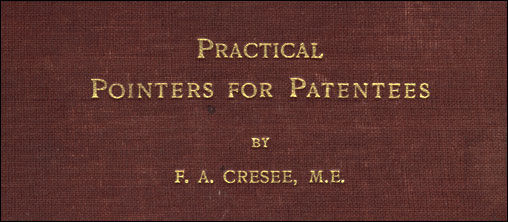
Project Gutenberg's Practical Pointers for Patentees, by Franklin Cresee
This eBook is for the use of anyone anywhere at no cost and with
almost no restrictions whatsoever. You may copy it, give it away or
re-use it under the terms of the Project Gutenberg License included
with this eBook or online at www.gutenberg.org
Title: Practical Pointers for Patentees
Author: Franklin Cresee
Release Date: September 20, 2007 [EBook #22683]
Language: English
*** START OF THIS PROJECT GUTENBERG EBOOK PRACTICAL POINTERS FOR PATENTEES ***
Produced by Joe Longo and the Online Distributed
Proofreading Team at http://www.pgdp.net

A GOOD PATENT, PROPERLY HANDLED,
IS A STEPPING STONE
TO SUCCESS AND FORTUNE.
PRACTICAL
POINTERS for PATENTEES
CONTAINING VALUABLE INFORMATION
AND ADVICE ON THE SALE
OF PATENTS
AN ELUCIDATION OF THE BEST METHODS
EMPLOYED BY THE MOST SUCCESSFUL
INVENTORS IN HANDLING THEIR INVENTIONS
By
F. A. CRESEE, M.E.
Revised and Corrected, with New Forms and Tables of Population
of the United States in Accordance with the 1910 Census

MUNN & CO., Inc.
Scientific American Office
361 Broadway
new york
1912
Copyright, 1901, by the
POTOMAC PUBLISHING COMPANY
Copyright, 1902, by
MUNN & COMPANY
Copyright, 1906, by
MUNN & COMPANY
Copyright, 1912, by
MUNN & CO., Inc.
New York
Macgowan & Slipper
30 Beekman Street
PREFACE
The original conception and working out of an invention is usually a labor of love on the part of the inventor: having perfected his invention in every detail, he finds able and skilled counsel waiting to prepare and prosecute his application for patent before the Patent Office Examiner. When the patent is allowed or issued, the patentee's real work begins—that of turning the patent into money. This is the business end of the inventor's work, which is generally to his interest financially to undertake himself, or to have under his immediate supervision.
The object of this little work, based upon the experience and observation of the author and other successful inventors, is to give the patentee such information and advice as will enable him to proceed more intelligently, on the most successful and economical basis, to realize from his invention.
The American Government issues annually over thirty-five thousand patents, a large number of which are offered for sale by their respective patentees, who in many cases have no definite lines to pursue in negotiating their patents; many realizing little or nothing from their inventions through careless or bad management, while others, through incompetency, drift into the hands of unscrupulous patent-selling agents only to be swindled.
The numerous inquiries from patentees seeking practical, reliable, and up-to-date information as to the best and most successful methods of realizing from the product of their ingenuity, has led the author, after due deliberation, to prepare and present this work to the American inventor, with a view of supplying a long-felt want, with the hope that it will save them many expensive experiments in handling their patents, and advance them on the road to success.
It has been the endeavor of the writer to cover briefly every subject that is usually encountered by patentees in disposing of their patents, not only in the matter of selling, but also in the equally important and perplexing questions of arriving at the value of patents, legal forms, statistics, etc., etc.
Realizing that the work may be deficient in many respects, the hope that it will prove instructive, and the belief that it contains many practical pointers for patentees is still entertained by
THE AUTHOR.
CONTENTS
CHAPTER I.DEMAND FOR INVENTIONS OF MERIT.
Monopoly in Patents—Industrial Progress Based upon the Patent System
9-12 CHAPTER II.INCOME FROM INVENTIONS.
Independence through Successful Invention—Unprofitable Patents—Money in Patents—Business Capacity of the Inventor—Inventions as a Poor Man's Opportunity to Advance
13-19 CHAPTER III.SECURING CAPITAL.
Danger in an Undivided Interest—A Better Plan—Form of Agreement—Perfecting Inventions—Exhibit of Inventions—To Avoid Being "Squeezed"—Value of Record of Invention—Newspaper Notoriety
20-29 CHAPTER IV.HOW TO ARRIVE AT THE VALUE OF A PATENT.
Pecuniary Value—Commercial Value—Basis for Estimation—General Rules for Valuation—How Rating for Royalty Is Figured—Stock in Stock Companies—Prices for Territorial Rights—Valuation Tables
30-40 CHAPTER V.HOW TO CONDUCT THE SALE OF PATENTS.
Patent-selling Agencies—The Best Selling Agent—In Case the Patentee Cannot Undertake the Selling—Methods of Selling Patents—About Advertising—How to Write an Advertisement—Correspondence as a Means of Bringing Patents before Interested Parties—How to Correspond with Manufacturers—Circulars—Illustrations—About Getting up Circulars—Copies of Patents, How to Secure—Uses of Printed Copies—First Impressions All—important—Value of Models—Working Drawings
41-54 CHAPTER VI.HOW TO CONDUCT THE SALE OF PATENTS.—
ContinuedValue of Personal Influence—Personal Solicitation Advisable—Selling Outright—Assigning an Undivided Interest—Dividing a Patent into Different Classes of Rights—Granting Licenses—Placing upon Royalty—Manufacturing and Forming Companies—To Organize Stock Companies—Trading as a Last Resort
55-72 CHAPTER VII.CANADIAN PATENTS.
About Canadian Patents—Selling Canadian Patents— Population of Canadian Cities
73-78 CHAPTER VIII.DECISIONS AND NOTES.
Assignments—Territorial Grants—Licenses—Patent Title—Rules of Practice—Assignments—Assignees— Grantees—Mortgages—Licensees—Must be Recorded— Conditional Assignments—State Laws on Selling Patents
79-91 CHAPTER IX.THE TRANSFER OF PATENT RIGHTS.
Assignee, Grantee, and Licensee Defined—The Language of Law—Assignment of Entire Interest in Letters Patent—Assignment of an Undivided Interest—Grant of a Territorial Interest—License; Shop Right—License; Non-exclusive, with Royalty—License; Exclusive, with Royalty
92-105 CHAPTER X.TABLES AND STATISTICS.
Map of the United States—Official Census of the United States by Counties for 1910—Population of Cities of the United States—Number, Acreage and Value of Farms, by States—Table of Occupations
106-141Index
142-146PRACTICAL
POINTERS for PATENTEES
CHAPTER I
DEMAND FOR INVENTIONS OF MERIT
That there is a demand for inventions of merit which can be readily disposed of at a reasonable profit to the inventor, there can be no doubt. There perhaps never was a time in the history of our country when the demand for meritorious inventions was so great as the present. The conveniences of mankind, in all his varied vocations and callings, require continual changes and improvements in the apparatuses and implements used in order to save time, labor, and expense, and to keep pace with the never-ceasing progress of civilization.
At no time in the past has there been so deep an interest manifested by the public generally in the inventions of our bright-minded men and women, and at no time has capital been more readily interested and ready to invest in any practical improvement which can offer a fair chance of monopoly under the patent laws.
Business men, capitalists, and manufacturers are ever on the alert for new and desirable inventions, which will supersede in utility those which are already on the market. By purchasing such inventions, they secure novelties which will not only enable them to avoid the keen competition and to a great extent monopolize the trade in their own respective lines of business, but also to make sales more easily, and thus make their business more profitable.
Monopoly in Patents.
Every well-informed person knows that a monopoly is the desideratum of business men. The monopoly or protection of an industry afforded by the patent laws is, perhaps, the one monopoly that directly benefits the world. Were it not for the protection and monopoly offered inventors by governments, for a certain number of years, to disclose their inventions, inventors would simply keep them secret, or if used at all, would do so only in such a manner as would prevent the world at large from learning of or utilizing them, thus debarring the public as a whole from their benefits. This monopoly in patents has had much to do with the material progress of the world during the century just ended.
Anyone having a monopoly of a good trade article is assured of a fortune. If capitalists and manufacturers can secure the control of any new invention of merit for their sole use and purposes, which can be manufactured and sold more cheaply than those now on the market, and which will perform its work in a quicker and better manner than the devices now in use, they will be only too willing to pay patentees handsomely for patents covering such inventions.
There are numerous staple articles of commerce whose manufacture is open to all, and which every mercantile house in the country is handling at a profit, notwithstanding the great number engaged in their manufacture and sale in every section of the country. Now, if there can be supplied some better or cheaper article in any line of industry, the firm or person who secures the monopoly of its manufacture and sale, simply controls the market, and human endurance and energy are the only limits to the degree of profits such a firm or person can secure from the manufacture and sale of such an article, if adequately protected by a valid patent.
Industrial Progress Based on the Patent System.
In an official report the Commissioner of Patents clearly sets forth that from six to seven eighths of the entire manufacturing capital of the United States is either directly or indirectly based upon patents. This vast amount of money, upward of six thousand millions of dollars, continually employing great armies of people, in industries based upon patents of every class, supplies the country with improved articles of every description. It has been well said that, "Patents and trade go hand in hand."
The largest and most opulent manufacturers in the country will be found to be the heaviest owners of patents, developers of inventions, and patrons of the Patent Office. While all inventions are not telegraphs, telephones, sewing-machines, or electric lights; nor can all business houses be Westinghouses, Hoes, McCormicks, Bells, or Edisons, yet all over this country, and others as well, there are springing up a great number of moderately large growing firms who, ever on the alert for success, devise or secure control of some valuable patent, by which they can successfully invade and control to a certain extent particular lines of industry.
Nearly every leading factory in the world owes its commencement and success to the prestige and protection afforded by the possession of a good and valid patent.
CHAPTER II
INCOME FROM INVENTIONS
It has been aptly said that the products of all the gold, silver, and diamond mines in the world would not equal in value the annual income of American inventors. It has been carefully estimated that there are at least fifty patents in the United States which yield over $1,000,000 annually, some 300 that yield over one-half million, from 500 to 800 which bring from $250,000 to $500,000, and between 15,000 and 20,000 that bring over $100,000 annuities. Besides these, there are thousands upon thousands of patents which yield yearly more profit to their fortunate possessors than could be accumulated in a lifetime by a wage-earner.
Independence through Successful Invention.
There are thousands of patents sold outright every year by the patentees of the United States for thousands of dollars; and, to the already long list of successful inventors, each year adds many more, who have become independent through the proper handling of the product of their ingenuity. Indeed there can hardly be conceived a quicker way for the average person to attain independence and wealth than by inventing something of real worth and merit that can be quickly turned into money. The inventive field is large, and each invention opens up a new field for improvements, and it is the "improver," without question, that reaps the greatest benefit from any invention. Owing to the ever forward progress of civilization, there is no limit to the possible improvements in the sciences, arts, and manufactures.
Unprofitable Patents.
It must, however, be borne in mind that all patents are not remunerative, neither are all gold mines productive of fortunes, and one may lose money in patents as well as in any other business. There are thousands of patents, many having merit no doubt, which have never been sufficiently brought before the public to test their merits, effect their sale, or manufacture; this in many instances is owing to incompetency, or bad management on the part of the patentee or his agents. There are thousands of other patents that do not prove remunerative because they do not supply a real want, while still others are such slight improvements upon existing inventions that they necessitate such narrow claims, which render the patent of little or no value. One has only to look over the weekly issue of patents to see many of the last class.
As before stated, while there are many thousands of patents that do not pay—and many no doubt cause their owners disaster, as is the case in any other business or investment; on the other hand, the far greater proportion of patents granted are productive of handsome profits, if properly managed.
Money in Patents.
That the majority of patents taken out prove lucrative is evident from the fact that upward of seventy thousand applications for patents and designs are filed each year in the United States Patent Office, and approximately eight hundred are granted and issued each week. Probably about one-fifth of these patentees obtain their patents with a definite view of manufacturing their inventions, and the remainder obtain theirs with a view of realizing from the sale of the rights to manufacture.
It may be said, as a general thing, there is more money in small inventions than in larger ones, from the fact that they can be easily manufactured anywhere with but little outlay of capital; they usually fill a general need, and the profit derived from their manufacture is large, besides the patent is more readily disposed of; while with larger inventions it requires more money and ability in handling the patent, and the invention must be unusually promising to justify the erection of a plant costing thousands of dollars for its manufacture. However, when large and complicated inventions do pay, they usually pay well.
Business Capacity of the Inventor.
It must be remembered that the actual cash value of a patent is not in the patent itself, but in the sale or use of the monopoly it affords, and the amount realized from any invention frequently depends upon the business capacity of the inventor or his agents. Owing to his business ability, one person may make a fortune out of an unpromising improvement, while another, through bad or careless management, will realize little or nothing from a brilliant invention.
Speaking along this line in an official report the chief examiner of the Patent Office says: "A patent, if it is worth anything, when properly managed, is worth and can easily be sold for from $1,000 to $50,000. These remarks only apply to patents of ordinary or minor value. They do not include such as the telegraph, the planing machine, and the rubber patents, which are worth millions each. A few cases of the first kind will better illustrate my meaning:
"A man obtained a patent for a slight improvement in straw cutters, took a model of his invention through the Western States, and after a tour of eight months returned with $40,000 in cash or its equivalent.
"Another inventor in about fifteen months made sales that brought him $60,000, his invention being a machine to thrash and clean grain. A third obtained a patent for a printing ink, and refused $50,000, and finally sold it for about $60,000.
"These are ordinary cases of minor inventions embracing no very considerable inventive powers and of which hundreds go out from the Patent Office every year. Experience shows that the most profitable patents are those which contain very little real invention, and are to a superficial observer of little value."
Under the writer's personal observation has come many instances where inventors have secured patents on improvements which to a casual observer would appear insignificant, yet through shrewd management they have been made to yield princely incomes. Among these one case worthy of note is that of a young man in Pennsylvania who secured a patent on a toy game which any person could have thought of, but few would have considered worth protecting by letters patent. He was offered $1,000 for the patent by one manufacturer at the outset which he refused, and afterward he placed it on royalty with quite a number of large manufacturers throughout the country. He receives but one cent on each one manufactured, yet his income averages over $12,000 a year. Another borrowed part of the money with which to obtain a patent on a railway tie plate, which was bought by a corporation for $25,000, after having manufactured it for two years on royalty. And many others, who have realized from one to five thousand dollars on such slight improvements on which few would have thought worth applying for a patent.
Patentees who would realize any considerable amount from their patents must not sit down and expect the other fellow to make money out of their inventions for them.
Inventions as a Poor Man's Opportunity to Advance.
Invention is sometimes called the "genius of the poor," and it is a singular fact that there are a greater number of inventions made by men and women of limited means than by those whose wealth, education, and other advantages would seem to have especially fitted them for success in a field dominated so completely by "brains." This may be explained in a measure by the fact that people of moderate means are brought into closer contact with the arts and manufactures, and are thus the first to discover and improve their defects.
A self-made millionaire, recently speaking to the writer about patents, said: "I know of no business or vocation requiring so small amount of capital, and yielding such immense profits as that of invention. Certainly no person of inventive genius can employ his time and ingenuity to better or more profitable advantage than to invent something that is really needed. Many poor men, through the art of invention, have risen from poverty to reputation, fame, and honor, and taken high places among noted men of all times.
Our moneyed kings may have enriched themselves by stock jobbing, but this precarious procedure requires large capital, and the few enormous fortunes accumulated are merely the monuments marking the graves of thousands of foolhardy unfortunates caught in the vortex of speculation."
CHAPTER III
SECURING CAPITAL
It is a curious but well demonstrated fact that people who have inventive genius often lack the means to carry out their ideas. An inventor who has ample means can secure his patent and proceed to turn it into money without the necessity of being compelled to solicit financial aid from anyone. This, unfortunately, is not generally the case with inventors; indeed, many are often barely able to stand the expense incident to taking out the patent. Patentees laboring under this disadvantage are frequently tempted to part with a small interest in their patents for the sake of securing sufficient funds to carry on the promotion of their inventions and sale of the patent; and in doing this the inexperienced patentee is apt to make the fatal mistake of assigning to another an undivided interest in his invention.
Danger in an Undivided Interest.
Such an assignment may appear well enough on the face of it, and many patentees have been misled, supposing that under the assignment the proceeds from the patent should be divided pro rata, according to the several interests. This, however, is not the case in such assignments, and joint-ownership of a patent, or interest therein, does not of itself, without an express agreement to that effect, make the parties partners. They are merely tenants in common, each having the right to separately make, use, or sell the invention so assigned without liability to account to their co-owners for any part of the profits derived from the invention through their own efforts.
In an assignment of an undivided interest, the assignee is afforded an opportunity of manufacturing, using, and selling to others to be used the article covered by the patent; also, to grant territorial grants, such rights being unlimited by the terms of the assignment, and it is actually of little consequence how small an interest is thus conveyed, the assignee can proceed with the patent in much the same way as if he were the sole owner; therefore, whenever it is intended that the relation of co-partnership shall exist between the patentee and the assignee of an undivided interest, and that the profits arising from the invention shall be equitable, for their joint benefit, there must be an express agreement between them to that effect, otherwise the assignee will have a decided advantage over the inventor, if he is inclined to be dishonorable, and there are numerous cases on record where patentees have virtually lost their patents by such assignments. Patentees should especially guard against strangers who offer to purchase an undivided interest in their patents.
A Better Plan.
A better procedure to secure means necessary for the development, introduction, and sale of an invention is to borrow the money from a friend contingent on the sale of the patent, sell a State or county right, or enter into a contract with a party willing to furnish the means for a certain proportion of the proceeds derived from the invention. Generally speaking, it will not be hard to find a party willing to advance sufficient means to promote an invention which is protected by a patent for a certain percentage of the net receipts arising from its manufacture, sale, or territorial grants, and the patentee will probably find a person among his own acquaintances who will not only be glad to furnish the means necessary, but also be of value to the patentee in realizing from his invention. In any case, whatever is agreed upon should be put in the form of a contract, or an agreement, couched in such terms as will leave no doubt as to the understanding between the parties. The following form secures both parties, and will be suggestive of others:
Form of Agreement.
Whereas I, Richard Doe, of Philadelphia, County of Philadelphia, and State of Pennsylvania, have invented certain new and useful improvements in Telegraph Keys, for which I have obtained Letters Patent of the United States, bearing date January 1, 1901, and number 000,000, and whereas John Roe, of Camden, County of Camden, and State of New Jersey, is desirous of obtaining an interest in the net profits arising from the sale or working of the said invention covered by the said Letters Patent.
Now, therefore, this indenture witnesseth, that for and in consideration of one dollar by each of the parties hereto paid to the other, the receipt of which is hereby acknowledged, it is stipulated and agreed as follows:
First, That the said John Roe shall pay all moneys necessary to the construction of a suitable model to represent the said invention; that he shall pay all necessary expense in advertising and bringing said invention before interested parties (and such other clauses as may be deemed necessary and agreed upon, such as the expense of constructing a working model, or carrying out a process, etc.); that he shall make diligent effort to promote the said invention, its manufacture, and sale.
Second, That the said Richard Doe, sole owner of said invention and Letters Patent, in consideration of the payment of the moneys above mentioned, agrees to pay the said John Roe twenty-five per cent. (or other amount agreed upon) of all the net receipts in any manner arising from the sale or working of the said Letters Patent, during the term for which said patent is granted.
Witness our hands and seals this tenth day of January, A.D. 1901.
Richard Doe,
John Roe.
In the presence of:
John Smith,
Thos. Jones.
Perfecting Inventions.
Should an inventor defer the filing of his application until his invention is fully developed as regards the detail construction and arrangement of the parts? The best opinion seems to be in favor of the prompt filing of the application. The final form of the details can best be determined by the manufacturer and expert machinists and designers, who appreciate the matter of economical manufacture, which is quite as essential as the efficiency of the device or machine. Clearly, therefore, the inventor cannot decide as to all the details; why then should he delay his application?
The safest course for an inventor is to file his application for a patent as soon as his invention is complete in its principal features, so as to conform to the requirement of the Patent Law that an invention be sufficiently complete to be theoretically operative. The mechanical details are rarely of great importance as far as the patentable features of the invention are concerned. Still, it is well to give the attorney full particulars of whatever details the inventor has in mind.
Exhibit of the Invention.
Under the security thus afforded for the main features involved in his idea, the inventor can proceed more deliberately in perfecting and improving his invention, and can then file an additional application if necessary, to secure special protection on particular improvements or the improved invention as a whole. The early filing of an application may turn out to be important in securing to the inventor his right of priority. When the inventor comes to exhibit his invention, with the idea of bringing it to the attention of the public in general, there is no question that he should then have his invention in the best form he can, and in as attractive shape as possible.
To Avoid being "Squeezed."
The patentee who proposes to realize from his invention should never let it be known that he is in want; of course, in some cases he cannot help himself, but he should endeavor to obtain the necessary assistance from his acquaintances, and under no circumstances let those with whom he is trying to deal get an insight into his financial condition, as capitalists and others will very often take the advantage of an inventor when known to be in straitened circumstances, and the patentee probably would not realize as much from his patent as he otherwise could. Therefore, it is advisable in all cases for the patentee to manifest no impatience, remain silent as to his financial condition, and strive to impress those with whom he is dealing that he is in no condition to be "squeezed."
Value of Record of Invention.
Inventors, while working on a complicated machine, should not overlook the value and importance of keeping a record of the progress of the development, illustrating it with sketches, signing and dating them with each new addition, and, when practical, having it witnessed by one or more persons. This plan is preferred by many inventors to filing a caveat. Such a record will be found very valuable in case of an infringement, as it enables the inventor to ascertain the various steps of his invention, and is a sort of evidence that cannot be impeached. Such a record of a complicated invention, when the inventor has put much time and study upon the subject in perfecting it, will also be found valuable in effecting sales, and in fixing the price of the patent.
Prejudice against Patents.
It cannot be denied that at the present time there seems to be in many sections of the country a strong prejudice against patents, which sometimes makes it difficult to get people sufficiently interested to take hold of any patent; especially is this true when the patentee endeavors to sell his patent piecemeal; that is, by county, township, shop, or farm rights. No matter how important or valuable the invention may be, there seems to be a disposition on the part of the public to look upon such rights as a fraud, and to be very cautious how they invest in them.
The public is not wholly to blame for this, as in recent years there has been a class of men who have canvassed the country with patent rights, not caring what representations they made so long as they were able to effect a sale; consequently, many people have been lured into purchasing patent rights for a small territory which in many instances were worthless or not as represented, causing them to be more or less skeptical of all patents, as well as to bring this manner of selling patents generally into ill repute. With manufacturers and capitalists, this prejudice does not exist to any great extent, as with them the patent rests solely upon its own merits.
Newspaper Notoriety.
Many inventors overlook the importance of interesting newspaper men in their inventions. This is a matter of great consequence to the inventor in exploiting his invention, and should be given some attention. Newspapers desire items of interest of every description, and readers are usually interested in brief accounts of any new invention possessing novelty or merit; so that when the inventor once gets his invention into the newspapers it is generally copied by other papers, with the result that the invention gets a large amount of free advertising and publicity. These items frequently attract the attention of capitalists, manufacturers, and others, and at once put the invention in a favorable position before the public as could be done possibly in no other way—certainly in no cheaper way.
Many of the trade journals and other periodicals are also open to receive technical descriptions of inventions of merit concerning industrial improvements. Such articles should be written in good form, containing not over five hundred or a thousand words, and if admitted to this class of publications will be of the utmost value and importance in creating favorable public opinion, and in advancing the inventor's interests.
With hardly an exception, if an invention strikes editors favorably and is adjudged to be of sufficient interest to form an article of news in newspapers, or of sufficient merit to warrant a description in the trade papers, it is pretty certain to prove a success and bring the inventor large returns.
If the invention is of such a character as to strike newspaper men unfavorably, the inventor can resort to the advertisement columns; using the large daily papers, or such publications which in some way relate to the industry to which the patent appertains, and such as have the largest circulation among the class of people it is desired to reach. See about advertising on page 46.
CHAPTER IV
HOW TO ARRIVE AT THE VALUE OF A PATENT
Most inventors are not concerned so much about the fame or honor their inventions will bring them, or how much their inventions will advance civilization, or build up a nation, or administer to the conveniences and pleasures of mankind generally, as they are about how much it will net them in dollars and cents; but the patentee should not lose sight of the fact that the profits are in the exact proportion to the actual usefulness of the invention, and its general adaptability. It is immaterial whether the inventor himself intends to deal with the public, or to deal with a man or set of men who are afterward to deal with the public, the conditions are the same, and the profits must ultimately come from the sale of the manufactured article.
Pecuniary Value.
It may seem superfluous to say that mere Letters Patent aside from an invention is of no value, though many inventors are under the erroneous impression that if an invention possesses patentability, it must also necessarily have pecuniary value. To be of any pecuniary value whatever, the invention must cover something for which there is a demand, or for which there can be a demand created, for it cannot be disputed, that if an invention will not bring in money by manufacturing it, it is, in a financial sense, worthless; and the patent thereon is therefore worth some seventy or eighty dollars less than nothing.
Commercial Value.
An invention, to have commercial value, as previously stated, must cover something for which there is a demand, or for which there can be a demand created. It may be an entirely new device, or it may be an improvement upon an existing invention, but in any event it must contain a certain degree of utility. In rare cases inventors are able to hit upon an invention in an entirely new field; for these a demand has to be created. For improvements, however, as a general thing, the demand already exists; then the important question arises in determining the commercial value of the patent. "Does the invention in question possess sufficient merit to successfully compete with existing devices of the same class?" In order to do this, it must be of a simpler or cheaper construction, so that it can be manufactured and put on the market at a lower figure; or, it must yield better results, work quicker and at less expense, or economize power, labor, or time. A patented improvement upon an article that can be sold more cheaply, or one which will yield better results than those now selling well on the market, has a decided commercial value and can easily be disposed of at a good price. If the inventor be fortunate enough to combine both of these features in his invention, the value is doubled and success certain.
Basis for Estimation.
Perhaps one of the hardest questions that confronts the patentee is how to arrive at a just valuation of his patent, and to know just exactly what he should receive for it. This is a very important question, and one which should be looked into before undertaking negotiations. Patentees should not, of course, undervalue their patents, or accept the first small offer made for fear of not receiving another; at the same time, they should not fall into the common error of asking a price that cannot be obtained, which too frequently precludes all chances of a sale. Many business men would rather lose the patent than waste their time constantly dickering about an unreasonable price.
Inventors should be reasonable in their demands, and consider that the purchaser must have a fair share of the profits. He cannot expect to realize all there is in the patent himself. Indeed, patentees usually find that men willing to establish a business on the basis of their untried patents will require the greater bulk of the profits to be derived from it.
General Rules for Valuation.
It is evident that only the most general rules for valuation can be given, as each invention must be studied and valued strictly upon its own merits. Undoubtedly, the best and most practical method of ascertaining the value of any invention which is susceptible of being manufactured on a small scale is to have a limited quantity of the articles manufactured—say five hundred or a thousand—and try the experiment of introducing them in a small territory; that is, in a certain county, city, or town, taking great precaution in selecting a person who is capable of carrying forward the business in a business-like manner. This method demonstrates conclusively whether or not the invention will meet with success, and with these figures at hand the patentee will be prepared to prove, to the satisfaction of interested parties, just what the patent is really worth.
This method of procedure not only enables the patentee to get a just valuation of his patent, but also puts it in a more favorable position to be sold; since the commercial value is known and established, it no longer remains an experiment. Interested parties can take their calculations from these figures, and the patentee can exact a price in proportion to the success of the trial experiment.
In order to thus demonstrate the value of a patent, the patentee must possess and advance the necessary means to carry it forward, though, if the experiment prove at all successful, the profits derived from the articles sold will in nearly all cases more than offset the expense incurred. This is a very popular course with inventors, especially in handling small inventions, known as novelty or specialty patents.
If the patentee have not the means to successfully demonstrate the value of his patent by actual trial, as above outlined, then the next best course would be to inquire among reliable manufacturers and ascertain the lowest price for which the invention can be manufactured in large quantities, and the highest price at which it will retail; and then, by carefully studying the market, the patentee should be able to estimate the amount of competition, cost of selling, probable number of sales, interest on the investment, etc., and on these figures base the price he should receive for the patent, being careful to allow the purchaser a liberally fair profit.
While there are at present about ninety-five million inhabitants in the United States, it is scarcely probable that any invention has yet or ever will be made that will reach half this number of people. With an article of the most general adaptability, including both sexes, the inventor can hardly hope to reach more than a fourth of the entire population, though, of course, the invention may be subject to regular consumption, so that the people reached would naturally purchase the article again a number of times during the course of a year.
The statistics in the last chapter are given with the view of assisting patentees in determining what proportion of the population will likely want their inventions, and to enable them to estimate prices. In estimating the price to ask for a patent, patentees should not conceive and hang their hopes upon fabulous prices and immediate wealth, which too often dooms ambitious inventors to bitter disappointment; they should rather endeavor to look at their inventions from the purchaser's stand-point, and try to see it in the light in which others view it. It may be well to remember that the million mark of patents issued in the United States, including re-issues and designs, was passed in 1911, and it is quite probable that any one inventor may not have the only good thing in the line of patents.
How Rating for Royalty Is Figured.
Many patents are more profitable by being placed upon royalty than by any other means, and quite often the patent can be placed this way when it is not possible to sell outright at a satisfactory price. In determining what royalty the patentee should receive, he should carefully estimate, in connection with the probable number of sales, what profit the manufacturer can probably make on each, or a number of the articles containing the patented improvements, and should require about twenty-five per cent. of the profits as royalty. Another method used by some inventors is to ascertain the price at which the article can be retailed, and figure the royalty at between one-twentieth and one-tenth of the retail price. Either of the above should give the approximate figure to ask for exclusive royalty contracts. For non-exclusive rights the patentee should ask about one-half of that for exclusive rights.
Stock in Stock Companies.
There is another class of patents that can be best realized from by organizing the proper kind of joint stock companies, and manufacturing the invention, the inventor taking a certain amount of the stock and assigning the patent to the company. The patentee should receive between one-fourth and one-half of the capital stock in consideration of his assigning his patent and rights to the company.
The inventor should see that a good portion of the stock is subscribed for and the amount actually paid into the treasury of the company before making the assignment. As a rule, inventors' stock is full paid and non-assessable.
Prices for Territorial Rights.
In calculating the prices for territorial rights, the application of the invention to that section must be taken into consideration, as well as the advancement in manufacturing, etc. If the invention belongs to that class of inventions which may be generally adapted in all States alike, such as domestic articles and articles of wearing apparel, then the population will form a very satisfactory basis for valuation.
There are other inventions, however, that apply almost wholly to a certain section of the country, while still others apply more to one section than to another; thus, for instance, mechanical contrivances of the higher order, such as writing machines, mathematical instruments, etc., the North and East are the most valuable; for mining and agricultural implements, etc., the West; while such as the cotton-gin, seeders, and presses apply almost wholly to the South. States and counties having large cities and large towns are also usually more valuable than other States and counties of same population.
Valuation Tables.
The following tables are given as a general estimate of the relative value of the different States and divisions in the majority of cases; however, these tables are only arbitrary at best, and cannot be applied to all classes of inventions satisfactorily, though they may serve to materially aid the patentee in determining what price to put upon each State in his own case. Having determined the value of the patent as a whole, the aggregate of the State prices should be about two-thirds more, as there are always some States that cannot be sold separately, while others may have to be sold at a discount.
TABLES FOR ESTIMATING PRICES OF STATE RIGHTS
States and Territories.
Price as a Whole.$1,000
$5,000
$10,000
$15,000
$20,000
Maine
35
175
350
500
700
New Hampshire
30
150
300
450
600
Vermont
30
150
300
450
600
Massachusetts
50
225
500
750
1,000
Rhode Island
20
100
200
300
400
Connecticut
35
175
350
500
700
New York
65
300
650
950
1,200
Pennsylvania
65
300
650
950
1,200
New Jersey
40
200
400
600
800
N. Atlantic Division.
$370
$1,775
$3,700
$5,450
$7,200
TABLES FOR ESTIMATING PRICES OF STATE RIGHTS—Continued
States and Territories.
Price as a Whole.$1,000
$5,000
$10,000
$15,000
$20,000
Delaware
20
100
200
300
400
Maryland
40
200
400
600
800
District of Columbia
15
75
150
200
300
Virginia
35
200
400
600
800
West Virginia
35
175
300
500
700
North Carolina
35
150
300
450
600
South Carolina
35
150
350
500
700
Georgia
40
200
400
600
800
Florida
15
75
150
200
300
S. Atlantic Division.
$270
$1,325
$2,700
$3,950
$5,400
Ohio
60
300
600
900
1,100
Indiana
55
275
550
800
1,000
Illinois
65
300
650
950
1,200
Michigan
45
200
350
600
800
Wisconsin
40
150
275
400
500
Minnesota
45
200
350
600
800
Iowa
40
175
350
500
700
Missouri
45
225
450
650
900
North Dakota
25
75
150
200
300
South Dakota
30
100
200
300
400
Nebraska
30
150
300
450
600
Kansas
40
175
300
500
700
N. Central Division.
$485
$2,325
$4,525
$6,850
$9,000
TABLES FOR ESTIMATING PRICES OF STATE RIGHTS—Continued
States and Territories.
Price as a Whole.$1,000
$5,000
$10,000
$15,000
$20,000
Kentucky
40
200
375
600
700
Tennessee
30
175
350
500
700
Alabama
30
150
300
450
600
Mississippi
30
150
300
450
600
Louisiana
35
175
300
500
700
Texas
35
175
300
500
700
Oklahoma
20
100
200
300
400
Arkansas
20
75
150
200
300
S. Central Division.
$230
$1,200
$2,275
$3,500
$4,700
Montana
15
100
175
250
300
Colorado
40
175
350
350
700
New Mexico
15
50
100
150
200
Arizona
15
50
100
150
200
Utah
15
50
100
150
200
Idaho
10
50
75
100
200
Washington
15
50
100
150
200
Oregon
20
75
125
200
300
California
50
250
450
700
900
Western Division.
$235
$975
$1,800
$2,750
$3,700
Grand Total.
$1,600
$7,600
$15,000
$22,500
$30,000
CHAPTER V
HOW TO CONDUCT THE SALE OF PATENTS
While the inventor may put much hard study upon his invention and make many costly experiments, this part of his work is usually a pleasure; and in securing the patent he invariably has able counsel in his attorney with no anxiety on his part; but with the commercial proceeding of selling his patent, which involves the greatest prudence and care in managing, it is different, and here is where the inventor's real work begins if he expects to reap the benefit of his invention.
Patent-selling Agencies.
For the benefit of unexperienced patentees it is deemed expedient to give a word of warning here regarding the host of so-called patent-selling agencies, which under various imposing titles, coupled with an apparently honest and straightforward method of business, tempt each patentee, upon the issue of his patent, to place the same in their hands and authorize them to negotiate the sale thereof. Their propositions are very attractive and temptingly prepared; their offers appear to be "gilt edge"; their circulars are high-sounding and rose-colored; their contracts are formal looking, and drawn up in an impressive way, highly advantageous to the patentee; but it will be noted in all cases that they will require the patentee to pay down a certain sum under some pretence,—such as to cover the cost of advertising the patent, to have circulars printed, to secure copies of the patent for distribution, to have a cut made illustrating the invention, or for membership fee, and so on, it matters not what, so long as it is an advance fee. Many will also agree to sell both the United States and Canadian patents, if the patentee will file the Canadian application through them; it is evident, however, that this is only a scheme to get the patentee to take out the Canadian patent through them—they having no facilities for disposing of either of the patents.
The writer is not prepared to say that there are no honestly conducted patent-selling agencies, but from long experience and observation, has never known where a patentee was ever materially benefited by placing his interests in the hands of these concerns, and has yet to learn of them ever making a sale solely through their own efforts. Very few of these concerns have any facilities whatever for selling patents; all of their time being taken up in mailing their weekly circulars to inventors immediately upon the publication of the Official Gazette, and working inventors up to the remitting point which usually ends the matter so far as they are concerned, unless they believe they can get another fee out of the patentee.
There may be exceptions, but patentees should fully satisfy themselves as to the integrity of these firms before placing business in their hands, as the Assistant Commissioner of Patents in his report in the Webberburn case, 81 O. G., 191 K, clearly pointed out that the methods of these concerns were such as to sell the patentees rather than their patents.
The Patentee the Best Selling Agent.
That the patentee himself is the best selling agent there can be no doubt, for he is familiar with the construction and operation of his invention in every detail, and knows its merits and superior points far better than anyone else, besides manufacturers and others wishing to purchase patents invariably desire to deal with the patentee himself. Business men, it may be said as a rule, do not think very much of an invention which the inventor has abandoned to others to negotiate, moreover the personal push of the inventor is, in nearly all cases, essential to the successful termination of a sale.
Subtract the personal energy and presence of the inventor from the successful inventions of the past and of to-day, and the chances are that they would not have succeeded as they did. It is not only a question of material interest, but also of enthusiasm and confidence, and each patentee, having but one patent or a set of patents to push, can lend thereto that individual attention which insures good work and success.
In Case the Patentee Cannot Undertake the Selling.
However, if from any reason the patentee is unable to handle his own invention and must engage the services of an agent or salesman, he should select one from among his own acquaintances, in whom he has confidence. He should if possible get a person who has had experience in the line of the invention, as such a person would likely understand it and the trade better than others. It is not really necessary that he should have had experience in selling patents; if he is a good talker, knows how to approach business men, and thoroughly understands the invention, he will probably make money for the inventor and himself. The patentee should have him submit all offers of value for his consideration, and should not give the agent power to sign or collect. The patentee should name a reasonable price for the patent, allowing the agent a liberal commission upon the price, and encouraging the agent by allowing him a certain percentage of all he may be able to get over and above the price named. This will encourage the agent to work for the highest price obtainable. The inventor should make every effort to be able to personally attend to the details of selling, and keep the business under his personal supervision.
Methods of Selling Patents.
There are a number of plausible methods to which the patentee may resort in disposing of his patent without the aid of questionable selling agents, and it is the purpose of the following pages and succeeding chapter to set forth such methods as have in the past proved beneficial to patentees; those along which success have been achieved, and such as are employed by the most successful inventors of the present time in handling their patents.
It is true that no definite method or system can be given that will apply to all patents alike, as the method in each case will depend more or less upon the character of the invention, and to the particular art to which it belongs; however, from the following pages the patentee should be able to judge what particular methods will best apply to his individual case, and proceed along these lines.
There are many patents issued which the patentees thereof can as successfully dispose of from the smallest hamlet in the United States as from New York, Chicago, or any of our larger cities, while, of course, there are others which only those directly connected with the largest and wealthiest corporations can hope to dispose of successfully. The main thing is not to become discouraged or give up until one succeeds in making a sale.
About Advertising.
To make the merits and importance of an invention publicly known is, in many cases, one of the best ways of bringing about the introduction and sale of a patent. If the inventor has a patent on an invention that manufacturers or others want, and can make its merits and superior qualities known to them, negotiations will soon follow. There is no way for patentees to place themselves in communication with prospective investors quite equal to an advertisement in the proper medium. Here it may be well to state that patentees who decide to advertise their patents for sale or otherwise should place their advertisements in publications of known standing, such as the leading daily newspapers. A brief, well-worded advertisement in the "Business Opportunities" column of these papers bring quick and good results, though, perhaps a better class of inquiries may be obtained by advertising in the trade journals of the class to which the invention relates, and while the trade journals may not bring about as many inquiries as the dailies, those that answer will be more apt to be interested and talk business. Either of the above are good mediums, but in advertising patents for sale patentees should carefully avoid those publications that are published at uncertain intervals, and usually for the express purpose of circulating among inventors for various purposes. They do not reach the class of people that invest in patents. Inventors should know the class of people that would be likely to become interested in their inventions, and advertise in such mediums as have the largest circulation among that class.
How to Write an Advertisement.
In the construction of an advertisement there is often too much waste by using too much verbiage, too many unnecessary words or sentences, sometimes too much display. Prudence in the arrangement, and care in editing an advertisement, will save much expense. The size of an advertisement of this class has really little to do with its pulling qualities.
The statements should be assuming, and at the same time truthful, as any deception in an advertisement is sure to work an injury. There should not be more claimed in the advertisement than sounds reasonable, even though it be stating facts; if an advertisement sounds unreasonable it will not have the desired result. Inventors sometimes become so enthusiastic over their inventions that they exaggerate unintentionally. A good rule is for the inventor to read over the advertisement, and ask himself, "If this statement was read by me, would I believe it; would it convince me?" etc.
Putting one's self in the purchaser's place is always one of the best factors in writing good advertisements. The inventor should put himself in the place of the purchaser of the patent, and reason what would induce him to investigate its merits; what would likely cause him to take it up, and so on; he should think and write fully along these general lines, incorporate these reasons into an advertisement; then boil it down by cutting out the unnecessary words and sentences; prune, remodel, and rewrite until he has a brief advertisement, clear, concise, and to the point.
Correspondence as a Means of Bringing Patents before Interested Parties.
While to advertise, as suggested in the foregoing pages, would require a very moderate outlay, and be, perhaps, the better course to pursue: however, in connection with it, or if the patentee does not feel that he can afford the expense of advertising, a very good plan is for him to secure copies of a number of the trade journals of the class to which his invention relates, and carefully look over the advertisements therein, and select a list of such manufacturers as would seem likely to be induced to purchase the patent in question, or manufacture the article on royalty. In this manner the patentee will probably get the best up-to-date list obtainable, and it may be set down as a fact, with very few exceptions, that if manufacturers and dealers who make and handle just such articles as the patent calls for cannot be interested, it is very hard to interest others not engaged in such line, except when the invention is large, and requires a great deal of capital to work the same.
How to Correspond with Manufacturers.
To each of the parties of the list thus selected, or to a number of them, the inventor should write a well-composed and convincing letter setting forth the invention in its best light, and stating just why it would be to the interest of the parties solicited to investigate the same. Some time should be spent on this letter before attempting to write it, and the writer should weigh well in his own mind what would be best to say, and the proper way of expressing it. He should be as brief as possible, consistent with legibility. The statements should be assuming, yet in every respect true. He should state in brief terms just what the invention is, what it will do, the points and advantages it has, and at the same time endeavoring to get the parties interested so that they will inquire into the invention, rather than attempt to come to terms in the first letter.
The letter should be brief and pointed, and plainly written upon business-size paper; and if the inventor has a typewriter, or access to one, he should use it. If he has printed circulars he should send one with his first letter, which will enable him to make the letter briefer and more business-like.
In correspondence it is well not to name a price until the parties are interested, and first endeavor to get them to make an offer. The patentee should be patient and should not expect to jump right into a bargain at once. If the invention is a meritorious one there will be more than one of the manufacturers to whom the patentee may write, who will become interested, and when such a state exists, the patentee can begin to be more exacting as to his demands since competition has been created between the manufacturers.
Circulars.
A few dollars invested in circulars will frequently be found of great value to the patentee if he intends to negotiate the sale of his patent mainly by advertising and correspondence, as they will save a great deal of writing and explaining as well as appear more business-like and attractive, and may be the means of more readily effecting a sale.
Illustrations.
If the patentee can afford the additional expense of an illustration, it will greatly increase the appearance of the circular, and make it more readily understood and interesting. The cut should be neat and set forth the invention in its best light. It would be better to entrust the procuring of the cut to the printer, for he will know just what is wanted and can secure the same at a better price. A sufficient number of well printed circulars, with illustration, can be obtained of any printer for a few dollars.
About Getting up Circulars.
The circulars should be attractive, convincing, and logical; nicely arranged, and neatly printed upon good paper. A mistake is often made in sending out trashy-looking circulars, poorly printed upon cheap paper; they repel rather than attract, and do not have the desired effect.
The circular should have good head-lines so as to attract the attention of its recipient at a glance, and his interest should be held by having the uses and advantages of the invention well written.
Many of the pointers suggested in advertising and letter-writing will equally apply to the writing and getting up of the circulars, and need not be treated further here, except that the patentee should dwell especially upon the merits of the invention, its uses, and advantages over like articles. This should be done in the most interesting manner possible, describing it so that its value will be fully understood.
Uses of Printed Copies.
It will be well for the patentee to order some printed copies of his patent, as manufacturers and others usually ask for them if interested, in order that they may examine the patent, or have an expert to examine it, to ascertain its validity, novelty, and what protection is really afforded by the patent. It cannot be denied that in either case the invention will suffer a cold-blooded rigid examination, and must stand or fall solely upon its merits. If, however, the invention is adjudged to have real merit and properly protected by the Letters Patent, business negotiations will likely begin, and the patentee will perhaps speedily make a satisfactory deal.
First Impressions All-Important.
Some inventors use printed copies of their patents instead of circulars, but, while they fully set forth the invention in a technical way, it cannot be said that in all cases it is advisable to send copies of the patent until called for. Many parties who become interested in patents are not familiar with mechanical drawings and technical specifications, and very often do not get a very favorable impression from a copy of the patent; and it is very important that the first impressions should be favorably created, for upon this much will depend. If parties become sufficiently interested to fully investigate an invention, they are very apt to form a favorable opinion of it.
Value of Models.
There is no way of so easily creating a favorable impression and gaining the interest in an invention as by a neat and perfect working model of the invention. Man never loses the child-love for toys, and a perfect miniature machine of any description will attract more attention than one of full size. With a model the inventor has the full and immediate attention of his prospective purchasers at once. If the patentee, or his agent, intends visiting manufacturers, or to sell the patent by territorial rights, he will find a model of his invention almost indispensable.
Inventors should be very careful about sending models to unknown parties, and should mark the number of the patent and their name and address upon the model. It should invariably be understood in advance who is to pay the transportation charges, before sending a model with any charges to collect.
While models are very helpful in setting forth an invention and making sales, high prices exclude many inventors from their use. Model-makers usually charge fifty cents per hour for each man working upon the model, and market price for the material used; from these figures the inventor may make a rough estimate of what a model of his invention will cost.
Working Drawings.
Working drawings are different from those forming a part of the patent in that they are more detailed, giving the size of each piece and the material of which it is constructed. While working drawings are not quite as expensive as models, they do not show the invention to the advantage that models do, and are of little value to those who do not understand them. On the other hand, working drawings have the advantage of being easily sent through the mails, and can be duplicated at small cost. Manufacturers prefer working drawings to models in quoting prices on manufacturing the invention in quantities.
CHAPTER VI
HOW TO CONDUCT THE SALE OF PATENTS—Continued
In conducting the sale of patents, the greatest difficulty is most frequently experienced in getting manufacturers or others sufficiently interested to look into the merits and possibilities of the invention. If the inventor can get the parties to actually consent in their own minds to the proposition of taking up the invention, the question of terms and conditions can soon be arranged. Until the parties solicited can see beyond a doubt that there is large profits in it for them, the price of the patent is out of the question; therefore, the first step is to demonstrate its merits and commercial value, and get the parties thoroughly interested.
Patentees should not labor under the impression that because a patent is offered at a very low price that it will be quickly snapped up as a bargain; as before stated, if a patent will not bring in money by manufacturing and selling the article, it is worthless; and its real value is in exact proportion to the amount of profits that can be made from its manufacture.
Should the patentee find that his patent has no commercial value, it is almost useless to spend more time and money in trying to realize anything from it; he had better start again, and endeavor to invent something that has value and can be sold.
Value of Personal Influence.
Inventors should use the full extent of their personal influence to spread particulars of their inventions as far as possible, for this indirect work is often a leading factor in creating a favorable impression that frequently results in the adaption of an invention.
However unacquainted he may be in a business way, every patentee can, more or less, in his immediate neighborhood, consult with merchants, friends, and others in the line of his invention, who can post him upon the right parties to submit the patent to, and the best way to see them about it, and perhaps go with him to visit such as might be interested in the invention.
Personal Solicitation Advisable.
In nearly every case it is more satisfactory for the patentee to call on the manufacturers or interested parties personally whenever it is possible for him to do so. This brings about a more satisfactory understanding between them. Many inventors, however, prefer opening up communication by correspondence, and after the parties manifest a willingness or desire to look into the invention more closely, then arrange to visit them personally.
Having determined upon a visit, the patentee should endeavor to get a friend known by the parties to go with him to make their acquaintance. If the friend cannot go with the patentee, he will probably give him a note of introduction. It may happen that his friend does not know the parties whom the patentee wishes to see, in that event he may know of someone who does, to whom he can introduce the patentee and who in turn may either go with him or arrange to make him known to the parties solicited. An introduction, of course, is not absolutely necessary, but it invariably has a good effect and is generally worth the effort.
The patentee should be prepared to make a straightforward, business-like presentation of his invention by means of a suitable model or drawings; carefully explaining its merits and advantages, showing as clearly as possible just what the value of the invention is and what can be made out of it, and giving tangible reasons why it would be to the interest of the parties solicited to invest in the patent. If the patentee is dealing with a manufacturer it is well to point out not only the possible advantage he may have by securing the control of the patent, but also the possible loss that his business may suffer by allowing one of his competitors to obtain its control. Many businesses have been hopelessly crippled by an enterprising firm securing control of a good patent and introducing a like article that can be sold cheaper, or one that will do its work in a better and more satisfactory manner.
Selling Outright.
Many inventors prefer to sell their patents outright; that is, in consideration of a specified sum of money the patentee assigns his entire interest in the patent, in the same manner that a person would sell a piece of real estate. This is a very good method and one of the quickest ways for the patentee to turn his invention into money, though it must be remembered that to sell a patent outright is usually for a very much smaller sum than could be realized if handled by other methods.
The day for obtaining enormous sums or fortunes from the sale of a patent outright is past; at present to realize any considerable amount, the patentee generally has to share in the risks as well as the profits, unless the invention is very highly developed, and even then he cannot expect to get as much out of an outright assignment as he could by sharing in the success of the invention commercially. If, however, the patentee is content to take the utmost cash his patent will bring him outright, he is assured of a principal or lump sum, free from any chances of the article not selling well when placed upon the market.
Before signing and delivering the assignment, the patentee will, of course, see that he has the consideration, or its equivalent, for which the assignment is made. If the transaction is made through correspondence he should send the assignment duly executed to the purchaser through the bank or express C. O. D. for the amount.
Assigning an Undivided Interest.
In a preceding chapter, the dangers and disadvantages of an undivided interest are set forth, and it cannot be considered a wise course under any consideration to part with any undivided interest in the proprietorship of the patent, unless unusually well paid, or there exists an agreement of copartnership between the patentee and the assignee. By such an assignment, no matter how small, the patentee loses control of his patent.
Dividing a Patent into Different Classes of Rights.
Many patents, from the nature of the invention, can be subdivided into different classes of rights, and each class sold or granted separately as the patentee may choose. Thus, the patentee of a tire, or other appliances for a bicycle, could license one party to make the same for bicycles and another for automobiles. In like manner a car-coupler could be divided between those who build railway equipments and those who build street-cars, and so on.
Goodyear, the inventor of the process of vulcanizing rubber, divided his patent up into many different rights, licensing one company for manufacturing rubber combs, licensing another for hose pipes, another for shoes, another for clothing, and a number of other different rights, for which each company or partner paid a tariff. Lyall, inventor of the continuous loom, also divided his patent into many different rights; one company weaving carpets, another corsets, another bags, another sheeting, etc.
In every case where the invention covers articles not in the same line of manufacture, the patentee should not fail to divide the rights into different classes, granting each party only such rights as they may be interested in. In this way the patentee can quite often double or treble the receipts from his invention.
The patentee may, if he desires, have his machines built and require the purchasers to pay him a regular annual rental on each machine, or a tariff upon the goods produced, in addition to the price of the machine. Companies are sometimes organized to manufacture an invention, and employ travelling men to place the article on annual rental instead of selling.
Selling by Territorial Rights.
Another method is to sell State and county rights. This consists of a license whereby the patentee, in consideration of a certain sum of money paid him, grants unto another person or persons the exclusive right to make and sell the invention, and to authorize others to make and sell the same, within a specified territory, during the life of the patent. This plan of disposing of a patent has often been highly profitable, but it must be said that these territorial sales have been conducted in such a manner in the past, as to bring the whole system of selling patent rights into disrepute, and in recent years patentees have found some difficulty in making sales in this way, unless the device is of unusual great novelty and attraction to householders or the general public.
Occasionally, however, there are patents issued for meritorious inventions that are susceptible of this mode of procedure, and which can be disposed of to the greatest advantage by territorial grants. Such inventions as household novelties possessing great merit and utility have been most successfully placed upon this plan, but it must be remembered that the value of the system rests upon its capabilities of effecting sales of the manufactured article to a vast proportion of the people.
In selling territorial rights it is a mistake to begin with the small places with the idea of working the business up and effecting larger sales on the basis of the smaller ones; it is better to shove the sales, as much as possible in the start, and after the more valuable portion of the territory is disposed of, proceed with the balance until it ceases to be profitable.
Experience teaches that it is usually advisable to accept any reasonable offer made for a small right, even if it does not come up to the patentee's estimate of its value, as he has plenty of other territory left, and may lose much time and money in finding another in the same territory willing to pay more; besides, the purchaser of such a right may, by his energy and good judgment, advertise the invention in such a way as to greatly benefit the patentee in making further sales.
Some patentees employ good and reliable special agents to travel and dispose of the patent rights; others advertise for and appoint State agents to sell their respective county rights. In either case these agents expect to make money by the operation, and require a liberal proportion of the proceeds for their remuneration; generally speaking, they will require about one-third the selling price, unless the patentee can show that the rights will sell readily, in which case the rating can be made lower.
Granting Licenses.
The patentee may also sell licenses under his patent; that is, in consideration of a certain sum, the patentee licenses a manufacturer to make the invention at his own place of business; it being a personal privilege and is not transferable unless its terms so state.
Unless there are a great many manufacturers in the line of industry to which the patent relates, and unless the invention has real merit so that it will be readily adapted by the manufacturers, the patentee cannot hope to realize any considerable amount from selling shop-rights alone. As a general thing, patents for mechanical inventions can be disposed of to better advantage by other means, or by selling shop-rights in connection with other methods; for example, if the patentee was selling his patent by territorial grants, he might grant shop-rights in such territory as he has not sold; or if he is placing the patent upon non-exclusive royalty contracts, he could grant shop-rights in such portions of the territory as he does not contemplate using otherwise.
Some inventions, such as methods or processes, as a general rule, have to ultimately be sold by licenses. Such patents can be employed most profitably by selling licenses, county and State rights; thus, in the case of a method of constructing fences, the patentee could sell State and county rights to parties, who in turn could grant farm rights, etc.
Placing upon Royalty.
The license and royalty plan is perhaps the best and most popular method with inventors for realizing from their inventions. This, in effect, involves a contract between the patentee and the manufacturer, by which the latter in consideration of a license to manufacture the article covered by the patent, agrees to pay the patentee a certain specified sum as royalty for each article manufactured or sold bearing the patented improvement.
Placing a patent on royalty is ordinarily taking chances, but if the patentee has full confidence in his article selling well, he should by all means take royalty in preference to selling the patent in its entirety. Many valuable patents are sold by their owners for from $1,000 to $10,000, which yield the purchasers, when the article is on the market and selling well, as much as $25,000 annually in profits. This calls to the author's mind a patent for which at the outset was doubtfully offered $3,000, but before the negotiations terminated, the patentee succeeded in placing it upon an exclusive royalty basis. The royalties paid to the patentee during the first four years amounted to over $50,000, and the manufacturers subsequently made an offer of $100,000, for the patent.
In making royalty contracts with parties, the patentee should investigate the standing, rating, and capabilities of the manufacturer, and, above all, should be certain that the parties have the right motive in view, and that the contract is so drawn that it will fully protect his own interests. Many patentees have been caught by manufacturers offering large royalties for the sole purpose of gaining possession of the patent, that they might pigeon-hole it, in order to keep the article out of the market, so that the sale of some similar article in which they are interested would not be interfered with by the introduction of a similar or better article, such as the patent anticipates.
There are others who propose and make royalty contracts with patentees with no other object than that of making the special tools, patterns, dies, etc., for which they charge the patentee an extortionate price.
The best and safest way for the patentee to guard against having his patent tied up is to bind the parties to do certain things in the way of pushing the sales, making the necessary tools at their own expense, and commencing its manufacture within a reasonable time, paying an advance royalty, or annexing some such condition to the agreement by which they will be the loser should they fail to push the inventor's interests.
Unless it cannot be otherwise arranged, the patentee should not transfer his rights merely in consideration of receiving a certain sum on each article sold, as however sterling the character of the manufacturer, there would be no certainty of the sales being pushed. The patentee should endeavor to get the manufacturer to guarantee that the royalties shall amount to at least a certain pre-stipulated sum each year, or within a period of time, and that such sum shall absolutely be paid to him by the manufacturer, irrespective of sales. This insures that the manufacturer will be obliged to push the sales of the article, and do it justice, since if he neglects his duty purposely, or from lack of energy, he is out of pocket, and the patentee is sure of a certain income, with the addition of a possible fortune that unprecedented sales may yield him. However, manufacturers are not always willing to agree to this condition, unless the guaranteed amount is exceedingly reasonable; they will usually simply agree to do their best, and if the sales do not reach a certain figure each year, the patentee shall have the option of cancelling the agreement, and receiving back the patent free and clear.
Royalty licenses can either be exclusive or non-exclusive; that is, with an exclusive contract the manufacturer has the exclusive right to manufacture the article, excluding all others; non-exclusive is simply a shop-right, in consideration of which the manufacturer agrees to pay the patentee or owner of the patent a stipulated price or percentage upon each article made or sold. The license can also be exclusive in a certain section, county, State, or a number of States, as may be agreed upon.
Any number of conditions that may be agreed upon may be annexed to and form a part of the contract, and such an agreement should be drawn up in compliance with the terms and conditions agreed upon by a competent attorney, or one skilled in matters of this kind.
Manufacturing and Forming Companies.
If the patentee has a really good invention, often he cannot do better than to retain the patent and work it himself, in case he has the ability to do so. If he cannot conduct the manufacturing alone, he may be able to secure a partner with just sufficient funds, and equal common sense and business acumen, to add the necessary elements to the firm to achieve success.
In some cases, if the patentee does not wish to retain the whole patent for his own use, an excellent plan is to commence the manufacture of the invention in a suitable locality, and after the business is so far under way as to show progress and profit, then sell out the business with license under the patent. To illustrate: a gentleman in Illinois, having obtained a patent on a farming implement, succeeded in interesting a party in his own neighborhood to join with him in its manufacture, which soon proved successful and remunerative, and in a short time he was able to sell out his interest in the business to his partner, with license under the patent, after which the patentee started its manufacture in a number of places elsewhere, and, at the same time, granting licenses and selling territory in still other sections, where he was unable to work the invention. In this way he made a fair fortune from his invention, realizing about as much from each business established as he could have probably obtained for the entire patent if sold outright at first.
In this manner the patentee, with a valuable patent on an article of general usefulness, could go on and establish its manufacture in any number of places, and sell out with license under the patent. If the first experiment is successful, it is an easy matter to carry the method out in other places, and the business can be readily disposed of anywhere, if it can be shown to be on a paying basis.
To Organize Stock Companies
In recent years many inventors have been quite successful in organizing stock companies on the basis of their patents. This is considered one of the best ways for handling patents for large and promising inventions, and it is a method that any patentee, with ordinary business ability, should be able to carry out successfully, providing his invention is of sufficient merit and importance to form a suitable basis for a successful stock company.
Many stock companies are incorporated under the laws of New Jersey, but it is believed the State of West Virginia is also very favorable to corporations. The entire expense for incorporating a company under the laws of the latter State should not exceed $150. The company can be incorporated for any amount; large or small, one hundred dollars or five millions, cost and fees being the same. The incorporators need not be residents of the State. No annual statements required. The meetings of the directors can be held at any place, and need not be held in the State where the charter is granted.
Before applying for a charter for a corporation or stock company, the patentee should mention his plan to some of his friends and get five persons who will promise to subscribe for one or more shares of the stock and act as incorporators of the company.
Next he should secure the services of a reliable attorney, familiar with corporation laws, to prepare the necessary articles of incorporation and legal papers. The attorney will advise the patentee how to proceed properly in organizing his company, and as to the securing of the stock certificates, subscription blanks, seal, etc. These, including the attorney's fee, should not cost the patentee more than $50.
It is well to have some stationery printed with the proposed name of the company and business displayed thereon; and also a prospectus published, setting forth the invention and the plans of the company for introducing it, etc.
Quite often the patentee can find enough idle capital in his immediate neighborhood to float a good portion of the stock. Capital is more easily secured by the formation of a stock company than by any other means, as people can subscribe for small or large amounts, and they often prove good investments.
In soliciting subscriptions for stock, it is desirable to get as many prominent and influential men to buy one or more shares at first to head the list—their names will be a great aid in making further sales. Ordinarily the promoter only collects ten per cent, of the amount subscribed, the balance being subject to the call of the board of directors.
After it is ascertained that the shares or stock are being rapidly subscribed for and selling fully up to expectation, the patentee can have the incorporators sign the charter application and have the attorney file it with the proper State authorities. This will cost the patentee about $100 more, for State tax, attorney fees, etc.
When sufficient stock has been subscribed for, a meeting of the stockholders should be called to elect directors, and to transact such other business as may be deemed necessary in regard to locating and building the plant and getting the company in shape.
The patentee should receive about one-half the capital stock in consideration of his transferring his rights and franchises to the corporation, the remainder of the stock is sold for the benefit of the company to create a working capital. The patentee may sell a portion of his stock, if he desires, but should also retain a good portion of it to show his own confidence in the business.
After the meeting of the stockholders, the direction of the business will probably be taken out of the hands of the inventor, and the control will lie in the board of directors of the company. As a rule it is better that the inventor does not take an active part in the management of the company's affairs, unless he is specially fitted for the position.
If the company is provided with ample capital, and if the business manager is a competent man, there is little chance of failure if the invention has real merit.
Trading as a Last Resort.
Patentees are sometimes offered securities or other property in trade for a patent. It is not deemed a wise course by most inventors to consider any proposition for a trade, especially in the early life of a patent. Only as a last resort, after failing to realize from a patent by any other means, is it advisable to trade a patent; and, before finally agreeing upon a trade, the patentee should have a reputable attorney to look fully into the value and title of the property offered. He should also insist upon receiving an abstract of title, or a title guarantee from a reliable title insurance company.
Unless known to himself, the patentee should never engage the services of an attorney or broker recommended by the parties offering the trade to look into the value and title of the property. Inventors should be on the lookout for a set of sharpers who make a business of offering worthless securities and property in exchange for patents.
CHAPTER VII
ABOUT CANADIAN PATENTS
The geographical nearness of Canada to the United States, and the intimate commercial relations existing between the two countries, render Canada, in one sense, a part of the industrial market of America; and owing to its liberal patent laws, which are based closely upon our own, inventors generally find it advantageous to protect their interests in this country, which can be done from time to time by a very small outlay, and thus giving the inventor the advantage of disposing of his patent or dropping it if not found remunerative, before expending the total cost of the patent.
The commercial and manufacturing interests of Canada are extensive, increasing yearly, and are closely knit with our own. If the invention is not protected in Canada, it is sometimes manufactured there and sent here without paying royalty to the inventor.
Copies of the "Rules and Forms of the Canadian Patent Office" and "The Patent Act" can be obtained upon application to the Hon. Commissioner of Patents, Ottawa, Canada. Section 8 of the Patent Act, revised May, 1898, provides:
"Any inventor who elects to obtain a patent for his invention in a foreign country before obtaining a patent for the same invention in Canada, may obtain a patent in Canada, if the same be applied for within one year from the date of the issue of the first foreign patent for such invention; and,
"If within three months after the date of the issue of a foreign patent, the inventor give notice to the Commissioner of his intention to apply for a patent in Canada for such invention, then no other person having commenced to manufacture the same device in Canada during such period of one year, shall be entitled to continue the manufacture of the same after the inventor has obtained a patent therefor in Canada, without the consent or allowance of the inventor."
The Patent Act as amended does not now require a Canadian patent to expire at the earliest date at which a foreign patent for the same invention expires.
Under the section just cited the patentee has three months, after the issue of his patent, within which to protect his interests in Canada. If within these three months he has not sufficiently demonstrated the commercial value of his home patent, and the advisability of taking out a Canadian patent, he is advised to give notice to the Commissioner of Patents, Ottawa, of his intention of doing so, which will fully protect his interests for one year, as under the above provision; and if the patentee fail to give this formal notice, he cannot obtain redress from any person who has commenced to manufacture his invention in Canada during the year.
There is also an advantage sometimes in giving this formal notice within three months and delaying the grant of the patent for one year, as the patentee is allowed to import the patented article into Canada during one year only, after the grant of the Canadian patent.
The construction or manufacturing of the invention in Canada must be commenced within two years from the date of the patent, and continuously carried on from that time, though the extension of this time may be secured upon timely application to the Commissioner, giving any good and proper reason. The time for importation is also sometimes extended upon proper application.
Canadian patents are granted originally for a term of eighteen years, the Government fee being $60 for the eighteen years, but at the election of the patentee this fee may be divided into three payments of $20 each, as follows: $20 at the time of the grant, $20 at the expiration of the sixth year, if the owner desires to keep the patent alive, if not he can allow the patent to become forfeited; and at the end of the twelfth year, if it is still desired to maintain the patent, the remaining fee of $20 may be paid. If the patentee in the meantime assigns his patent, the assignee will pay the required government fees at the end of the sixth and twelfth years, if it is desired to maintain its validity.
The Canadian patent covers and affords full protection in the following provinces:
Provinces.
Area
Sq. Miles.
Population
1911
Alberta
253,000
372,919
British Columbia
390,000
362,768
Manitoba
72,870
454,691
New Brunswick
28,000
351,815
Nova Scotia
20,600
461,847
Ontario
222,000
2,519,902
Prince Edward Island
2,000
93,722
Quebec
347,000
2,000,697
Saskatchewan
250,000
453,508
Northwest Territories
1,922,750
10,000
Yukon
200,000
———
Total3,708,220
7,081,869
Selling Canadian Patents.
In selling Canadian patents, the patentee will proceed in much the same way as in the United States, though he cannot expect, nor should he ask, more than about one-third as much for the Canadian patent as he receives, or expects, from the United States patent. Patents are not as readily sold in Canada as here, but if the inventor has a useful invention of merit, which is being manufactured profitably in the United States, he will have no trouble in disposing of his Canadian patent at a satisfactory price.
It is in nearly all cases advisable for the inventor to first put his invention upon the market in the United States before trying to realize from his Canadian interests, as it will be found difficult to interest Canadian capital in a patent that has not been first put into practice here; and if the patentee be able to dispose of his Canadian patent at all, it is usually for a very insignificant sum; whereas, on the other hand, if the patentee fully protects his interests there, and proceeds to put the invention upon the home market, he will not only be able to present his Canadian patent in a more favorable and forcible way by proving its commercial value, but he will undoubtedly get better offers, and realize full value for his Canadian interests, in exact proportion to the success of his invention in the United States.
POPULATION OF
CANADIAN CITIES
(Compiled from the Census of 1911)
Montreal
406,197
New Westminster
13,394
Toronto
376,240
Stratford
12,929
Winnipeg
135,440
Owen Sound
12,555
Vancouver
100,333
St. Catharines
12,460
Ottawa
86,340
Saskatoon
12,002
Hamilton
81,897
Verdun
11,622
Quebec
78,067
Moncton
11,319
London
46,177
Port Arthur
11,216
Halifax
46,081
Lachine
10,778
Calgary
43,736
Chatham
10,760
St. John
42,363
Galt
10,299
Victoria
31,620
Sault Ste. Marie
10,179
Regina
30,210
Sarnia
9,936
Edmonton
24,882
Belleville
9,850
Brantford
23,046
St. Hyacinthe
9,797
Kingston
18,815
Valleyfield
9,447
Maissonneuve
18,674
Brockville
9,372
Peterboro
18,312
Woodstock
9,321
Windsor
17,819
Niagara Falls
9,245
Sydney Town
17,617
Sorel
8,419
Hull
17,585
Nanaimo
8,305
Glace Bay
16,561
Lethbridge
8,048
Fort William
16,498
Vancouver, North
7,781
Sherbrooke
16,495
North Bay
7,718
Vancouver, South
16,021
St. Boniface
7,717
Berlin
15,192
Sydney Mines
7,464
Guelph
15,148
Levis
7,448
St. Thomas
14,050
Oshawa
7,433
Brandon
13,837
Collingwood
7,077
Moose Jaw
13,824
Fredericton
7,028
CHAPTER VIII
DECISIONS AND NOTES
The following digest will be found to contain much useful information for the patentee, it being a carefully selected list of decisions affecting assignments, territorial grants, licenses, State laws, etc.; including those rendered by the Supreme Court of the United States, the Circuit Court of Appeals, State Courts, and of various Commissioners of Patents, all of which decisions enunciate well-settled and controlling principles of Patent Law.
Assignments.
Assignments of patents are not required to be under seal. The statutes simply provide that "every patent, or any interest therein shall be assignable in law by an instrument in writing." (Gottfried vs. Miller, U. S. S. C. Decided Jan. 23, 1882.)
A contract assigning a patent and all future improvements thereon is enforceable against assignees of such improvements who take notice of the contract. (Westinghouse Air Brake Co. vs. Chicago Brake and Mfg. Co., 85 F. R., 786.)
Each co-owner of a patent may use his right without the concurrence of the others and license at will. (Washburn & Moen Co. vs. Chicago Wire Fence Co., 109 Ill., 71.)
Owners of a patent are tenants in common, and each, as an incident of his ownership, has the right to use the patent or manufacture under it. But neither can be compelled by his co-owner to join in such use or work, or be liable for the losses which may occur, or to account for the profits which may arise from such use. (De Witt vs. Elmira Nobles Mfg. Co., 12 N. Y. Spur., 301.)
Joint owners of a patent, right are not copartners, and in the absence of any express contract each is at liberty to use his moiety as he may think fit, without any liability to or accounting to the other for profits or losses. (Vose vs. Singer, 4 Allen (Mass.), 226; vide Pitt vs. Hall, 3 Blatch., 201.)
Although an assignment of patent is not recorded within three months, it is binding on the assignor, and he cannot sell the patent again. (Ex parte Waters, Com. Dec., 1899, p. 42.)
A verbal license or interest in an invention has no effect as against a subsequent assignee without notice of such verbal license or interest. (U. S. S. C., Gates Iron Works vs. Fraser et al., 1894, C. D., 304.)
An assignment to assign future patents, in consideration of the assignee's paying the expense of taking them out, is broken by his refusal to pay for and take out a particular patent when requested, and a subsequent assignment to another conveys a perfect title. (Buck vs. Timony, 78 Fed. Rep., 487.)
Any assignment which does not convey to the assignee the entire and unqualified monopoly which the patentee holds in the territory specified, or an undivided interest in the entire monopoly, is a mere license. (Sanford vs. Messer, 2 O. G., 470.)
When a party does license, grant, and convey any invention which he may hereafter make, this gives only an equitable right to have an assignment made, and this right may be defeated by assignment of the patent to a purchaser for value without notice of this equity. (Regan Vapor Engine Co. vs. Pacific Gas Engine Co. (Nineth Cir.), 7 U. S., App., 73.)
Territorial Grants.
A territorial grantee cannot be restrained from advertising and selling within his territory, even though the purchasers may take the patented article outside the vendor's territory. (Hatch vs. Hall, 22 Fed. Rep., 483.)
One who buys patented articles of manufacture from an assignee for a specified territory becomes possessed of an absolute property in such articles, unrestricted in time or place. (U. S. S. C., Keller et al. vs. Standard Folding Bed Co., 71 O. G., 451.)
The sale of a patented machine by one authorized to sell, conveys the whole ownership to the purchaser, who may sell it again to another. (Morgan Envelope Co. vs. Albany Perforated Wrapping Paper Co., 152 U. S. 425.)
Licenses.
Every person who pays the patentee for a license to use his process becomes the owner of the product, and may sell it to whom he pleases, or apply it to any purpose, unless he binds himself by covenants to restrict his rights of making and vending certain articles that may interfere with the special business of some other licensee. (Met. Washing Machine Co. vs. Earl, 2 Fish., 203; 2 Wall., Jr., 230.)
A license is not forfeitable for non-payment of royalties in the absence of express provisions to that effect. (Wagner Typewriter Co. vs. Watkins, 84 Fed. Rep., 57; 1898.)
A shop right is a personal license and is not assignable. (Gibbs vs. Hoefner, 19 Fed. Rep., 323; 22 Blatch., 36.)
A license to a person to use an invention only "at his own establishment" does not authorize a use at an establishment owned by him and others. (Rubber Co. vs. Goodyear, 9 Wallace, 788.)
A license is not transferable unless its terms so state. (Olmer vs. Rumford Chemical Co., 109 U. S., 75.)
A license merely to make and not to sell does not impair the patent owner's right to sue for infringement outside of the license; and the purchaser of the licensee's tools and materials would not carry the right to sell the product made thereon. (American Graphophone Co. vs. Walcut, 87 Fed. Rep., 556; 1898.)
A license to use a machine carries with it the right to repair the machine, and replace worn parts until the essential original parts of the machine have disappeared. (Robinson on Patents, Sec. 827.)
A lawful sale of a patented article by a patentee or grantee, within his own territory, carries with it the right to use such article throughout the whole United States. (Adams vs. Burke, 5 O.G., 118; Hobbie vs. Smith. 27 Fed. Rep., 636.)
When an applicant in certain instruments assigned his right, title, and interest in an invention, retaining for himself the exclusive right to employ the invention in the manufacture of a certain class of machines, Held, that such instruments do not convey the entire interest in the invention or any undivided part thereof, and they are construed to be nothing more than licenses. (Ex parte Rosback, 89 O. G., 705. Decided Oct. 5, 1899.)
An implied license to use a patented improvement without payment of any royalties during the continuance of employment of the inventor, and thereafter, on the same terms and royalties fixed for other parties, is shown where the inventor applies the patent to his employer's work without any agreement for compensation for its use further than a notice that he would require pay after his employment terminated. (Keys vs. Eureka Consol. Min. Co., U. S. S. C., 158 U. S., 150.)
A breach of a covenant in a license does not work a forfeiture of the license unless it is so expressly agreed. (Consol. Middlings Purifier Co. vs. Wolf, 37 O. G., 567.)
Patent Title.
A patent right, like any other personal property, is understood by Congress to vest in the executors and administrators of the patentee, if he dies without having assigned it. (Shaw Relief Valve Co. vs. City of New Bedford, 19th Fed. Rep., 758.)
A patent to a dead man at the time of its grant is not void for the want of a grantee, but vests in his heirs or assigns. (U. S. S. C, De La Vergne Ref. Machine Co. vs. Featherstone, 1893, C. D., 181.)
A court of equity may direct a sale of an inventor's interest in his patent to satisfy a judgment against him, and will require the patentee to assign as provided in Rev. Stat., Sec. 4898, and if he refuses, will appoint a trustee to make the assignment. (Murray vs. Ager, 20 O. G., 1311.)
A patent right cannot be seized and sold on execution. (Carver vs. Peck, 131 Mass., 291.)
A receiver cannot, under his general powers, convey the legal title to a patent (Adams vs. Howard, 23 Blatch., 27), but a court may compel an insolvent to assign his patent to a trustee or receiver. (Pacific Bank vs. Robinson, 20 O. G., 1314; Murray vs. Ager, 20 O. G., 1311.)
A patentee who assigns his patent cannot, when sued for infringement, contest the validity thereof. (Griffith vs. Shaw, 89 Fed. Rep., 313.)
RULES OF PRACTICE
The following from the "Rules of Practice in the United States Patent Office" may be perused with interest to the patentee; a copy of which, together with a copy of the "Patent Laws," will be mailed free to any person upon addressing the Hon. Commissioner of Patents, Washington, D. C., requesting the same; these being the only books or pamphlets published by the Office for gratuitous distribution.
Assignments.
Every patent or any interest therein shall be assignable in law by an instrument in writing; and the patentee or his assigns or legal representatives may, in like manner, grant and convey an exclusive right under the patent to the whole or any specified part of the United States. Interests in patents may be vested in assignees, in grantees of exclusive sectional rights, in mortgagees, and in licensees.
Assignees.
An assignee is a transferee of the whole interest of the original patent or of an undivided part of such whole interest, extending to every portion of the United States. The assignment must be written or printed and duly signed.
Grantees.
A grantee acquires by the grant the exclusive right under the patent to make and use and to grant to others the right to make and use, the thing patented within and throughout some specified part of the United States, excluding the patentee therefrom. The grant must be written or printed and be duly signed.
Mortgages.
A mortgage must be written or printed and duly signed.
Licensees.
A licensee takes an interest less than or different from either of the others. A license may be oral, written, or printed, and if written or printed, must be duly signed.
Must be Recorded.
An assignment, grant, or conveyance of a patent will be void as against any subsequent purchaser or mortgagee for a valuable consideration without notice unless recorded in the Patent Office within three months from the date thereof. If any such assignment, grant, or conveyance of any patent shall be acknowledged before any notary public of the several States or territories, or the District of Columbia, or any commissioner of the United States Circuit Court, or before any secretary of legation, or consular officer authorized to administer oaths or perform notarial acts under Section 1750 of the Revised Statutes, the certificate of such acknowledgment, under the hand and official seal of such notary or other officer, shall be prima facie evidence of the execution of such assignment, grant, or conveyance.
No instrument will be recorded which does not, in the judgment of the Commissioner, amount to an assignment, grant, mortgage, lien, encumbrance, or license, or which does not affect the title of the patent or invention to which it relates. Such instruments should identify the patent by date and number; or, if the invention is unpatented, the name of the inventor, the serial number, and date of the application should be stated.
Conditional Assignments.
Assignments which are made conditional on the performance of certain stipulations, as the conditional payment of money, if recorded in the office are regarded as absolute assignments until cancelled with the written consent of both parties, or by the decree of a competent court. The office has no means for determining whether such conditions have been filled. (Rev. Stat., Sec. 4898.)
STATE LAWS ON SELLING PATENTS
In some States, laws have been passed by which attempts have been made to regulate or prevent the sale of patent rights within their borders, by imposing upon patentees or their agents certain State restrictions, such as requiring the filing of copies of patents, making and filing proofs, taking out licenses, procuring certificates, complying with forms, or prescribing the terms of a note to be given for a patent.
While it has never been squarely brought before the United States Supreme Court, with the result that much conflicting legislation has been enacted by the different States, it may be said, as a general proposition, that a State or municipality, through the medium of its Legislature or officials, has no constitutional right to make or enforce laws which in any way affect or control the transfer, sale, or other disposition of United States Letters Patent; or to interfere in any manner with the patentee going into the open market anywhere to sell his rights conferred by the patent.
It is a well-established principle of law that Congress has exclusive right and power to legislate on the subjects specially assigned to it by the Constitution, while power is delegated to the several States to legislate on those subjects not thus expressly placed within the control of Congress. It would seem clear that there can be no State interference with the rights which are incident to the grant of Letters Patent and expressly conferred thereby.
Ohio was the first State attempting to place restrictions upon the handling of patent rights, which, in 1868, passed an act requiring any person, before offering for sale a patent right in any county, to submit the patent to the Probate Judge of the county, and make affidavit before said judge that the patent was in force, and that the applicant had the right to sell, and also requiring that any written obligation taken on the sale of such right should bear on its face the words, "Given for a Patent Right."
The portion of the Ohio statute relating to the making and filing proofs was subsequently made the law in Illinois, Minnesota, Indiana, Nebraska, and Kansas, while the requirement that written obligations given for a patent right should bear such statement written upon its face was made the law in Vermont, Michigan, Pennsylvania, Wisconsin, New York, Connecticut, and Arkansas.
In view of the decisions rendered by the Supreme Court of the United States in the cases of ex parte Robinson, 2 Bissel, 309, and Webber vs. Virginia, 103 U. S., 347; 20 O. G., 136, some of the States repealed their statutes relating to the filing of proofs, while others did not—notably Indiana and Kansas, where the statute still remains in force.
While the Supreme Court in the above cases did not decide the constitutionality of the State statutes, it was clearly indicated that property in inventions existed by virtue of the laws of Congress, and that no State had any right to interfere with its enjoyment, or to annex conditions to the grant, and that the patentee had a right to go into the open market anywhere in the United States and sell his property. It also established the proposition that a State may require the taking out of a license for the sale of the manufactured article covered by the patent; and the patentee should keep in mind the distinction between selling patents, or patent privileges, and the selling of goods or manufactured articles, as all who sell goods, whether patented or not, must conform with the local and State laws relating to same.
The statute requiring the insertion in written obligations of the words, "Given for a Patent Right," has been declared unconstitutional by the higher State Courts in Illinois, Michigan, Minnesota, and Nebraska, and by the Circuit Courts in the southern district of Ohio, and in the district of Indiana; while its validity has been sustained by the courts of last resort in New York, Pennsylvania, Ohio, Indiana, and Kansas. Therefore, the validity of the State statutes on the point referred to may be regarded as finally established in the last-named States until brought before the Supreme Court of the United States.
CHAPTER IX
THE TRANSFER OF PATENT RIGHTS
It frequently occurs to the patentee that a knowledge of the legal requirements of the transfer of patent rights would save him much time and trouble. Patentees should carefully scrutinize all papers offered by the parties in whose favor they are drawn, and, if possible, he should have his attorney to examine them.
There are three classes of persons in whom the patentee can vest an interest of some kind. They are an assignee, a grantee of an exclusive sectional right, and a licensee.
Assignee, Grantee, and Licensee Defined.
"An assignee is one who has transferred to him in writing the whole interest in the original patent, or any undivided part of such whole interest in every portion of the United States. And no one, unless he has such an interest transferred to him, is an assignee.
"A grantee is one who has transferred in writing the exclusive right under the patent, to make and use, and to grant to others to make and use, the thing patented, within and throughout some specified part or portion of the United States. Such right must be an exclusive sectional right, excluding the patentee therefrom.
"A licensee is one who has transferred to him in writing, or orally, a less or different interest than either the interest in the whole patent, or an undivided part of such whole interest, or an exclusive sectional interest." (Potter vs. Holland, 1 Fish, 327.)
The Language of Law.
If a man were to give another an orange he would simply say, "I give you this orange"; but if the transaction be intrusted to a lawyer to draw up according to the requirements of law, says the Observer, he would most probably put it in the following language: "I hereby give, grant, and convey to you all my interest, right, title, and advantage of and in said orange, together with its rind, skin, juice, pulp, and pits, and all right and advantage therein with full power to bite, suck, cut, or otherwise eat the same or to give the same away, as fully and effectually as I, the said A. B., am now entitled to cut, bite, or otherwise eat the same, or give away the same with or without the rind, skin, juice, pulp, or pits; anything hereinbefore or hereafter or in any other deed or deeds, instruments of nature or kind whatsoever to the contrary in anywise notwithstanding."
It is always better and more satisfactory to have assignments, royalty contracts, agreements, etc., drawn up specially to accord with the facts, details, and covenants of each particular case; and there is no one probably better able to do this than the attorney who secured the patent. However, if in the case the parties to the transaction cannot well delay proceedings to have the papers prepared by an attorney, by adhering to the following forms in any such transactions, both the purchaser and seller may rest assured that their rights are protected.
ASSIGNMENT OF ENTIRE INTEREST IN
LETTERS PATENT
Whereas, I, Richard Doe, of Columbus, County of Franklin, State of Ohio, did obtain Letters Patent of the United States for an improvement in Typewriting Machines, which Letters Patent are numbered 000,000, and bear date January 1, 1901; and whereas I am now sole owner of said patent, and of all rights under the same; and whereas the Ohio Typewriter Company, a corporation, of Cincinnati, County of Hamilton, and State of Ohio, is desirous of acquiring an interest in the same:
Now, therefore, to all whom it may concern, be it known, that for and in consideration of the sum of five thousand dollars to me in hand paid by the aforesaid corporation, the receipt of which is hereby acknowledged, I, the said Richard Doe have sold, assigned, and transferred, and by these presents do sell, assign, and transfer unto the said Ohio Typewriter Company, its successors and assigns, the entire right, title and interest in and to said Letters Patent and the invention therein patented; the same to be held and enjoyed by the said corporation for its own use and behoof, and for the use and behoof of its successors and assigns, to the full end of the term for which said Letters Patent are or may be granted, as fully and entirely as the same would have been held and enjoyed by me had this assignment and sale not been made.
In testimony whereof, I have hereto set my hand and affixed my seal, at Columbus, County and State aforesaid, this tenth day of January, A.D. 1901.
Richard Doe. (Seal.)
In the presence of
John Smith,
Thos. Jones.
State of Ohio,
}ss.:
County of FranklinSubscribed and acknowledged before me this tenth day of January, a.d. 1901.
Seal.
John Rice,
Notary Public.
If it is the intention of the assignor to convey to the assignee the right to recover for past infringement of the patent, a clause like the following should be added:
And for the same consideration, I do hereby sell, assign and transfer unto the aforesaid corporation, all claims and demands, both at law and in equity, which may have accrued to me by reason of the infringement of the aforesaid Letters Patent with the right to sue and recover therefor in its own name and for its own use and behoof.
ASSIGNMENT OF AN UNDIVIDED INTEREST
Whereas, I, Richard Doe, of Philadelphia, County of Philadelphia, State of Pennsylvania, did obtain Letters Patent of the United States for improvements in Locomotive Headlights, which Letters Patent are numbered 000,000, and bear the date of June 26, 1900; and whereas, John Roe, of Philadelphia, County of Philadelphia and State of Pennsylvania, is desirous of acquiring an interest in the same: Now, therefore, this indenture witnesseth, that for and in consideration of the sum of one thousand dollars to me in hand paid by said John Roe, the receipt of which is hereby acknowledged, I do hereby sell, assign, and transfer unto the said John Roe, his heirs and assigns, one undivided one-half interest in and to the aforesaid Letters Patent and the invention therein patented; the same to be held and enjoyed by the said John Roe, his heirs and assigns to the full end of the term for which said Letters Patent are or may be granted as fully and entirely as the same would have been held and enjoyed by me if this assignment and sale had not been made.
And I do hereby declare that I have not conveyed to any other party the rights and interest herein transferred to the said John Roe.
Witness my hand and seal this tenth day of January, a.d. 1901,
Richard Doe.
In the presence of
John Smith,
Thos. Jones.
State of Penna.,
}ss.:
County of PhiladelphiaSubscribed and sworn before me this tenth day of January, a.d. 1901.
Seal.
John Rice,
Notary Public.
GRANT OF A TERRITORIAL INTEREST
Whereas, I, Richard Doe, of Dayton, County of Montgomery, State of Ohio, did obtain Letters Patent of the United States for improvements in Corn-Cultivators, which Letters Patent are numbered 000,000, and bear date the first day of January, 1901, and whereas, I am now the sole owner of said patent, and of all rights under the same in the below-recited territory; and whereas, John Roe, of Indianapolis, County of Marion, State of Indiana, is desirous of acquiring an interest in the same;
Now, therefore, to all whom it may concern, be it known, that for and in consideration of the sum of one thousand dollars to me in hand paid, by the said John Roe, the receipt of which is hereby acknowledge, I, the said Richard Doe, have sold, assigned, and transferred, and by these presents do sell, assign and transfer unto the said John Roe, his heirs and assigns, the entire right, title and interest in and to said Letters Patent, and in and to the invention therein patented for the States of Indiana and Illinois, and in no other place or places; the same to be held and enjoyed by the said John Roe, his heirs and assigns, within and throughout the above specified territory, but not elsewhere, to the full end of the term for which said Letters Patent are or may be granted, as fully and entirely as the same would have been held and enjoyed by me had this assignment and sale not been made.
In testimony whereof, I have hereunto set my hand and affixed my seal this tenth day of January, a.d. 1901, in the presence of the subscribing witnesses.
Richard Doe.
In the presence of
John Smith,
Thos. Jones.
State of Indiana,
}ss.:
County of MarionOn this tenth day of January, a.d. 1901, personally appeared before me Richard Doe, to me known and known to me to be the individual who executed the foregoing instrument, and who acknowledged to me that he executed the same for the purpose therein expressed.
Seal.
John Rice,
Notary Public.
LICENSE:—SHOP-RIGHT
In consideration of the sum of two hundred dollars to me paid by The John Roe Company, a corporation of Pennsylvania, located in the city of Pittsburg, I do hereby license and empower said company to make and use at its foundry and machine shop in said Pittsburg, and in no other place or places, in connection with its own business only, or that of its successors and assigns, the improvements in Lathes, for which Letters Patent of the United States No. 000,000, were granted to me January 1, 1901, to the full end of the term for which said Letters Patent are granted.
Signed and delivered at Pittsburg, in the County of Allegheny, State of Pennsylvania, this tenth day of January, A. D. 1901.
Richard Doe.
To John Roe Company,
Pittsburg, Pa.
LICENSE:—NON-EXCLUSIVE—WITH ROYALTY
This agreement, made this tenth day of January, 1901, between Richard Doe, of Wilmington, County of New Castle, State of Delaware, party of the first part, and the Metallic Railway Tie Company, of Chicago, in the County of Cook, and State of Illinois, party of the second part,
Witnesseth, that whereas Letters Patent of the United States, No. 000,000, for an improvement in Metallic Railroad-Ties, were granted to the party of the first part January 1, 1901; and whereas the party of the second part is desirous of manufacturing Metallic Railroad-Ties containing the said patented improvements:
Now, therefore, the parties hereto have agreed as follows:
I. The party of the first part hereby licenses and empowers the party of the second part to manufacture, subject to the conditions herein named, at their plant in Chicago, and in no other place or places, to the end of the term for which said Letters Patent were granted, Metallic Railroad-Ties containing the patented improvements, and to sell the same within the United States.
II. The party of the second part agrees to make full and true returns to the party of the first part, under oath, upon the first days of January and July in each year, of all Metallic Railroad-Ties containing said patented improvements manufactured by them.
III. The party of the second part agrees to pay the party of the first part five dollars as a license fee upon each and every thousand Metallic Railroad-Ties manufactured by the party of the second part containing the patented improvements: provided, that if the said fee be paid upon the days provided herein for semi-annual returns, or within ten days thereafter, a discount of fifty per cent, shall be made from said fee for prompt payment.
IV. The party of the second part agrees to put forth their best efforts and use due diligence in the manufacture and sale of the Metallic Railroad-Ties containing the said patented improvements, and if the royalties do not amount to five hundred dollars semi-annually, the party of the first part may terminate this license by serving a written notice upon the party of the second part.
V. Upon the failure of the party of the second part to make returns or to make payment of license fees, as herein provided, for thirty days after the days herein named, the party of the first part may terminate this license by serving a written notice upon the party of the second part; but the party of the second part shall not thereby be discharged from any liability to the party of the first part for any license fees due at the time of the service of such notice.
In witness whereof, the parties above named have hereto set their hands the day and year first above written, at Chicago, County of Cook, and State of Illinois.
Richard Doe,
Metallic Railroad Tie Company,
Per John Roe, President.
LICENSE:—EXCLUSIVE—WITH ROYALTY
This agreement, made this tenth day of January, 1901, between Richard Doe, of Boston, State of Massachusetts, party of the first part, and the Roe Vending Machine Company, a corporate body under the laws of the State of New Jersey, located and doing business at the city of New York, in the State of New York, party of the second part,
Witnesseth, that whereas, Letters Patent of the United States, No. 000,000, were, on the first day of January, 1901, granted to the said party of the first part, for improvements in Coin-Controlled Machines, and whereas said party of the second part is desirous of manufacturing and selling said patented article: Now, therefore, the parties hereto have agreed as follows:
I. The party of the first part gives to the party of the second part the exclusive right to manufacture and sell the said patented improvements, to the end of the term of said patent, subject to the conditions hereinafter named.
II. The party of the second part agrees to make full and true returns, on the first days of January and July in each year, of all machines manufactured and sold by them containing the said patented improvements in the six calendar months next preceding the date of any such notice; and if the party of the first part shall not be satisfied in any respect with any such return, then shall the party of the first part have the right, either by himself or by his attorney, to examine any and all books of account of said party of the second part concerning any items, charges, memoranda, or information relating to the manufacture or sale of said patented Coin-Controlled Machines; and upon request made, said party of the second part shall produce all such books for said examination.
III. The party of the second part agrees to pay the party of the first part five dollars as a license fee upon every one of the said patented Coin-Controlled Machines manufactured by them, the whole of said license fee for each term of six months to be due and payable on the days hereinabove provided for semi-annual returns; provided, that if said fee be paid upon the days herein provided, or within fifteen days thereafter, a discount of fifty per cent, shall be made from said fee for prompt payment.
IV. The party of the second part agrees to pay the party of the first part at least two thousand dollars, less discount, as said license fee upon each of the semi-annual terms, even though they should not make enough of said patented machines to amount to that sum at the regular royalty of five dollars each.
V. The party of the second part shall cast, or otherwise permanently place, upon every such machine made under this license the word "Doe," and in close relation thereto the word "Patented," and the number and date of said patent.
VI. The party of the second part shall not, during the life of this license, make or sell any article which can compete in the market with said Coin-Controlled Machines.
VII. Upon the failure of the party of the second part to keep each and all of the conditions of this license and agreement, the party of the first part may, at his option, terminate this license, and such termination shall not release said party of the second part from any liability due at such time to the party of the first part.
In witness whereof, the above-named parties (the said Roe Vending Machine Company, by its president) have hereto set their hands the day and year first above written,
Richard Doe,
Roe Vending Machine Company,
By John Roe, President.
No general legal forms should be relied upon too implicitly as suiting particular cases, and an inventor, in order to fully protect his interests, should consult a reliable patent attorney, and have the forms properly prepared to suit his individual case.

Map of Continental USA
CHAPTER X
TABLES AND STATISTICS
official census
OF THE
united states, by counties, for 1910
(From the Bulletin of the Director of the Census)
ALABAMA.—Area, 51,998 square miles.
Autauga
20,038
Dallas
53,401
Marengo
39,923
Baldwin
18,178
Dekalb
28,261
Marion
17,495
Barbour
32,728
Marshall
28,553
Bibb
22,791
Elmore
28,245
Mobile
80,854
Blount
21,456
Escambia
18,889
Monroe
27,155
Etowah
39,109
Bullock
30,196
Fayette
16,248
Montgomery
82,178
Butler
29,030
Franklin
19,369
Morgan
33,781
Calhoun
39,115
Perry
31,222
Chambers
36,056
Geneva
26,230
Pickens
25,055
Cherokee
20,226
Greene
22,717
Pike
30,815
Hale
27,883
Chilton
23,187
Henry
20,943
Randolph
24,659
Choctaw
18,483
Houston
32,414
Russell
25,937
Clarke
30,987
St. Clair
20,715
Clay
21,006
Jackson
32,918
Shelby
26,949
Cleburne
13,385
Jefferson
226,476
Sumter
28,699
Lamar
17,487
Coffee
26,119
Lauderdale
30,936
Talladega
37,921
Colbert
24,802
Lawrence
21,984
Tallapoosa
31,034
Conecuh
21,433
Tuscaloosa
47,559
Coosa
16,634
Lee
32,867
Walker
37,013
Covington
32,124
Limestone
26,880
Washington
14,454
Lowndes
31,894
Crenshaw
23,313
Macon
26,049
Wilcox
33,810
Cullman
28,321
Madison
47,041
Winston
12,855
Dale
21,873
TOTAL
2,138,093
ARIZONA.—Area, 113,956 square miles.
Apache
9,196
Maricopa
34,488
Santa Cruz
6,766
Cochise
34,591
Mohave
3,773
Yavapai
15,996
Coconino
8,130
Navajo
11,491
Yuma
7,733
Gila
16,780
Pima
22,818
Graham
23,547
Pinal
9,045
TOTAL
204,354
ARKANSAS.—Area, 53,335 square miles.
Arkansas
16,103
Garland
27,271
Newton
10,612
Ashley
25,268
Grant
9,425
Ouachita
21,774
Baxter
10,389
Greene
23,852
Perry
9,402
Benton
33,389
Hempstead
28,285
Phillips
33,535
Boone
14,318
Hot Spring
15,022
Pike
12,565
Bradley
14,518
Howard
16,898
Poinsett
12,791
Calhoun
9,894
Independence
24,776
Polk
17,216
Carroll
16,829
Izard
14,561
Pope
24,527
Chicot
21,987
Jackson
23,501
Prairie
13,853
Clark
23,686
Jefferson
52,734
Pulaski
86,751
Clay
23,690
Johnson
19,698
Randolph
18,987
Cleburne
11,903
Lafayette
13,741
St. Francis
22,548
Cleveland
13,481
Lawrence
20,001
Saline
16,057
Columbia
23,820
Lee
24,252
Scott
14,302
Conway
22,729
Lincoln
15,118
Searcy
14,825
Craighead
27,627
Little River
13,597
Sebastian
52,278
Crawford
23,942
Logan
26,350
Sevier
16,616
Crittenden
22,447
Lonoke
27,983
Sharp
11,688
Cross
14,042
Madison
16,056
Stone
8,946
Dallas
12,621
Marion
10,203
Union
30,723
Desha
15,274
Miller
19,555
Van Buren
13,509
Drew
21,960
Mississippi
30,468
Washington
33,889
Faulkner
23,708
Monroe
19,907
White
28,574
Franklin
20,638
Montgomery
12,455
Woodruff
20,049
Fulton
12,193
Nevada
19,344
Yell
26,323
TOTAL
1,574,449
CALIFORNIA.—Area, 158,297 square miles.
Alameda
246,131
Glenn
7,172
Marin
25,114
Alpine
309
Humboldt
33,857
Mariposa
3,956
Amador
9,086
Imperial
13,591
Mendocino
23,929
Butte
27,301
Inyo
6,974
Merced
15,148
Calaveras
9,171
Kern
37,715
Modoc
6,191
Colusa
7,732
Kings
16,230
Mono
2,042
Contra Costa
31,674
Lake
5,526
Monterey
24,146
Del Norte
2,417
Lassen
4,802
Napa
19,800
Eldorado
7,492
Los Angeles
504,131
Nevada
14,955
Fresno
75,657
Madera
8,368
Orange
34,436
Placer
18,237
San Mateo
26,585
Sutter
6,328
Plumas
5,259
Santa Barbara
27,738
Tehama
11,401
Riverside
34,696
Santa Clara
83,539
Trinity
3,301
Sacramento
67,806
Santa Cruz
26,140
Tulare
35,440
San Benito
8,041
Shasta
18,920
Tuolumne
9,979
San Bernadino
56,706
Sierra
4,098
Ventura
18,347
San Diego
61,665
Siskiyou
18,801
Yolo
13,926
San Francisco
416,912
Solano
27,539
Yuba
10,042
San Joaquin
50,731
Sonoma
48,394
San Luis Obispo
19,383
Stanislaus
22,522
TOTAL
2,377,549
COLORADO.—Area, 103,948 square miles.
Adams
8,892
Garfield
10,144
Morgan
9,577
Arapahoe
10,263
Gilpin
4,131
Otero
20,201
Archuleta
3,302
Grand
1,862
Ouray
3,514
Baca
2,516
Gunnison
5,897
Park
2,492
Bent
5,043
Hinsdale
646
Phillips
3,179
Boulder
30,330
Huerfano
13,320
Pitkin
4,566
Chaffee
7,622
Jackson
1,013
Prowers
9,520
Cheyenne
3,687
Jefferson
14,231
Pueblo
52,223
Clear Creek
5,001
Kiowa
2,899
Rio Blanco
2,332
Conejos
11,285
Kit Carson
7,483
Rio Grande
6,563
Costilla
5,498
La Plate
10,812
Routt
7,561
Custer
1,947
Lake
10,600
Saguache
4,160
Delta
13,688
Larimer
25,270
San Juan
3,063
Denver
213,381
Las Animas
33,643
San Miguel
4,700
Dolores
642
Lincoln
5,917
Sedgwick
3,061
Douglas
3,192
Logan
9,549
Summit
2,003
Eagle
2,985
Mesa
22,197
Teller
14,351
El Paso
43,321
Mineral
1,239
Washington
6,002
Elbert
5,331
Montezuma
5,029
Weld
39,177
Fremont
18,181
Montrose
10,291
Yuma
8,499
TOTAL
799,024
CONNECTICUT.—Area, 4,965 square miles.
rfield
245,322
Middlesex
45,637
New London
91,253
Hartford
250,182
Tolland
26,459
Litchfield
70,260
New Haven
337,282
Windham
48,361
TOTAL
1,114,756
DELAWARE.—Area, 2,370 square miles.
Kent
32,721
Newcastle
123,188
Sussex
46,413
TOTAL
202,322
DISTRICT OF COLUMBIA.—Area, 70 square miles.
The District
331,069
FLORIDA.—Area, 58,666 square miles.
Alachua
34,305
Hillsboro
78,374
Osceola
5,507
Baker
4,805
Holmes
11,557
Palm Beach
5,577
Bradford
14,090
Jackson
29,821
Pasco
7,502
Brevard
4,717
Jefferson
17,210
Calhoun
7,465
Polk
24,148
Lafayette
6,710
Putnam
13,096
Citrus
6,731
Lake
9,509
St. John
13,208
Clay
6,116
Lee
6,294
St. Lucie
4,075
Columbia
17,689
Leon
19,427
Santa Rosa
14,897
Dade
11,933
Levy
10,361
De Soto
14,200
Sumter
6,696
Liberty
4,700
Suwanee
18,603
Duval
75,163
Madison
16,919
Taylor
7,103
Escambia
36,549
Manatee
9,550
Volusia
16,510
Franklin
5,201
Marion
26,941
Wakulla
4,802
Gadsden
22,198
Monroe
21,563
Hamilton
11,825
Walton
16,460
Nassau
10,525
Washington
16,403
Hernando
4,997
Orange
19,107
TOTAL
752,619
GEORGIA.—Area, 59,265 square miles.
Appling
12,318
Clayton
10,453
Forsyth
11,940
Baker
7,973
Clinch
8,424
Franklin
17,894
Baldwin
18,354
Cobb
28,397
Fulton
177,733
Banks
11,244
Coffee
21,953
Gilmer
9,237
Bartow
25,388
Colquitt
19,789
Glascock
4,669
Ben Hill
11,863
Columbia
12,328
Glynn
15,720
Berrien
22,772
Coweta
28,800
Gordon
15,861
Bibb
56,646
Crawford
8,310
Grady
18,457
Brooks
23,832
Crisp
16,423
Greene
18,512
Bryan
6,702
Dade
4,139
Gwinnett
28,824
Bulloch
26,464
Dawson
4,686
Habersham
10,134
Burke
27,268
Decatur
29,045
Hall
25,730
Butts
13,624
Dekalb
27,881
Hancock
19,189
Calhoun
11,334
Dodge
20,127
Haralson
13,514
Camden
7,690
Dooly
20,554
Harris
17,886
Campbell
10,874
Dougherty
16,035
Hart
16,216
Carroll
30,855
Douglas
8,953
Heard
11,189
Catoosa
7,184
Early
18,122
Henry
19,927
Charlton
4,722
Echols
3,309
Houston
23,609
Chatham
79,690
Effingham
9,971
Irwin
10,461
Chattahoochee
5,586
Elbert
24,125
Jackson
30,169
Chattooga
13,608
Emanuel
25,140
Jasper
16,552
Cherokee
16,661
Fannin
12,574
Jeff Davis
6,050
Clarke
23,273
Fayette
10,966
Jefferson
21,379
Clay
8,960
Floyd
36,736
Jenkins
11,520
Johnson
12,897
Paulding
14,124
Tift
11,487
Jones
13,103
Pickens
9,041
Toombs
11,206
Laurens
35,501
Pierce
10,749
Towns
3,932
Lee
11,679
Pike
19,495
Troup
26,228
Liberty
12,924
Polk
20,203
Turner
10,075
Lincoln
8,714
Pulaski
22,835
Twiggs
10,736
Lowndes
24,436
Putnam
13,876
Union
6,918
Lumpkin
5,444
Quitman
4,594
Upson
12,757
McDuffie
10,325
Rabun
5,562
Walker
18,692
McIntosh
6,442
Randolph
18,841
Walton
25,393
Macon
15,016
Richmond
58,886
Ware
22,957
Madison
16,851
Rockdale
8,916
Warren
11,860
Marion
9,147
Schley
5,213
Washington
28,174
Meriwether
25,180
Screven
20,202
Wayne
13,069
Miller
7,986
Spalding
19,741
Webster
6,151
Milton
7,239
Stephens
9,728
White
5,110
Mitchell
22,114
Stewart
13,437
Whitfield
15,934
Monroe
20,450
Sumter
29,092
Wilcox
13,486
Montgomery
19,638
Talbot
11,696
Wilkes
23,441
Morgan
19,717
Taliaferro
8,766
Wilkinson
10,078
Murray
9,763
Tattnall
18,569
Worth
19,147
Muscogee
36,227
Taylor
10,839
Newton
18,449
Telfair
13,288
Oconee
11,104
Terrell
22,003
Oglethorpe
18,680
Thomas
29,071
TOTAL
2,609,121
IDAHO.—Area, 84,313 square miles.
Ada
29,088
Cassia
7,197
Lemhi
4,786
Bannock
19,242
Custer
3,001
Lincoln
12,676
Bear Lake
7,729
Nez Perce
24,860
Bingham
23,306
Elmore
4,785
Oneida
15,170
Blaine
8,387
Fremont
24,606
Owyhee
4,044
Idaho
12,384
Boise
5,250
Kootenai
22,747
Shoshone
13,963
Bonner
13,588
Latah
18,818
Twin Falls
13,543
Canyon
25,323
Washington
11,101
TOTAL
325,594
ILLINOIS.—Area, 56,665 square miles.
Adams
64,588
Christian
34,594
Douglas
19,591
Alexander
22,741
Clark
23,517
Dupage
33,432
Bond
17,075
Clay
18,661
Edgar
27,336
Boone
15,481
Clinton
22,832
Edwards
10,049
Brown
10,397
Coles
34,517
Effingham
20,055
Bureau
43,975
Cook
2,405,233
Fayette
28,075
Calhoun
8,610
Crawford
26,281
Ford
17,096
Carroll
18,035
Cumberland
14,281
Franklin
25,943
Cass
17,372
Dekalb
33,457
Fulton
49,549
Champaign
51,829
Dewitt
18,906
Gallatin
14,628
Greene
22,363
McHenry
32,509
Rock Island
70,404
Grundy
24,162
McLean
68,008
St. Clair
119,870
Hamilton
18,227
Macon
54,186
Saline
30,204
Hancock
30,638
Macoupin
50,685
Sangamon
91,024
Hardin
7,015
Madison
[*]89,847
Schuyler
14,852
Henderson
9,724
Marion
35,094
Scott
10,067
Henry
41,736
Marshall
15,679
Shelby
31,693
Iroquois
35,543
Mason
17,377
Stark
10,098
Jackson
35,143
Massac
14,200
Stephenson
36,821
Jasper
18,157
Menard
12,796
Tazewell
34,027
Jefferson
29,111
Mercer
19,723
Union
21,856
Jersey
13,954
Monroe
13,508
Vermilion
77,996
Jo Daviess
22,657
Montgomery
35,311
Wabash
14,913
Johnson
14,331
Morgan
34,420
Warren
23,313
Kane
91,862
Moultrie
14,630
Washington
18,759
Kankakee
40,752
Ogle
27,864
Wayne
25,697
Kendall
10,777
Peoria
100,255
White
23,052
Knox
46,159
Perry
22,088
Whiteside
34,507
Lake
55,058
Platt
16,376
Will
84,371
Lasalle
90,132
Pike
28,622
Williamson
45,098
Lawrence
22,661
Pope
11,215
Winnebago
63,153
Lee
27,750
Pulaski
15,650
Woodford
20,506
Livingston
40,465
Putnam
7,561
Logan
30,216
Randolph
29,120
McDonough
26,887
Richland
15,970
TOTAL
5,638,591
INDIANA.—Area, 36,354 square miles.
Adams
21,840
Fayette
14,415
Johnson
20,394
Allen
93,386
Floyd
30,293
Knox
39,183
Bartholomew
24,813
Fountain
20,439
Kosciusko
27,936
Benton
12,688
Franklin
15,335
Lagrange
15,148
Blackford
15,820
Fulton
16,879
Lake
82,864
Boone
24,673
Gibson
30,137
Laporte
45,797
Brown
7,975
Grant
51,426
Lawrence
30,625
Carroll
17,970
Greene
36,873
Madison
65,224
Cass
36,368
Hamilton
27,026
Marion
263,661
Clark
30,260
Hancock
19,030
Marshall
24,175
Clay
32,535
Harrison
20,232
Martin
12,950
Clinton
26,674
Hendricks
20,840
Miami
29,350
Crawford
12,057
Henry
29,758
Monroe
23,426
Daviess
27,747
Howard
33,177
Montgomery
29,296
Dearborn
21,396
Huntington
28,982
Morgan
21,182
Decatur
18,793
Jackson
24,727
Newton
10,504
Dekalb
25,054
Jasper
13,044
Noble
24,009
Delaware
51,414
Jay
24,961
Ohio
4,329
Dubois
19,843
Jefferson
20,483
Orange
17,192
Elkhart
49,008
Jennings
14,203
Owen
14,053
Parke
22,214
Scott
8,323
Vermilion
18,865
Perry
18,078
Shelby
26,802
Vigo
87,930
Pike
19,684
Spencer
20,676
Wabash
26,926
Porter
20,540
Starke
10,567
Posey
21,670
Warren
10,899
Steuben
14,274
Warrick
21,911
Pulaski
13,312
Sullivan
32,439
Washington
17,445
Putnam
20,520
Switzerland
9,914
Wayne
43,757
Randolph
29,013
Tippecanoe
40,063
Wells
22,418
Ripley
19,452
Tipton
17,459
Rush
19,349
White
17,602
Union
6,260
Whitley
16,892
St. Joseph
84,312
Vanderburg
77,438
TOTAL
2,700,876
IOWA.—Area, 56,147 square miles.
Adair
14,420
Franklin
14,780
Monroe
25,429
Adams
10,998
Montgomery
16,604
Allamakee
17,328
Fremont
15,623
Muscatine
29,505
Appanoose
28,701
Greene
16,023
Audubon
12,671
Grundy
13,574
O'Brien
17,262
Guthrie
17,374
Osceola
8,956
Benton
23,156
Hamilton
19,242
Page
24,002
Blackhawk
44,865
Palo Alto
13,845
Boone
27,626
Hancock
12,731
Plymouth
23,129
Bremer
15,843
Hardin
20,921
Buchanan
19,748
Harrison
23,162
Pocahontas
14,808
Henry
18,640
Polk
110,438
Buena Vista
15,981
Howard
12,920
Pottawattamie
55,832
Butler
17,119
Poweshiek
19,589
Calhoun
17,090
Humboldt
12,182
Ringgold
12,904
Carroll
20,117
Ida
11,296
Cass
19,047
Iowa
18,409
Sac
16,555
Jackson
21,258
Scott
60,000
Cedar
17,765
Jasper
27,034
Shelby
16,552
Cerro Gordo
25,011
Sioux
25,248
Cherokee
16,741
Jefferson
15,951
Story
24,083
Chickasaw
15,375
Johnson
25,914
Clarke
10,736
Jones
19,050
Tama
22,156
Keokuk
21,160
Taylor
16,312
Clay
12,766
Kossuth
21,971
Union
16,616
Clayton
25,576
Van Buren
15,020
Clinton
45,394
Lee
36,702
Wapello
37,743
Crawford
20,041
Linn
60,720
Dallas
23,628
Louisa
12,855
Warren
18,194
Lucas
13,462
Washington
19,925
Davis
13,315
Lyon
14,624
Wayne
16,184
Decatur
16,347
Webster
34,629
Delaware
17,688
Madison
15,621
Winnebago
11,914
Des Moines
36,145
Mahaska
29,860
Dickinson
8,137
Marion
22,995
Winneshiek
21,729
Marshall
30,279
Woodbury
67,616
Dubuque
57,450
Mills
15,811
Worth
9,950
Emmet
9,816
Wright
17,951
Fayette
27,919
Mitchell
13,435
Floyd
17,119
Monona
16,633
TOTAL
2,224,771
KANSAS.—Area, 82,158 square miles.
Allen
27,640
Greeley
1,335
Osborne
12,827
Anderson
13,829
Greenwood
16,060
Ottawa
11,811
Atchison
28,107
Hamilton
3,360
Pawnee
8,859
Barber
9,916
Harper
14,748
Phillips
14,150
Barton
17,876
Harvey
19,200
Pottawatomie
17,522
Bourbon
24,007
Haskell
993
Pratt
11,156
Brown
21,314
Hodgeman
2,930
Rawlins
6,380
Butler
23,059
Jackson
16,861
Reno
37,853
Chase
7,527
Jefferson
15,826
Republic
17,447
Chautauqua
11,429
Jewell
18,148
Rice
15,106
Cherokee
38,162
Johnson
18,288
Riley
15,783
Cheyenne
4,248
Kearny
3,206
Rooks
11,282
Clark
4,093
Kingman
13,386
Rush
7,826
Clay
15,251
Kiowa
6,174
Russell
10,800
Cloud
18,388
Labette
31,423
Saline
20,338
Coffey
15,205
Lane
2,603
Scott
3,047
Comanche
3,281
Leavenworth
41,207
Sedgwick
73,095
Cowley
31,790
Lincoln
10,142
Seward
4,091
Crawford
51,178
Linn
14,735
Shawnee
61,874
Decatur
8,976
Logan
4,240
Sheridan
5,651
Dickinson
24,361
Lyon
24,927
Sherman
4,549
Doniphan
14,422
McPherson
21,521
Smith
15,365
Douglas
24,724
Marion
22,415
Stafford
12,510
Edwards
7,033
Marshall
23,880
Stanton
1,034
Elk
10,128
Meade
5,055
Stevens
2,453
Ellis
12,170
Miami
20,030
Sumner
30,654
Ellsworth
10,444
Mitchell
14,089
Thomas
5,455
Finney
6,908
Montgomery
49,474
Trego
5,398
Ford
11,393
Morris
12,397
Wabaunsee
12,721
Franklin
20,884
Morton
1,333
Wallace
2,759
Geary
12,681
Nemaha
19,072
Washington
20,229
Gove
6,044
Neosho
23,754
Wichita
2,006
Graham
8,700
Ness
5,883
Wilson
19,810
Grant
1,087
Norton
11,614
Woodson
9,450
Gray
3,121
Osage
19,905
Wyandotte
100,068
TOTAL
1,690,949
KENTUCKY.—Area, 49,598 square miles.
Adair
16,503
Boyle
14,668
Carroll
8,110
Allen
14,882
Bracken
10,308
Carter
21,966
Anderson
10,146
Breathitt
17,540
Casey
15,479
Ballard
12,690
Breckinridge
21,034
Christian
38,845
Barren
25,293
Bullitt
9,487
Clark
17,987
Bath
13,988
Butler
15,805
Clay
17,789
Bell
28,447
Caldwell
14,063
Clinton
8,153
Boone
9,420
Calloway
19,867
Crittenden
13,296
Bourbon
17,462
Campbell
59,369
Cumberland
9,846
Boyd
23,444
Carlisle
9,048
Daviess
41,020
Edmonson
10,469
Knox
22,116
Ohio
27,642
Elliott
9,814
Larue
10,701
Oldham
7,248
Estill
12,273
Laurel
19,872
Owen
14,248
Fayette
47,715
Lawrence
20,067
Owsley
7,979
Fleming
16,066
Lee
9,531
Pendleton
11,985
Floyd
18,623
Leslie
8,976
Perry
11,255
Franklin
21,135
Letcher
10,623
Pike
31,679
Fulton
14,114
Lewis
16,887
Powell
6,268
Gallatin
4,697
Lincoln
17,897
Pulaski
35,986
Garrard
11,894
Livingston
10,627
Robertson
4,121
Grant
10,581
Logan
24,977
Rockcastle
14,473
Graves
33,539
Lyon
9,423
Rowan
9,438
Grayson
19,958
McCracken
35,064
Russell
10,861
Green
11,871
McLean
13,241
Scott
16,956
Greenup
18,475
Madison
26,951
Shelby
18,041
Hancock
8,512
Magoffin
13,654
Simpson
11,460
Hardin
22,696
Marion
16,330
Spencer
7,567
Harlan
10,566
Marshall
15,771
Taylor
11,961
Harrison
16,873
Martin
7,291
Todd
16,488
Hart
18,173
Mason
18,611
Trigg
14,539
Henderson
29,352
Meade
9,783
Trimble
6,512
Henry
13,716
Menifee
6,153
Union
19,886
Hickman
11,750
Mercer
14,063
Warren
30,579
Hopkins
34,291
Metcalfe
10,453
Washington
13,940
Jackson
10,734
Monroe
13,663
Wayne
17,518
Jefferson
262,920
Montgomery
12,868
Webster
20,974
Jessamine
12,613
Morgan
16,259
Whitley
31,982
Johnson
17,482
Muhlenberg
28,589
Wolfe
9,864
Kenton
70,355
Nelson
16,830
Woodford
12,571
Knott
10,791
Nicholas
10,601
TOTAL
2,289,905
LOUISIANA.—Area, 48,506 square miles.
Acadia
31,847
East Carroll
11,637
Natchitoches
36,455
Ascension
23,887
East Feliciana
20,055
Orleans
339,075
Assumption
24,128
Franklin
11,989
Ouachita
25,830
Avoyelles
34,102
Grant
15,958
Plaquemines
12,524
Bienville
21,776
Iberia
31,262
Pointe Coupee
25,289
Bossier
21,738
Iberville
30,954
Rapides
44,545
Caddo
58,200
Jackson
13,818
Red River
11,402
Calcasieu
62,767
Jefferson
18,247
Richland
15,769
Caldwell
8,593
La Salle
9,402
Sabine
19,874
Cameron
4,288
Lafayette
28,733
St. Bernard
5,277
Catahoula
10,415
Lafourche
33,111
St. Charles
11,207
Claiborne
25,050
Lincoln
18,485
St. Helena
9,172
Concordia
14,278
Livingston
10,627
St. James
23,009
De Soto
27,689
Madison
10,676
St. John the Baptist
14,338
East Baton Rouge
34,580
Morehouse
18,786
St. Landry
66,661
St. Martin
23,070
Terrebonne
28,320
Webster
19,186
St. Mary
39,368
Union
20,451
West Baton Rouge
12,636
St. Tammany
18,917
Vermilion
26,390
West Carroll
6,249
Tangipahoa
29,160
Vernon
17,384
West Feliciana
13,449
Tensas
17,060
Washington
18,886
Winn
18,357
TOTAL
1,656,388
MAINE.—Area, 33,040 square miles.
Androscoggin
59,822
Kennebec
62,863
Piscataquis
19,887
Aroostook
74,664
Knox
28,981
Sagadahoc
18,574
Cumberland
112,014
Lincoln
18,216
Somerset
36,301
Franklin
19,119
Oxford
36,256
Waldo
23,383
Hancock
35,575
Penobscot
85,285
Washington
42,905
York
68,526
TOTAL
742,371
MARYLAND.—Area, 12,327 square miles.
Allegany
62,411
Charles
16,386
Prince Georges
36,147
Anne Arundel
39,553
Dorchester
28,669
Queen Annes
16,839
Baltimore
122,399
St. Marys
17,030
Baltimore City
558,485
Frederick
52,673
Somerset
26,455
Calvert
10,325
Garrett
20,105
Hartford
27,965
Talbot
19,620
Caroline
19,216
Howard
16,106
Washington
48,671
Carroll
33,934
Kent
16,957
Wicomico
26,815
Cecil
23,759
Worcester
21,841
TOTAL
1,294,450
MASSACHUSETTS.—Area, 8,266 square miles.
Barnstable
27,542
Franklin
43,600
Norfolk
187,506
Berkshire
105,259
Hampden
231,369
Plymouth
144,337
Bristol
318,573
Hampshire
63,327
Suffolk
731,388
Dukes
4,504
Middlesex
669,915
Worcester
399,657
Essex
436,477
Nantucket
2,962
TOTAL
3,366,416
MICHIGAN.—Area, 57,980 square miles.
Alcona
5,703
Berrien
53,622
Delta
30,108
Alger
7,675
Branch
25,605
Dickinson
20,524
Allegan
39,819
Calhoun
56,638
Eaton
30,499
Alpena
19,965
Cass
20,624
Emmet
18,561
Antrim
15,692
Charlevoix
19,157
Genesee
64,555
Arenac
9,640
Cheboygan
17,872
Gladwin
8,413
Baraga
6,127
Chippewa
24,472
Gogebic
23,333
Barry
22,633
Clare
9,240
Grand Traverse
23,784
Bay
68,238
Clinton
23,129
Gratiot
28,820
Benzie
10,638
Crawford
3,934
Hillsdale
29,673
Houghton
88,098
Mackinac
9,249
Ontonagon
8,650
Huron
34,758
Macomb
32,606
Osceola
17,889
Ingham
53,310
Oscoda
2,027
Ionia
33,550
Manistee
26,688
Otsego
6,552
Iosco
9,753
Marquette
46,739
Ottawa
45,301
Mason
21,832
Iron
15,164
Mecosta
19,466
Presque Isle
11,249
Isabella
23,029
Menominee
25,648
Roscommon
2,274
Jackson
53,426
Saginaw
89,290
Kalamazoo
60,427
Midland
14,005
St. Clair
52,341
Kalkaska
8,097
Missaukee
10,606
St. Joseph
25,499
Monroe
32,917
Kent
159,145
Montcalm
32,069
Sanilac
33,930
Keweenaw
7,156
Montmorency
3,755
Schoolcraft
8,681
Lake
4,939
Shiawassee
33,246
Lapeer
26,033
Muskegon
40,577
Tuscola
34,913
Leelanau
10,608
Newaygo
19,220
Van Buren
33,185
Oakland
49,576
Lenawee
47,907
Oceana
18,379
Washtenaw
44,714
Livingston
17,736
Ogemaw
8,907
Wayne
531,590
Luce
4,004
Wexford
20,769
TOTAL
2,810,173
MINNESOTA.—Area, 84,628 square miles.
Aitkin
10,371
Isanti
12,615
Polk
36,001
Anoka
12,493
Pope
12,746
Becker
18,840
Itasca
17,208
Ramsey
223,675
Beltrami
19,337
Jackson
14,491
Benton
11,615
Kanabec
6,461
Red Lake
15,940
Kandiyohi
18,969
Redwood
18,425
Bigstone
9,367
Kittson
9,669
Renville
23,123
Blue Earth
29,337
Rice
25,911
Brown
20,134
Koochiching
6,431
Rock
10,222
Carlton
17,559
Lac qui Parle
15,435
Carver
17,455
Lake
8,011
Roseau
11,338
Le Sueur
18,609
St. Louis
163,274
Cass
11,620
Lincoln
9,874
Scott
14,888
Chippewa
13,458
Sheburne
8,136
Chisago
13,537
Lyon
15,722
Sibley
15,540
Clay
19,640
McLeod
18,691
Clearwater
6,870
Mahnomen
3,249
Stearns
47,733
Marshall
16,338
Steele
16,146
Cook
1,336
Martin
17,518
Stevens
8,293
Cottonwood
12,651
Swift
12,949
Crow Wing
16,861
Meeker
17,022
Todd
23,407
Dakota
25,171
Mille Lacs
10,705
Dodge
12,094
Morrison
24,053
Traverse
8,049
Mower
22,640
Wabasha
18,554
Douglas
17,669
Murray
11,755
Wadena
8,652
Faribault
19,949
Waseca
13,466
Fillmore
25,680
Nicollet
14,125
Washington
26,013
Freeborn
22,282
Nobles
15,210
Goodhue
31,637
Norman
13,446
Watonwan
11,382
Olmsted
22,497
Wilkin
9,063
Grant
9,114
Otter Tail
46,036
Winona
33,398
Hennepin
333,480
Wright
28,082
Houston
14,297
Pine
15,878
Yellow Medicine
15,406
Hubbard
9,831
Pipestone
9,553
TOTAL
2,075,708
MISSISSIPPI.—Area, 46,865 square miles.
Adams
25,265
Itawamba
14,526
Pearl River
10,593
Alcorn
18,159
Jackson
15,451
Perry
7,685
Amite
22,954
Jasper
18,498
Attala
28,851
Pike
37,272
Benton
10,245
Jefferson
18,221
Pontotoc
19,688
Jefferson Davis
12,860
Prentiss
16,931
Bolivar
48,905
Jones
29,885
Quitman
11,593
Calhoun
17,726
Kemper
20,348
Rankin
23,944
Carroll
23,139
Lafayette
21,883
Chickasaw
22,846
Scott
16,723
Choctaw
14,357
Lamar
11,741
Sharkey
15,694
Lauderdale
46,919
Simpson
17,201
Claiborne
17,403
Lawrence
13,080
Smith
16,603
Clarke
21,630
Leake
18,298
Sunflower
28,787
Clay
20,203
Lee
28,894
Coahoma
34,217
Tallahatchie
29,078
Copiah
35,914
Leflore
36,290
Tate
19,714
Lincoln
28,597
Tippah
14,631
Covington
16,909
Lowndes
30,703
Tishomingo
13,067
De Soto
23,130
Madison
33,505
Tunica
18,646
Forrest
20,722
Marion
15,599
Franklin
15,193
Union
18,997
George
6,599
Marshall
26,796
Warren
37,488
Monroe
35,178
Washington
48,933
Greene
6,050
Montgomery
17,706
Wayne
14,709
Grenada
15,727
Neshoba
17,980
Webster
14,853
Hancock
11,207
Newton
23,085
Harrison
34,658
Wilkinson
18,075
Hinds
63,726
Noxubee
28,503
Winston
17,139
Oktibbeha
19,676
Yalobusha
21,519
Holmes
39,088
Panola
31,274
Yazoo
46,672
Issaquena
10,560
TOTAL
1,797,114
MISSOURI.—Area, 69,420 square miles.
Adair
22,700
Cape Girardeau
27,621
Daviess
17,605
Andrew
15,282
Carroll
23,098
Dekalb
12,531
Atchison
13,604
Carter
5,504
Dent
13,245
Audrain
21,687
Cass
22,973
Douglas
16,664
Barry
23,869
Cedar
16,080
Dunklin
30,328
Barton
16,747
Chariton
23,503
Franklin
29,830
Bates
25,869
Christian
15,832
Gasconade
12,847
Benton
14,881
Clark
12,811
Gentry
16,820
Bollinger
14,576
Clay
20,302
Greene
63,831
Boone
30,533
Clinton
15,297
Grundy
16,744
Buchanan
93,020
Cole
21,957
Harrison
20,466
Butler
20,624
Cooper
20,311
Henry
27,242
Caldwell
14,605
Crawford
13,576
Hickory
8,741
Callaway
24,400
Dade
15,613
Holt
14,539
Camden
11,582
Dallas
13,181
Howard
15,653
Howell
21,065
Montgomery
15,604
St. Clair
16,412
Iron
8,563
St. Francois
35,738
Jackson
263,522
Morgan
12,863
St. Louis
82,417
Jasper
89,673
New Madrid
19,488
Jefferson
27,878
Newton
27,136
St. Louis City
587,029
Nodaway
28,833
Ste. Genevieve
10,607
Johnson
26,297
Oregon
14,681
Saline
29,448
Knox
12,403
Schuyler
9,062
Laclede
17,363
Osage
14,283
Scotland
11,869
Lafayette
30,154
Ozark
11,926
Lawrence
26,583
Pemiscot
19,559
Scott
22,372
Perry
14,898
Shannon
11,443
Lewis
15,514
Pettis
33,913
Shelby
14,864
Lincoln
17,033
Stoddard
27,807
Linn
25,253
Phelps
15,796
Stone
11,559
Livingston
19,453
Pike
22,556
McDonald
13,539
Platte
14,429
Sullivan
18,598
Polk
21,561
Taney
9,134
Macon
30,358
Pulaski
11,436
Texas
21,458
Madison
11,273
Vernon
28,827
Maries
10,088
Putnam
14,308
Warren
9,123
Marion
30,572
Ralls
12,913
Mercer
13,355
Randolph
26,182
Washington
13,378
Ray
21,451
Wayne
15,181
Miller
16,717
Reynolds
9,592
Webster
17,377
Mississippi
14,557
Worth
8,007
Moniteau
14,375
Ripley
13,099
Wright
18,315
Monroe
18,304
St. Charles
24,695
TOTAL
3,293,338
MONTANA.—Area, 146,572 square miles.
Beaverhead
6,446
Gallatin
14,079
Powell
5,904
Broadwater
3,491
Granite
2,942
Ravalli
11,666
Carbon
13,962
Jefferson
5,601
Rosebud
7,985
Cascade
28,833
Lewis and Clark
21,853
Sanders
3,713
Chouteau
17,191
Lincoln
3,638
Silver Bow
56,848
Sweet Grass
4,029
Custer
14,123
Madison
7,229
Dawson
12,725
Meagher
4,190
Teton
9,546
Deer Lodge
12,988
Missoula
23,596
Valley
13,630
Fergus
17,385
Park
10,731
Yellowstone
22,944
Flathead
18,785
TOTAL
376,053
NEBRASKA.—Area, 77,520 square miles.
Adams
20,900
Butler
15,403
Dakota
6,564
Antelope
14,003
Cass
19,786
Dawes
8,254
Banner
1,444
Cedar
15,191
Dawson
15,961
Blaine
1,672
Chase
3,613
Deuel
1,786
Boone
13,145
Cherry
10,414
Dixon
11,477
Boxbutte
6,131
Cheyenne
4,551
Dodge
22,145
Boyd
8,826
Clay
15,729
Douglas
168,546
Brown
6,083
Colfax
11,610
Dundy
4,098
Buffalo
21,907
Cuming
13,782
Fillmore
14,674
Burt
12,726
Custer
25,668
Franklin
10,303
Frontier
8,572
Kimball
1,942
Richardson
17,448
Furnas
12,083
Knox
18,358
Rock
3,627
Gage
30,325
Lancaster
73,793
Saline
17,866
Garden
3,538
Lincoln
15,684
Garfield
3,417
Sarpy
9,274
Logan
1,521
Saunders
21,179
Gosper
4,933
Loup
2,188
Scotts Bluff
8,355
Grant
1,097
McPherson
2,470
Seward
15,895
Greeley
8,047
Madison
19,101
Sheridan
7,328
Hall
20,361
Merrick
10,379
Hamilton
13,459
Sherman
8,278
Morrill
4,584
Sioux
5,599
Harlan
9,578
Nance
8,926
Stanton
7,542
Hayes
3,011
Nemaha
13,095
Thayer
14,775
Hitchcock
5,415
Nuckolls
13,019
Thomas
1,191
Holt
15,545
Otoe
19,323
Hooker
981
Thurston
8,704
Pawnee
10,582
Valley
9,480
Howard
10,783
Perkins
2,570
Washington
12,738
Jefferson
16,852
Phelps
10,451
Wayne
10,397
Johnson
10,187
Pierce
10,122
Webster
12,008
Kearney
9,106
Platte
19,006
Keith
3,692
Wheeler
2,292
Polk
10,521
York
18,721
Keyapaha
3,452
Redwillow
11,056
TOTAL
1,192,214
NEVADA.—Area, 110,690 square miles.
Churchill
2,811
Eureka
1,830
Nye
7,513
Clark
3,321
Humboldt
6,825
Ormsby
3,089
Douglas
1,895
Lander
1,786
Storey
3,045
Elko
8,133
Lincoln
3,489
Washoe
17,434
Esmeralda
9,695
Lyon
3,568
White Pine
7,441
TOTAL
81,875
NEW HAMPSHIRE.—Area, 9,341 square miles.
Belknap
21,309
Grafton
41,652
Rockingham
52,188
Carroll
16,316
Strafford
38,951
Cheshire
30,659
Hillsboro
126,072
Sullivan
19,337
Coos
30,753
Merrimack
53,335
TOTAL
430,572
NEW JERSEY.—Area, 8,224 square miles.
Atlantic
71,894
Hudson
537,231
Passaic
215,902
Bergen
138,002
Hunterdon
33,569
Salem
26,999
Burlington
66,565
Somerset
38,820
Camden
142,029
Mercer
125,657
Sussex
26,781
Cape May
19,745
Middlesex
114,426
Union
140,197
Monmouth
94,734
Cumberland
55,153
Morris
74,704
Warren
43,187
Essex
512,886
Ocean
21,318
Gloucester
37,368
TOTAL
2,537,167
NEW MEXICO.—Area, 122,634 square miles.
Bernalillo
23,606
Luna
3,913
Sandoval
8,579
Chaves
16,850
Santa Fe
14,770
Colfax
16,460
McKinley
12,963
Curry
11,443
Mora
12,611
Sierra
3,536
Dona Ana
12,893
Otero
7,069
Socorro
14,761
Quay
14,912
Taos
12,008
Eddy
12,400
Rio Arriba
16,719
Torrance
10,119
Grant
14,813
Union
11,404
Guadalupe
10,927
Roosevelt
12,064
Lincoln
7,822
San Juan
8,504
Valencia
13,320
San Miguel
22,930
TOTAL
327,396
NEW YORK.—Area, 49,204 square miles.
Albany
173,666
Herkimer
56,356
Rensselaer
122,276
Allegany
41,412
Jefferson
80,382
Richmond
85,969
Broome
78,809
Kings
1,634,351
Rockland
46,873
Cattaraugus
65,919
Lewis
24,849
St. Lawrence
89,005
Cayuga
67,106
Livingston
38,037
Saratoga
61,917
Chautauqua
105,126
Madison
39,289
Schenectady
88,235
Chemung
54,662
Monroe
283,212
Schoharie
23,355
Chenango
35,575
Montgomery
57,567
Schuyler
14,004
Clinton
48,230
Nassau
83,930
Seneca
26,972
Columbia
43,658
New York
2,762,522
Steuben
83,362
Cortland
29,249
Niagara
92,036
Suffolk
96,138
Delaware
45,575
Oneida
154,157
Sullivan
33,808
Dutchess
87,661
Onondaga
200,298
Tioga
25,624
Erie
528,985
Ontario
52,286
Tompkins
33,647
Essex
33,458
Orange
116,001
Ulster
91,769
Franklin
45,717
Orleans
32,000
Warren
32,223
Fulton
44,534
Oswego
71,664
Washington
47,778
Genesee
37,615
Otsego
47,216
Wayne
50,179
Greene
30,214
Putnam
14,665
Westchester
283,055
Hamilton
4,373
Queens
284,041
Wyoming
31,880
Yates
18,642
TOTAL
9,113,614
NORTH CAROLINA.—Area, 52,426 square miles.
Alamance
28,712
Burke
21,408
Clay
3,909
Alexander
11,592
Cabarrus
26,240
Cleveland
29,494
Alleghany
7,745
Caldwell
20,579
Columbus
28,020
Anson
25,465
Camden
5,640
Craven
25,594
Ashe
19,074
Carteret
13,776
Cumberland
35,284
Beaufort
30,877
Caswell
14,858
Currituck
7,693
Bertie
23,039
Catawba
27,918
Dare
4,841
Bladen
18,006
Chatham
22,635
Davidson
29,404
Brunswick
14,432
Cherokee
14,136
Davie
13,394
Buncombe
49,798
Chowan
11,303
Duplin
25,442
Durham
35,276
Lincoln
17,132
Robeson
51,945
Edgecombe
32,010
McDowell
13,538
Rockingham
36,442
Forsyth
47,311
Macon
12,191
Rowan
37,521
Franklin
24,692
Rutherford
28,385
Gaston
37,063
Madison
20,132
Sampson
29,982
Martin
17,797
Gates
10,455
Mecklenburg
67,031
Scotland
15,363
Graham
4,749
Mitchell
17,245
Stanly
19,909
Granville
25,102
Montgomery
14,967
Stokes
20,151
Greene
13,083
Surry
29,705
Guilford
60,497
Moore
17,010
Swain
10,403
Nash
33,727
Halifax
37,646
New Hanover
32,037
Transylvania
7,191
Harnett
22,174
Northampton
22,323
Tyrrell
5,219
Haywood
21,020
Onslow
14,125
Union
33,277
Henderson
16,262
Vance
19,425
Hertford
15,436
Orange
15,064
Wake
63,229
Pamlico
9,966
Hyde
8,840
Pasquotank
16,693
Warren
20,266
Iredell
34,315
Pender
15,471
Washington
11,062
Jackson
12,998
Perquimans
11,054
Watauga
13,556
Johnston
41,401
Wayne
35,698
Jones
8,721
Person
17,356
Wilkes
30,282
Pitt
36,340
Lee
11,376
Polk
7,640
Wilson
28,269
Lenoir
22,769
Randolph
29,491
Yadkin
15,428
Richmond
19,673
Yancey
12,072
TOTAL
2,206,287
NORTH DAKOTA.—Area, 70,837 square miles.
Adams
5,407
Griggs
6,274
Pierce
9,740
Barnes
18,066
Hettinger
6,557
Ramsey
15,199
Benson
12,681
Kidder
5,962
Ransom
10,345
Billings
10,186
Lamoure
10,724
Richland
19,659
Bottineau
17,295
Logan
6,168
Rolette
9,558
Bowman
4,668
McHenry
17,627
Sargent
9,202
Burleigh
13,087
McIntosh
7,251
Sheridan
8,103
Cass
33,935
McKenzie
5,720
Stark
12,504
Cavalier
15,659
McLean
14,578
Steele
7,616
Dickey
9,839
Mercer
4,665
Stutsman
18,189
Dunn
5,302
Mountrail
8,491
Towner
8,963
Eddy
4,800
Morton
25,289
Traill
12,545
Emmons
9,796
Nelson
10,140
Walsh
19,491
Foster
5,313
Oliver
3,577
Ward
42,185
Grand Forks
27,888
Pembina
14,749
Wells
11,814
Williams
20,249
TOTAL
577,056
OHIO.—Area, 41,040 square miles.
Adams
24,755
Auglaize
31,246
Champaign
26,351
Allen
56,580
Belmont
76,856
Clark
66,435
Ashland
22,975
Brown
24,832
Clermont
29,551
Ashtabula
59,547
Butler
70,271
Clinton
23,680
Athens
47,798
Carroll
15,761
Columbiana
76,619
Coshocton
30,121
Jefferson
65,423
Pike
15,723
Crawford
34,036
Knox
30,181
Portage
30,307
Cuyahoga
637,425
Lake
22,927
Preble
23,834
Darke
42,933
Lawrence
39,488
Putnam
29,972
Defiance
24,498
Licking
55,590
Richland
47,667
Delaware
27,182
Logan
30,084
Ross
40,069
Erie
38,327
Lorain
76,037
Sandusky
35,171
Fairfield
39,201
Lucas
192,728
Scioto
48,463
Fayette
21,744
Madison
19,902
Seneca
42,421
Franklin
221,567
Mahoning
116,151
Shelby
24,663
Fulton
23,914
Marion
33,971
Stark
122,987
Gallia
25,745
Medina
23,598
Summit
108,253
Geauga
14,670
Meigs
25,594
Trumbull
52,766
Greene
29,733
Mercer
27,536
Tuscarawas
57,035
Guernsey
42,716
Miami
45,047
Union
21,871
Hamilton
460,732
Monroe
24,244
Van Wert
29,119
Hancock
37,860
Montgomery
163,763
Vinton
13,096
Hardin
30,407
Morgan
16,097
Warren
24,497
Harrison
19,076
Morrow
16,815
Washington
45,422
Henry
25,119
Muskingum
57,488
Wayne
38,058
Highland
28,711
Noble
18,601
Williams
25,198
Hocking
23,650
Ottawa
22,360
Wood
46,330
Holmes
17,909
Paulding
22,730
Wyandot
20,760
Huron
34,206
Perry
35,396
Jackson
30,791
Pickaway
26,158
TOTAL
4,767,121
OKLAHOMA.—Area, 70,057 square miles.
Adair
10,535
Dewey
14,132
Logan
31,740
Alfalfa
18,138
Ellis
15,375
Love
10,236
Atoka
13,808
Garfield
33,050
McClain
15,659
Beaver
13,631
Garvin
26,545
McCurtain
20,681
Beckham
19,699
Grady
30,309
McIntosh
20,961
Blaine
17,960
Grant
18,760
Major
15,248
Bryan
29,854
Greer
16,449
Marshall
11,619
Caddo
35,685
Harmon
11,328
Mayes
13,596
Canadian
23,501
Harper
8,189
Murray
12,744
Carter
25,358
Haskell
18,875
Muskogee
52,743
Cherokee
16,778
Hughes
24,040
Noble
14,945
Choctaw
21,862
Jackson
23,737
Nowata
14,223
Cimarron
4,553
Jefferson
17,430
Okfuskee
19,995
Cleveland
18,843
Johnston
16,734
Oklahoma
85,232
Coal
15,817
Kay
26,999
Okmulgee
21,115
Comanche
41,489
Kingfisher
18,825
Osage
20,101
Craig
17,404
Kiowa
27,526
Ottawa
15,713
Creek
26,223
Latimer
11,321
Pawnee
17,332
Custer
23,231
Le Flore
29,127
Payne
23,735
Delaware
11,469
Lincoln
34,779
Pittsburg
47,650
Pontotoc
24,331
Seminole
19,964
Tulsa
34,995
Pottawatomie
43,595
Sequoyah
25,005
Wagoner
22,086
Pushmataha
10,118
Stephens
22,252
Washington
17,484
Roger Mills
12,861
Texas
14,249
Washita
25,034
Rogers
17,736
Tillman
18,650
Woods
17,567
Woodward
16,592
TOTAL
1,657,155
OREGON.—Area, 96,699 square miles.
Baker
18,076
Hood River
8,016
Multnomah
226,261
Benton
10,663
Jackson
25,756
Polk
13,469
Clackamas
29,931
Josephine
9,567
Clatsop
16,106
Sherman
4,242
Columbia
10,580
Klamath
8,554
Tillamook
6,266
Lake
4,658
Umatilla
20,309
Coos
17,959
Lane
33,783
Union
16,191
Crook
9,315
Lincoln
5,587
Wallowa
8,364
Curry
2,044
Linn
22,662
Douglas
19,674
Wasco
16,336
Gilliam
3,701
Malheur
8,601
Washington
21,522
Marion
39,780
Wheeler
2,484
Grant
5,607
Morrow
4,357
Yamhill
18,285
Harney
4,059
TOTAL
672,765
PENNSYLVANIA.—Area, 45,126 square miles.
Adams
34,319
Erie
115,517
Northampton
127,667
Allegheny
1,018,463
Northumberland
111,420
Armstrong
67,880
Fayette
167,449
Perry
24,136
Beaver
78,353
Forest
9,435
Bedford
38,879
Franklin
59,775
Philadelphia
1,549,008
Fulton
9,703
Pike
8,033
Berks
183,222
Greene
28,882
Potter
29,729
Blair
108,858
Schuylkill
207,894
Bradford
54,526
Huntingdon
38,304
Snyder
16,800
Bucks
76,530
Indiana
66,210
Butler
72,689
Jefferson
63,090
Somerset
67,717
Juniata
15,013
Sullivan
11,293
Cambria
166,131
Lackawanna
259,570
Susquehanna
37,746
Cameron
7,644
Tioga
42,829
Carbon
52,846
Lancaster
167,029
Union
16,249
Center
43,424
Lawrence
70,032
Chester
109,213
Lebanon
59,565
Venango
56,359
Lehigh
118,832
Warren
39,573
Clarion
36,638
Luzerne
343,186
Washington
143,680
Clearfield
93,768
Wayne
29,236
Clinton
31,545
Lycoming
80,813
Westmoreland
231,304
Columbia
48,467
McKean
47,868
Crawford
61,565
Mercer
77,699
Wyoming
15,509
Mifflin
27,785
York
136,405
Cumberland
54,479
Monroe
22,941
Dauphin
136,152
Delaware
117,906
Montgomery
169,590
Elk
35,871
Montour
14,868
TOTAL
7,665,111
RHODE ISLAND.—Area, 1,248 square miles.
Bristol
17,602
Newport
39,335
Washington
24,942
Kent
36,378
Providence
424,417
TOTAL
542,674
SOUTH CAROLINA.—Area, 30,989 square miles.
Abbeville
34,804
Dillon
22,615
Marion
20,596
Aiken
41,849
Dorchester
17,891
Marlboro
31,189
Anderson
69,568
Edgefield
28,281
Newberry
34,586
Bamberg
18,544
Fairfield
29,442
Oconee
27,337
Barnwell
34,209
Florence
35,671
Orangeburg
55,893
Beaufort
30,355
Georgetown
22,270
Pickens
25,422
Berkeley
23,487
Greenville
68,377
Richland
55,143
Calhoun
16,634
Greenwood
34,225
Saluda
20,943
Charleston
88,594
Hampton
25,126
Spartanburg
83,465
Cherokee
26,179
Horry
26,995
Sumter
38,472
Chester
29,425
Kershaw
27,094
Union
29,911
Chesterfield
26,301
Lancaster
26,650
Williamsburg
37,626
Clarendon
32,188
Laurens
41,550
York
47,718
Colleton
35,390
Lee
25,318
Darlington
36,027
Lexington
32,040
TOTAL
1,515,400
SOUTH DAKOTA.—Area, 77,615 square miles.
Armstrong
647
Fall River
7,763
Minnehaha
29,631
Aurora
6,143
Faulk
6,716
Beadle
15,776
Grant
10,303
Moody
8,695
Bonhomme
11,061
Pennington
12,453
Brookings
14,178
Gregory
13,061
Perkins
11,348
Hamlin
7,475
Potter
4,466
Brown
25,867
Hand
7,870
Roberts
14,897
Brule
6,451
Hanson
6,237
Buffalo
1,589
Harding
4,228
Sanborn
6,607
Butte
4,993
Schnasse
292
Campbell
5,244
Hughes
6,271
Spink
15,981
Hutchinson
12,319
Stanley
14,975
Charles Mix
14,899
Hyde
3,307
Sterling
252
Clark
10,901
Jerauld
5,120
Clay
8,711
Kingsbury
12,560
Sully
2,462
Codington
14,092
Tripp
8,323
Corson
2,929
Lake
10,711
Turner
13,840
Lawrence
19,694
Union
10,676
Custer
4,458
Lincoln
12,712
Walworth
6,488
Davison
11,625
Lyman
10,848
Day
14,372
McCook
9,589
Yankton
13,135
Deuel
7,768
Pine Ridge Indian
Reservation
6,607
Dewey
1,145
McPherson
6,791
Marshall
8,021
Rosebud Indian
Reservation
3,960
Douglas
6,400
Meade
12,640
Edmunds
7,654
Miner
7,661
TOTAL
583,888
TENNESSEE.—Area, 42,022 square miles.
Anderson
17,717
Hancock
10,778
Morgan
11,458
Bedford
22,667
Hardeman
23,011
Obion
29,946
Benton
12,452
Overton
15,854
Bledsoe
6,329
Hardin
17,521
Perry
8,815
Blount
20,809
Hawkins
23,587
Pickett
5,087
Haywood
25,910
Bradley
16,336
Henderson
17,030
Polk
14,116
Campbell
27,387
Henry
25,434
Putnam
20,023
Cannon
10,825
Rhea
15,410
Carroll
23,971
Hickman
16,527
Roane
22,860
Carter
19,838
Houston
6,224
Robertson
25,466
Humphreys
13,908
Cheatham
10,540
Jackson
15,036
Rutherford
33,199
Chester
9,090
James
5,210
Scott
12,947
Claiborne
23,504
Sequatchie
4,202
Clay
9,009
Jefferson
17,755
Sevier
22,296
Cocke
19,399
Johnson
13,191
Shelby
191,439
Knox
94,187
Coffee
15,625
Lake
8,704
Smith
18,548
Crockett
16,076
Lauderdale
21,105
Stewart
14,860
Cumberland
9,327
Sullivan
28,120
Davidson
149,478
Lawrence
17,569
Sumner
25,621
Decatur
10,093
Lewis
6,033
Tipton
29,459
Lincoln
25,908
Dekalb
15,434
Loudon
13,612
Trousdale
5,874
Dickson
19,955
McMinn
21,046
Unicoi
7,201
Dyer
27,721
Union
11,414
Fayette
30,257
McNairy
16,356
Van Buren
2,784
Fentress
7,446
Macon
14,559
Warren
16,534
Madison
39,357
Franklin
20,491
Marion
18,820
Washington
28,968
Gibson
41,630
Marshall
16,872
Wayne
12,062
Giles
32,629
Weakley
31,929
Grainger
13,888
Maury
40,456
White
5,420
Greene
31,083
Meigs
6,131
Williamson
24,213
Monroe
20,716
Grundy
8,322
Montgomery
33,672
Wilson
25,394
Hamblen
13,650
Moore
4,800
Hamilton
89,267
TOTAL
2,184,739
TEXAS.—Area, 265,896 square miles.
Anderson
29,650
Bastrop
25,344
Brazos
18,919
Andrews
975
Baylor
8,411
Brewster
5,220
Angelina
17,705
Bee
12,090
Briscoe
2,162
Aransas
2,106
Bell
49,186
Brown
22,935
Archer
6,525
Bexar
119,676
Burleson
18,687
Armstrong
2,682
Blanco
4,311
Burnet
10,755
Atascosa
10,004
Borden
1,386
Caldwell
24,237
Austin
17,699
Bosque
19,013
Calhoun
3,635
Bailey
312
Bowie
4,827
Callahan
12,973
Bandera
4,921
Brazoria
13,299
Cameron
27,158
Camp
9,551
Gaines
1,255
Knox
9,625
Carson
2,127
Galveston
44,479
La Salle
4,747
Cass
27,587
Garza
1,995
Lamar
46,544
Castro
1,850
Gillespie
9,447
Lamb
540
Chambers
4,234
Glasscock
1,143
Lampasas
9,532
Cherokee
29,038
Goliad
9,909
Lavaca
26,418
Childress
9,538
Gonzales
28,055
Lee
13,132
Clay
17,043
Gray
3,405
Leon
16,583
Cochran
65
Grayson
65,996
Liberty
10,686
Coke
6,412
Gregg
14,140
Limestone
34,621
Coleman
22,618
Grimes
21,205
Lipscomb
2,634
Collin
49,021
Guadalupe
24,913
Live Oak
3,442
Collingsworth
5,224
Hale
7,566
Llano
6,520
Colorado
18,897
Hall
8,279
Loving
249
Comal
8,434
Hamilton
15,315
Lubbock
3,624
Comanche
27,186
Hansford
935
Lynn
1,713
Concho
6,654
Hardeman
11,213
McCulloch
13,405
Cooke
26,603
Hardin
12,947
McLennan
73,250
Coryell
21,703
Harris
115,693
McMullen
1,091
Cottle
4,396
Harrison
37,243
Madison
10,318
Crane
331
Hartley
1,298
Marion
10,472
Crockett
1,296
Haskell
16,249
Martin
1,549
Crosby
1,765
Hays
15,518
Mason
5,683
Dallam
4,001
Hemphill
3,170
Matagorda
13,594
Dallas
135,748
Henderson
20,131
Maverick
5,151
Dawson
2,320
Hidalgo
13,728
Medina
13,415
De Witt
23,501
Hill
46,760
Menard
2,707
Deaf Smith
3,942
Hockley
137
Midland
3,464
Delta
14,566
Hood
10,008
Milam
36,780
Denton
31,258
Hopkins
31,038
Mills
9,694
Dickens
3,092
Houston
29,564
Mitchell
8,956
Dimmit
3,460
Howard
8,881
Montague
25,123
Donley
5,284
Hunt
48,116
Montgomery
15,679
Duval
8,964
Hutchinson
892
Moore
561
Eastland
23,421
Irion
1,283
Morris
10,439
Ector
1,178
Jack
11,817
Motley
2,396
Edwards
3,768
Jackson
6,471
Nacogdoches
27,406
El Paso
52,599
Jasper
14,000
Navarro
47,070
Ellis
53,629
Jeff Davis
1,678
Newton
10,850
Erath
32,095
Jefferson
38,182
Nolan
11,999
Falls
35,649
Johnson
34,460
Nueces
21,955
Fannin
44,801
Jones
24,299
Ochiltree
1,602
Fayette
29,796
Karnes
14,942
Oldham
812
Fisher
12,596
Kaufman
35,323
Orange
9,528
Floyd
4,638
Kendall
4,517
Palo Pinto
19,506
Foard
5,726
Kent
2,655
Panola
20,424
Fort Bend
18,168
Kerr
5,505
Parker
26,331
Franklin
9,331
Kimble
3,261
Parmer
1,555
Freestone
20,557
King
810
Pecos
2,071
Frio
8,895
Kinney
3,401
Polk
17,459
Potter
12,424
Sherman
1,376
Val Verde
8,613
Presidio
5,218
Smith
41,746
Rains
6,787
Somervell
3,931
Van Zandt
25,651
Randall
3,312
Victoria
14,990
Reagan
392
Starr
13,151
Walker
16,061
Stephens
7,980
Waller
12,138
Red River
28,564
Sterling
1,493
Ward
2,389
Reeves
4,392
Stonewall
5,320
Refugio
2,814
Sutton
1,569
Washington
25,561
Roberts
950
Webb
22,503
Robertson
27,454
Swisher
4,012
Wharton
21,123
Tarrant
108,572
Wheeler
5,258
Rockwall
8,072
Taylor
26,293
Wichita
16,094
Runnels
20,858
Terrell
1,430
Rusk
26,946
Terry
1,474
Wilbarger
12,000
Sabine
8,582
Williamson
42,228
San Augustine
11,264
Throckmorton
4,563
Wilson
17,066
Titus
16,422
Winkler
442
San Jacinto
9,542
Tom Green
17,882
Wise
26,450
San Patricio
7,307
Travis
55,620
San Saba
11,245
Trinity
12,768
Wood
23,417
Schleicher
1,893
Yoakum
602
Scurry
10,924
Tyler
10,250
Young
13,657
Upshur
19,960
Zapata
3,809
Shackelford
4,201
Upton
501
Zavalla
1,889
Shelby
26,423
Uvalde
11,233
TOTAL
3,896,542
UTAH.—Area, 84,990 square miles.
Beaver
4,717
Kane
1,652
Tooele
7,924
Boxelder
13,894
Millard
6,118
Uinta
7,050
Cache
23,062
Morgan
2,467
Utah
37,942
Carbon
8,624
Piute
1,734
Wasatch
8,920
Davis
10,191
Rich
1,883
Washington
5,123
Emery
6,750
Salt Lake
131,426
Wayne
1,749
Garfield
3,660
San Juan
2,377
Weber
35,179
Grand
1,595
Sanpete
16,704
Iron
3,933
Sevier
9,775
Juab
10,702
Summit
8,200
TOTAL
373,351
VERMONT.—Area, 9,564 square miles.
Addison
20,010
Franklin
29,866
Rutland
48,139
Bennington
21,378
Grand Isle
3,761
Washington
41,702
Caledonia
26,031
Lamoille
12,585
Windham
26,932
Chittenden
42,447
Orange
18,703
Windsor
33,681
Essex
7,384
Orleans
23,337
TOTAL
355,956
VIRGINIA.—Area, 42,627 square miles.
Accomac
36,650
Amherst
18,932
Bland
5,154
Albemarle
29,871
Appomattox
8,904
Botetourt
17,727
Alexandria
10,231
Augusta
32,445
Brunswick
19,244
Alleghany
14,173
Bath
6,538
Buchanan
12,334
Amelia
8,720
Bedford
29,549
Buckingham
15,204
Campbell
23,043
Highland
5,317
Prince Edward
14,266
Caroline
16,596
Isle of Wight
14,929
Prince George
7,848
Carroll
21,116
James City
3,624
Charles City
5,253
King and Queen
9,576
Prince William
12,026
Charlotte
15,785
King George
6,378
Princess Anne
11,526
Pulaski
17,246
Chesterfield
21,299
King William
8,547
Rappahannock
8,044
Clarke
7,468
Lancaster
9,752
Richmond
7,415
Craig
4,711
Lee
23,840
Culpeper
13,472
Loudoun
21,167
Roanoke
19,623
Cumberland
9,195
Louisa
16,578
Rockbridge
21,171
Rockingham
34,903
Dickenson
9,199
Lunenburg
12,780
Russell
23,474
Dinwiddie
15,442
Madison
10,055
Scott
23,814
Elizabeth City
21,225
Mathews
8,922
Essex
9,105
Mecklenburg
28,956
Shenandoah
20,942
Fairfax
20,536
Middlesex
8,852
Smyth
20,326
Southampton
26,302
Fauquier
22,526
Montgomery
17,268
Spotsylvania
9,935
Floyd
14,092
Nansemond
26,886
Stafford
8,070
Fluvanna
8,323
Nelson
16,821
Franklin
26,480
New Kent
4,682
Surry
9,715
Frederick
12,787
Norfolk
52,744
Sussex
13,664
Tazewell
24,946
Giles
11,623
Northampton
16,672
Warren
8,589
Gloucester
12,477
Northumberland
10,777
Warwick
6,041
Goochland
9,237
Nottoway
13,462
Grayson
19,856
Orange
13,486
Washington
32,830
Greene
6,937
Page
14,147
Westmoreland
9,313
Wise
34,162
Greenesville
11,890
Patrick
17,195
Wythe
20,372
Halifax
40,044
Pittsylvania
50,709
York
7,757
Hanover
17,200
Powhatan
6,099
Henrico
23,437
Henry
18,459
TOTAL
2,061,612
WASHINGTON.—Area, 69,127 square miles.
Adams
10,920
Grant
8,698
Pierce
120,812
Asotin
5,831
Island
4,704
San Juan
3,603
Benton
7,937
Skagit
29,241
Chehalis
35,590
Jefferson
8,337
Skamania
2,887
Chelan
15,104
King
284,638
Snohomish
59,209
Kitsap
17,647
Clallam
6,755
Kittitas
18,561
Spokane
139,404
Clarke
26,115
Klickitat
10,180
Stevens
25,297
Columbia
7,042
Thurston
17,581
Cowlitz
12,561
Lewis
32,127
Wahkiakum
3,285
Douglas
9,227
Lincoln
17,539
Walla Walla
31,931
Mason
5,156
Ferry
4,800
Okanogan
12,887
Whatcom
49,511
Franklin
5,153
Pacific
12,532
Whitman
33,280
Garfield
4,199
Yakima
41,709
TOTAL
1,141,990
WEST VIRGINIA.—Area, 24,170 square miles.
Barbour
15,858
Kanawha
81,457
Pocahontas
14,740
Berkeley
21,999
Preston
26,341
Boone
10,331
Lewis
18,281
Putnam
18,587
Braxton
23,023
Lincoln
20,491
Brooke
11,098
Logan
14,476
Raleigh
25,633
McDowell
47,856
Randolph
26,028
Cabell
46,685
Marion
42,794
Ritchie
17,875
Calhoun
11,258
Roane
21,543
Clay
10,233
Marshall
32,388
Summers
18,420
Doddridge
12,672
Mason
23,019
Fayette
51,903
Mercer
38,371
Taylor
16,554
Mineral
16,674
Tucker
18,675
Gilmer
11,379
Mingo
19,431
Tyler
16,211
Grant
7,838
Upshur
16,629
Greenbrier
24,833
Monongalia
24,334
Wayne
24,081
Hampshire
11,694
Monroe
13,055
Hancock
10,465
Morgan
7,848
Webster
9,680
Nicholas
17,699
Wetzel
23,855
Hardy
9,163
Ohio
57,572
Wirt
9,047
Harrison
48,381
Wood
38,001
Jackson
20,956
Pendleton
9,349
Wyoming
10,392
Jefferson
15,889
Pleasants
8,074
TOTAL
1,221,119
WISCONSIN.—Area, 56,066 square miles.
Adams
8,604
Iowa
22,497
Polk
21,367
Ashland
21,965
Portage
30,945
Barron
29,114
Iron
8,306
Price
13,795
Bayfield
15,987
Jackson
17,075
Brown
54,098
Jefferson
34,306
Racine
57,424
Juneau
19,569
Richland
18,809
Buffalo
16,006
Kenosha
32,929
Rock
55,538
Burnett
9,026
Rusk
11,160
Calumet
16,701
Kewaunee
16,784
St. Croix
25,910
Chippewa
32,103
La Crosse
43,996
Clark
30,074
Lafayette
20,075
Sauk
32,869
Langlade
17,062
Sawyer
6,227
Columbia
31,129
Lincoln
19,064
Shawano
31,884
Crawford
16,288
Sheboygan
54,888
Dane
77,435
Manitowoc
44,978
Taylor
13,641
Dodge
47,436
Marathon
55,054
Door
18,711
Marinette
33,812
Trempealeau
22,928
Marquette
10,741
Vernon
28,116
Douglas
47,422
Milwaukee
433,187
Vilas
6,019
Dunn
25,260
Walworth
29,614
Eau Claire
32,721
Monroe
28,881
Washburn
8,196
Florence
3,381
Oconto
25,657
Fond du Lac
51,610
Oneida
11,433
Washington
23,784
Outagamie
49,102
Waukesha
37,100
Forest
6,782
Ozaukee
17,123
Waupaca
32,782
Grant
39,007
Waushara
18,886
Green
21,641
Pepin
7,577
Winnebago
62,116
Green Lake
15,491
Pierce
22,079
Wood
30,583
TOTAL
2,333,860
WYOMING.—Area, 97,914 square miles.
Albany
11,574
Fremont
11,822
Sheridan
16,324
Bighorn
8,886
Johnson
3,453
Sweetwater
11,575
Carbon
11,282
Laramie
26,127
Uinta
16,982
Converse
6,294
Natrona
4,766
Weston
4,960
Crook
6,492
Park
4,909
National Park
Reservation
519
TOTAL
145,935
POPULATION OF CITIES
OF THE
UNITED STATES
Census of 1910
Cities of over 100,000 population
Albany, N. Y.
100,253
Minneapolis, Minn.
301,408
Atlanta, Ga.
154,839
Nashville, Tenn.
110,364
Baltimore, Md.
558,485
Newark, N. J.
347,469
Birmingham, Ala.
132,685
New Haven, Conn.
133,605
Boston, Mass.
670,585
New Orleans, La.
339,075
Bridgeport, Conn.
102,054
New York, N. Y.
4,766,883
Buffalo, N. Y.
423,715
Oakland, Cal.
150,174
Cambridge, Mass.
104,839
Omaha, Neb.
124,096
Chicago, Ill.
2,185,283
Paterson, N. J.
125,600
Cincinnati, Ohio
364,463
Philadelphia, Pa.
1,549,008
Cleveland, Ohio
560,663
Pittsburgh, Pa.
533,905
Columbus, Ohio
181,548
Portland, Ore.
207,214
Dayton, Ohio
116,577
Providence, R. I.
224,326
Denver, Colo.
213,381
Richmond, Va.
127,628
Detroit, Mich.
465,766
Rochester, N. Y.
218,149
Fall River, Mass.
119,295
St. Louis, Mo.
687,029
Grand Rapids, Mich.
112,571
St. Paul, Minn.
214,744
Indianapolis, Ind.
233,650
San Francisco, Cal.
416,912
Jersey City, N. J.
267,779
Scranton, Pa.
129,867
Kansas City, Mo.
248,381
Seattle, Wash.
237,194
Los Angeles, Cal.
319,198
Spokane, Wash.
104,402
Louisville, Ky.
223,928
Syracuse, N. Y.
137,249
Lowell, Mass.
106,294
Toledo, Ohio
168,497
Memphis, Tenn.
131,105
Washington, D. C.
331,069
Milwaukee, Wis.
373,857
Worcester, Mass.
145,986
Cities of from 25,000 to 100,000 population
Akron, Ohio
69,067
Auburn, N. Y.
34,668
Allentown, Pa.
51,913
Augusta, Ga.
41,040
Altoona, Pa.
52,127
Aurora, Ill.
29,807
Amsterdam, N. Y.
31,267
Austin, Tex.
29,860
Atlantic City, N. J.
46,150
Battle Creek, Mich.
25,267
Bay City, Mich.
45,166
Hoboken, N. J.
70,324
Bayonne, N. J.
55,545
Holyoke, Mass.
57,730
Berkeley, Cal.
40,434
Houston, Tex.
78,800
Binghamton, N. Y.
48,443
Huntington, W. Va.
31,161
Bloomington, Ill.
25,768
Jackson, Mich.
31,433
Brockton, Mass.
56,878
Jacksonville, Fla.
57,699
Brookline, Mass.
27,792
Jamestown, N. Y.
31,297
Butte, Mont.
39,165
Johnstown, Pa.
55,482
Camden, N. J.
94,538
Joliet, Ill.
34,670
Canton, Ohio
50,217
Joplin, Mo.
32,073
Cedar Rapids, Iowa
32,811
Kalamazoo, Mich.
39,437
Charleston, S. C.
58,833
Kansas City, Kans.
82,331
Charlotte, N. C.
34,014
Kingston, N. Y.
25,908
Chattanooga, Tenn.
44,604
Knoxville, Tenn.
36,346
Chelsea, Mass.
32,452
La Crosse, Wis.
30,417
Chester, Pa.
38,537
Lancaster, Pa.
47,227
Chicopee, Mass.
25,401
Lansing, Mich.
31,229
Clinton, Iowa
25,577
Lawrence, Mass.
85,892
Colorado Springs, Colo.
29,078
Lewiston, Me.
26,247
Columbia, S. C.
26,319
Lexington, Ky.
35,099
Council Bluffs, Iowa
29,292
Lima, Ohio
30,508
Covington, Ky.
53,270
Lincoln, Nebr.
43,973
Dallas, Tex.
92,104
Little Rock, Ark.
45,941
Danville, Ill.
27,871
Lorain, Ohio
28,883
Davenport, Iowa
43,028
Lynchburg, Va.
29,494
Decatur, Ill.
31,140
Lynn, Mass.
89,336
Des Moines, Iowa
86,368
Macon, Ga.
40,665
Dubuque, Iowa
38,494
McKeesport, Pa.
42,694
Duluth, Minn.
78,466
Madison, Wis.
25,531
Easton, Pa.
28,523
Malden, Mass.
44,404
East Orange, N. J.
34,371
Manchester, N. H.
70,063
East St. Louis, Ill.
58,547
Meriden, Conn.
27,265
El Paso, Tex.
39,279
Mobile, Ala.
51,521
Elgin, Ill.
25,976
Montgomery, Ala.
38,136
Elizabeth, N. J.
73,409
Mount Vernon, N. Y.
30,919
Elmira, N. Y.
37,176
Muskogee, Okla.
25,278
Erie, Pa.
66,525
Nashua, N. H.
26,005
Evansville, Ind.
69,647
Newark, Ohio
25,404
Everett, Mass.
33,484
New Bedford, Mass.
96,652
Fitchburg, Mass.
37,826
New Britain, Conn.
43,916
Flint, Mich.
38,550
Newburgh, N. Y.
27,805
Fort Wayne, Ind.
63,933
Newcastle, Pa.
36,280
Fort Worth, Tex.
73,312
Newport, Ky.
30,309
Galveston, Tex.
36,981
Newport, R. I.
27,149
Green Bay, Wis.
25,236
New Rochelle, N. Y.
28,867
Hamilton, Ohio
35,279
Newton, Mass.
39,806
Harrisburg, Pa.
64,186
Niagara Falls, N. Y.
30,445
Hartford, Conn.
98,915
Norfolk, Va.
67,452
Haverhill, Mass.
44,115
Norristown, Pa.
27,875
Hazleton, Pa.
25,452
Ogden, Utah
25,580
Oklahoma City, Okla.
64,205
South Omaha, Nebr.
26,259
Orange, N. J.
29,630
Springfield, Ill.
51,678
Oshkosh, Wis.
33,062
Springfield, Mass.
88,926
Pasadena, Cal.
30,291
Springfield, Mo.
35,201
Passaic, N. J.
54,773
Springfield, Ohio.
46,921
Pawtucket, R. I.
51,622
Stamford, Conn.
25,138
Peoria, Ill.
66,950
Superior, Wis.
40,384
Perth Amboy, N. J.
32,121
Tacoma, Wash.
83,743
Pittsfield, Mass.
32,121
Tampa, Fla.
37,782
Portland, Me.
58,571
Taunton, Mass.
34,259
Portsmouth, Va.
33,190
Terre Haute, Ind.
58,157
Poughkeepsie, N. Y.
27,936
Topeka, Kans.
43,684
Pueblo Colo.
44,395
Trenton, N. J.
96,815
Quincy, Ill.
36,587
Troy, N. Y.
76,813
Quincy, Mass.
32,642
Utica N. Y.
74,419
Racine, Wis.
38,002
Waco, Tex.
26,425
Heading, Pa.
96,071
Waltham, Mass.
27,834
Roanoke, Va.
34,874
Warwick, R. I.
26,629
Rockford, Ill.
45,401
Waterbury, Conn.
73,141
Sacramento, Cal.
44,696
Waterloo, Iowa
26,693
Saginaw, Mich.
50,510
Watertown, N. Y.
26,730
St. Joseph, Mo.
77,403
West Hoboken, N. J.
35,403
Salem, Mass.
43,697
Wheeling, W. Va.
41,641
Salt Lake City, Utah
92,777
Wichita, Kans.
52,450
San Antonio, Tex.
96,614
Wilkes-Barre, Pa.
67,105
San Diego, Cal.
39,578
Williamsport, Pa.
31,860
San Jose, Cal.
28,946
Wilmington, Del.
87,411
Savannah, Ga.
65,064
Wilmington, N. C.
25,748
Schenectady, N. Y.
72,826
Woonsocket, R. I.
38,125
Sheboygan, Wis.
26,398
Yonkers, N. Y.
79,803
Shenandoah, Pa.
25,774
York, Pa.
44,750
Shreveport, La.
28,015
Youngstown, Ohio
79,066
Sioux City, Iowa
47,828
Zanesville, Ohio
28,026
Somerville, Mass.
77,236
South Bend, Ind.
53,684
NUMBER, ACREAGE, AND VALUE OF FARMS, BY STATES: 1910.
State. Number of Farms. Land in Farms. (Acres.) Value of Farms. (Land.) Value of Farms. (Buildings.) Implements and Machinery.The United States
6,398,491
75,788,000
$28,457,789,000
$6,302,777,000
$1,270,528,000
Alabama
262,720
20,713,000
216,510,000
71,163,000
16,279,000
Arizona
8,078
1,242,000
42,116,000
4,918,000
1,779,000
Arkansas
214,275
17,377,000
245,137,000
62,992,000
16,806,000
California
87,670
27,883,000
1,315,718,000
132,842,000
36,393,000
Colorado
45,839
13,448,000
361,680,000
45,335,000
12,761,000
Connecticut
26,431
2,176,000
71,527,000
65,094,000
6,865,000
Delaware
10,800
1,037,000
34,810,000
18,117,000
3,202,000
District of Columbia
214
6,000
5,466,000
835,000
62,000
Florida
49,834
5,231,000
93,288,000
24,335,000
4,429,000
Georgia
290,499
26,866,000
369,120,000
108,483,000
20,883,000
Idaho
30,741
5,269,000
219,346,000
25,074,000
10,459,000
Illinois
250,853
32,471,000
3,081,564,000
429,630,000
73,533,000
Indiana
214,741
21,264,000
1,325,475,000
264,750,000
40,880,000
Iowa
216,807
33,905,000
2,799,025,000
454,694,000
95,273,000
Kansas
177,299
43,261,000
1,534,552,000
199,101,000
48,244,000
Kentucky
258,742
22,159,000
483,127,000
150,655,000
20,793,000
Louisiana
120,270
10,519,000
189,071,000
49,611,000
18,951,000
Maine
59,773
6,291,000
85,923,000
72,753,000
14,476,000
Maryland
48,769
5,051,000
163,023,000
77,751,000
11,845,000
Massachusetts
36,512
2,870,000
104,273,000
87,025,000
11,512,000
Michigan
206,376
18,913,000
612,143,000
284,914,000
49,771,000
Minnesota
155,759
27,623,000
1,016,889,000
242,621,000
52,243,000
Mississippi
273,820
18,419,000
250,715,000
79,580,000
16,726,000
Missouri
276,081
34,516,000
1,441,529,000
268,976,000
50,769,000
Montana
25,946
13,499,000
225,819,000
24,666,000
10,522,000
Nebraska
129,419
38,553,000
1,613,077,000
198,480,000
44,215,000
Nevada
2,660
2,585,000
34,876,000
4,277,000
1,558,000
NUMBER, ACREAGE, AND VALUE OF FARMS, BY STATES: 1910.—Continued
State. Number of Farms. Land in Farms. (Acres.) Value of Farms. (Land.) Value of Farms. (Buildings.) Implements and Machinery.New Hampshire
26,913
3,242,000
$44,327,000
$41,215,000
$5,870,000
New Jersey
33,161
2,562,000
122,357,000
90,784,000
12,955,000
New Mexico
35,032
11,225,000
98,496,000
12,934,000
4,101,000
New York
214,650
21,998,000
703,214,000
473,008,000
83,330,000
North Carolina
253,425
22,400,000
342,545,000
113,170,000
18,415,000
North Dakota
74,165
28,392,000
729,896,000
92,139,000
43,887,000
Ohio
271,383
24,074,000
1,283,827,000
366,919,000
51,115,000
Oklahoma
189,438
28,717,000
647,178,000
89,295,000
27,002,000
Oregon
45,128
11,628,000
409,949,000
43,622,000
13,135,000
Pennsylvania
218,394
18,556,000
627,185,000
408,115,000
70,547,000
Porto Rico
58,371
2,085,000
73,968,000
8,752,000
8,711,000
Rhode Island
5,191
442,000
14,837,000
12,619,000
1,753,000
South Carolina
176,180
13,469,000
267,931,000
63,902,000
14,067,000
South Dakota
77,314
25,952,000
901,134,000
102,317,000
33,762,000
Tennessee
245,509
20,011,000
370,783,000
108,823,000
21,260,000
Texas
416,377
109,226,000
1,613,513,000
209,200,000
56,533,000
Utah
21,426
33,540,000
98,891,000
17,987,000
4,451,000
Vermont
32,598
4,653,000
58,255,000
54,072,000
10,162,000
Virginia
183,762
19,476,000
393,837,000
137,081,000
18,079,000
Washington
55,744
11,663,000
515,918,000
54,224,000
16,653,000
West Virginia
95,876
9,961,000
205,610,000
56,848,000
6,962,000
Wisconsin
176,546
21,012,000
909,462,000
288,096,000
52,783,000
Wyoming
10,980
8,543,000
88,877,000
8,983,000
3,765,000
[*] Madison (Illinois) p. 122. The original has a footnote anchor here, but no corresponding footnote appears in the text.
TABLE OF OCCUPATIONS
Census of 1890
- All Occupations (persons engaged in) 22,735,861
Agriculture, Fisheries, and Mining, total, 9,013,336
- Agricultural laborers 3,004,061
- Apiarists 1,778
- Dairymen and dairywomen 17,895
- Farmers, planters, and overseers 5,281,557
- Fishermen and oystermen 60,162
- Gardeners, florists, nurserymen, and vine growers 72,601
- Lumbermen and raftsmen 65,866
- Miners (coal) 208,545
- Miners (not otherwise specified) 141,047
- Quarrymen 37,656
- Stock raisers, herders, and drovers 70,729
- Wood choppers 33,697
- Other agricultural pursuits 17,747
Professional Service, 944,333
- Actors 9,728
- Architects 8,070
- Artists and teachers of art 22,496
- Authors and literary and scientific persons 6,714
- Chemists, assayers, and metallurgists 4,503
- Clergymen 88,203
- Dentists 17,498
- Designers, draughtsmen, and inventors 9,391
- Engineers (civil, mechanical, electrical, and mining and surveyors) 43,239
- Journalists 21,849
- Lawyers 89,630
- Musicians and teachers of music 62,155
- Officers of the United States army and navy 2,926
- Officials (Government) 79,664
- Physicians and surgeons 104,805
- Professors in colleges and universities 5,393
- Teachers 341,952
- Theatrical managers, showmen, etc. 18,055
- Veterinary surgeons 6,494
- Other professional service 1,569
Domestic and Personal Service, 4,360,577
- Barbers and hairdressers 84,982
- Bartenders 55,806
- Boarding and lodging house keepers 44,349
- Engineers and firemen (not locomotive) 139,765
- Hotel keepers 44,076
- Housekeepers and stewards 92,036
- Hunters, trappers, guides, and scouts 2,534
- Janitors 21,556
- Laborers (not specified) 1,913,373
- Launderers and laundresses 248,463
- Nurses and midwives 47,586
- Restaurant keepers 19,283
- Saloon keepers 71,385
- Servants 1,454,791
- Sextons 4,982
- Soldiers, sailors, and marines (United States) 27,819
- Watchmen, policemen, and detectives 74,629
- Other domestic and personal service 13,063
Trade and Transportation, 3,326,122
- Agents (claim, commission, real estate, insurance, etc.) and collectors 174,582
- Auctioneers 3,205
- Bankers and brokers (money and stocks) 30,008
- Boatmen and canalmen 16,716
- Bookkeepers and accountants 159,374
- Brokers (commercial) 5,960
- Clerks and copyists 557,358
- Commercial travellers 58,691
- Draymen, hackmen, teamsters, etc 368,499
- Foremen and overseers 36,084
- Hostlers 54,036
- Hucksters and pedlers 59,083
- Livery stable keepers 26,757
- Locomotive engineers and firemen 79,463
- Merchants and dealers in drugs and chemicals (retail) 46,375
- Merchants and dealers in drygoods (retail) 42,527
- Merchants and dealers in groceries (retail) 114,997
- Merchants and dealers in wines and liquors (retail) 10,078
- Merchants and dealers in wines and liquors (wholesale) 3,643
- Merchants and dealers not specified (retail) 446,262
- Merchants and dealers (wholesale), importers and shipping merchants 27,443
- Messengers, and errand and office boys 51,355
- Newspaper carriers and newsboys 5,288
- Officials of banks and insurance, trade, transportation, trust and other companies 39,900
- Packers and shippers 24,946
- Pilots 4,259
- Porters and helpers (in stores and warehouses) 24,356
- Sailors 55,899
- Salesmen and saleswomen 264,394
- Steam railroad employés (not otherwise specified) 382,750
- Stenographers and typewriters 33,418
- Street railway employés 37,434
- Telephone and telegraph operators 52,314
- Telephone and telegraph linemen and electric light and power company employés 11,134
- Undertakers 9,891
- Weighers, gaugers, and measurers 3,860
- Other persons in trade and transportation 3,883
Manufacturing and Mechanical Industries. 5,091,393
- Agricultural implement makers (not otherwise classified) 3,755
- Apprentices (blacksmiths') 4,244
- Apprentices (boot and shoe makers') 1,031
- Apprentices (carpenters and joiners') 6,760
- Apprentices (carriage and wagon makers') 852
- Apprentices (dressmakers') 4,340
- Apprentices (leather curriers', etc.) 421
- Apprentices (machinists') 9,738
- Apprentices (masons') 1,927
- Apprentices (milliners') 1,204
- Apprentices (painters') 2,321
- Apprentices (plumbers') 4,624
- Apprentices (printers') 4,635
- Apprentices (tailors') 2,625
- Apprentices (tinsmiths') 2,037
- Apprentices (not otherwise specified) 35,698
- Artificial flower makers 3,046
- Bakers 60,197
- Basket makers 5,225
- Blacksmiths 205,337
- Bleachers, dyers, and scourers 14,210
- Bone and ivory workers 1,691
- Bookbinders 23,858
- Boot and shoe makers and repairers 213,544
- Bottlers and mineral and soda-water makers 7,230
- Box makers (paper) 17,757
- Box makers (wood) 10,883
- Brass workers (not otherwise specified) 17,265
- Brewers and maltsters 20,362
- Brick and tile makers and terra cotta workers 60,214
- Britannia workers 904
- Broom and brush makers 10,115
- Builders and contractors 45,988
- Butchers 105,456
- Butter and cheese makers 11,211
- Button makers 2,601
- Cabinetmakers 35,915
- Candle, soap, and tallow makers 3,450
- Carpenters and joiners 611,482
- Carpet makers 22,302
- Carriage and wagon makers (not otherwise classified) 34,538
- Charcoal, coke, and lime burners 8,704
- Chemical works employés 3,628
- Clock and watch makers and repairers 25,252
- Compositors 30,060
- Confectioners 23,251
- Coopers 47,486
- Cooper workers 3,384
- Corset makers 6,533
- Cotton mill operatives 173,142
- Distillers and rectifiers 3,314
- Door, sash, and blind makers 5,041
- Dressmakers 289,164
- Electroplaters 2,756
- Electrotypers and stereotypers 1,471
- Engravers 8,320
- Fertilizer makers 732
- Fish curers and packers 1,279
- Gas works employés 5,224
- Glass workers 34,382
- Glove makers 6,416
- Gold and silver workers 20,263
- Gunsmiths, locksmiths, and bell hangers 9,158
- Hair workers 1,254
- Harness and saddle makers and repairers 43,480
- Hat and cap makers 24,013
- Hosiery and knitting mill operatives 29,555
- Iron and steel workers 144,921
- Lace and embroidery makers 5,256
- Lead and zinc workers 4,616
- Leather curriers, dressers, finishers, and tanners 39,332
- Machinists 177,090
- Manufacturers and officials of manufacturing companies1 01,610
- Marble and stone cutters 61,070
- Masons (brick and stone) 158,918
- Meat and fruit packers, canners, and preservers 5,830
- Mechanics (not otherwise specified) 15,485
- Metal workers (not otherwise specified) 16,694
- Mill and factory operatives (not specified) 93,596
- Millers (flour and grist) 52,841
- Milliners 60,842
- Model and pattern makers 10,300
- Moulders 66,289
- Musical instrument makers (not otherwise specified) 652
- Nail and tack makers 4,583
- Oil well employés 9,147
- Oil works employés 5,624
- Painters, glaziers, and varnishers 219,912
- Paper hangers 12,369
- Paper mill operatives 27,817
- Photographers 20,840
- Piano and organ makers and tuners 14,683
- Plasterers 39,002
- Plumbers and gas and steam fitters 56,607
- Potters 14,928
- Powder and cartridge makers 1,385
- Printers, lithographers, and pressmen 86,893
- Print works operatives 6,701
- Publishers of books, maps, and newspapers 6,284
- Roofers and slaters 7,043
- Rope and cordage makers 8,001
- Rubber factory operatives 16,162
- Sail, awning, and tent makers 3,257
- Salt works employés 1,765
- Saw and planing mill employés 133,637
- Seamstresses 150,044
- Sewing machine makers (not otherwise classified) 880
- Sewing machine operators 7,126
- Ship and boat builders 22,951
- Shirt, collar, and cuff makers 21,097
- Silk mill operatives 34,855
- Starch makers 746
- Steam boiler makers 21,339
- Stove, furnace, and grate makers 8,932
- Straw workers 3,666
- Sugar makers and refiners 2,616
- Tailors and tailoresses 185,400
- Tinners and tinware makers 55,488
- Tobacco and cigar operatives 111,385
- Tools and cutlery (not otherwise specified) 17,985
- Trunk, valise, leather case, and pocket-book makers 6,297
- Umbrella and parasol makers 3,403
- Upholsterers 25,666
- Well borers 4,854
- Wheelwrights 12,856
- Whitewashers 3,996
- Wire workers 12,319
- Wood workers (not otherwise specified) 67,360
- Woolen mill operatives 84,109
- Other persons in manufacturing and mechanical industries 76,714
INDEX.
- page
- A Better Plan 22
- About Advertising 46
- " Canadian Patents 73
- " Getting Up Circulars 51
- Acreage of Farms by States 135
- Advertisements, How to Write 47
- Agreement, Form of 22
- Assignee, Grantee, and Licensee Defined 92
- Assigning an Undivided Interest 58
- Assignments 79
- "Conditional 87
- Canadian Cities, Population of 78
- "Patents, About 73
- "" Selling 76
- Capital, Securing 20
- Circulars 50
- "About Getting Up 51
- Cities in the United States, Population of 132
- Classes of Rights, Dividing a Patent into 59
- Commercial Value 31
- Companies, Forming, and Manufacturing 67
- " Stock in Stock 36
- " To Organize Stock 68
- Conditional Assignments 87
- Correspondence as a Means of Bringing Patents Before Interested Parties 48
- Danger in an Undivided Interest 26
- Decisions and Notes 79
- "Assignments 79
- "Licenses 82
- "Patent Title 84
- "Territorial Grants 76
- Demand for Inventions of Merit 9
- Dividing Patents into Classes of Rights 59
- Drawings, Working 53
- Farms in Each State, Number, Acreage and Value of 135
- First Impressions All-important 52
- Form, Assignment of an Undivided Interest 96
- " " of Entire Interest 94
- " Grant of a Territorial Interest 97
- " License, Exclusive With Royalty 102
- " "Non-exclusive With Royalty 100
- " "Shop-right 99
- " of Agreement (Securing Capital) 22
- Forming Companies, and Manufacturing 67
- Forms, Legal, of Value to Patentees 92
- How Rating for Royalty Is Figured 33
- " to Arrive at the Value of a Patent 30
- "" Conduct the Sale of Patents 41, 55
- "" Correspond with Manufacturers 49
- "" Write an Advertisement 47
- Illustrations for Circulars 50
- In Case the Patentee Cannot Undertake Selling 44
- Income from Inventions 13
- Independence Through Successful Invention 13
- Industrial Progress Based upon Patent System 11
- Inventions as a Poor Man's Opportunity 18
- " Exhibit of 25
- " Income from 13
- " of Merit, Demand for 9
- " Perfecting 24
- " Value of Record of 26
- Inventor, Business Capacity of the 16
- Law, the Language of 93
- Laws, State, on Selling Patents 88
- Legal Forms of Value to Patentees 92
- Licensee 86
- Licenses, Decisions 82
- " Granting 62
- Manufacturers, How to Correspond with 49
- Manufacturing, and Forming Companies 67
- Map of the United States 106
- Methods of Selling Patents 45
- Models, Value of 52
- Money in Patents 15
- Monopoly in Patents 10
- Mortgages 86
- Must Be Recorded (Transfer of Patents) 86
- Occupations, Table of 137
- Official Census of the United States for 1910 107
- Organizing Stock Companies 68
- Outright Assignments 58
- Patent, How to arrive at the Value of a 30
- " Selling Agencies 41
- " System, Industrial Progress Based upon 11
- " Title 79
- Patents, Canadian 73
- " Copies, How to Secure 51
- " How to Conduct the Sale of 41, 55
- " Money in 15
- " Monopoly in 10
- " Prejudice against 26
- " State Laws on 88
- " Unprofitable 14
- Pecuniary value 30
- Perfecting Inventions 24
- Personal Influence, Value of 56
- " Solicitation Advisable 56
- Pigeon-holing Patents 65
- Placing upon Royalty 64
- Population of Canadian Cities 78
- " " Cities of the United States, 1910 132
- " " Counties of Each State, 1910 107
- Prejudice against Patents 26
- Prices of Territorial Rights 37
- Printed Copies of Patents, Uses of 51
- Recorded, Must Be (Transfer of Patents) 86
- Royalty, How Rating for, Is Figured 35
- " Placing upon 64
- Rules for Valuation, General 33
- " of Practice 85
- " " " Assignees 86
- " " " Assignments 85
- " " " Conditional Assignments 87
- " " " Licensees 86
- " " " Grantees 86
- " " " Mortgages 86
- " " " Must Be Recorded 86
- Sale of Patents, How to Conduct 41, 55
- Securing Capital 20
- Selling Agencies, Patent 41
- " Agent, The Patentee the Best 43
- " by Territorial Rights 61
- " Canadian Patents 76
- " In Case Patentee Cannot Undertake the 44
- " Outright 58
- " Patents, Methods of 45
- Solicitation, Personal, Advisable 56
- State Laws on Selling Patents 88
- "Rights, Table for Estimating Prices of 38
- Statistics and Tables 107
- Stock Companies, To Organize 68
- " in Stock Companies 36
- "Squeezed," To Avoid Being 25
- " Valuation 37
- Territorial Grants 81
- "Rights, Prices for 37
- " " Selling by 61
- The Language of Law 92
- " Patentee the Best Selling Agent 43
- Title, Patent 84
- To Avoid Being "Squeezed" 25
- To Organize Stock Companies 68
- Trading as a Last Resort 71
- Uses of Printed Copies (Patents) 51
- Undivided Interest, Assigning an 59
- " " Dangers in an 20
- United States, Map of the 106
- " " Population of Cities of the 132
- " " " " by Counties, 1910 107
- Unprofitable Patents 14
- Valuation, General Rules for 33
- " Tables 37
- Value, Commercial 31
- " of Farms, by States, 1910 135
- " " Models 52
- " " Patent, How to Arrive at the 30
- " " Personal Influence 56
- " " Record of Invention 26
- " " Pecuniary 30
- Working Drawings 54
PATENTS
FOR OVER SIXTY-SIX YEARS the firm of MUNN & CO. has conducted the largest patent practice in the country. We file thousands of applications for patents every year. Our system is so perfected that every case receives the best of attention and is prepared by experts who have had special training in handling every class of invention.
SEND SKETCH. If you will send us a sketch, no matter how crude, we will give you a fair and candid opinion as to whether it is probable a patent can be obtained. All matters of this kind are strictly confidential and the description and sketches will be dated and placed in our secret archives for future reference. This service and our Hand Book on Patents are free.
QUALITY. The quality of our work has given us an unrivaled reputation among Patent Attorneys and we are the recognized American attorneys for many leading Foreign Patent Solicitors. Our staff consists largely of Examiners from the United States Patent Office, who are therefore familiar with the latest procedure and the best practice. Our draftsmen are all expert mechanical constructors who are able to show the invention in operative form.
FREE NOTICE. All patents secured through our house receive a free notice in the SCIENTIFIC AMERICAN. No better or more economical method of introducing your invention to the attention of the public could be devised.
We are prepared to conduct Interference Proceedings, give Validity Opinions, draw up contracts and attend to all branches of legal work connected with Patents, Trade Marks, etc.
WASHINGTON OFFICE625 F STREET, N. W.
WASHINGTON, D. C.
MUNN & CO., Attorneys 361 Broadway, New York, N. Y.Scientific American
The Weekly Journal of Practical Information
THE SCIENTIFIC AMERICAN, founded over sixty-seven years ago (1845), has become to-day the official organ of those people who really do things, and want to know what others are doing; it is for the one whose whole business success depends upon these great mechanical, chemical, electrical and engineering achievements, which are rapidly and surely making this nation.
THE SCIENTIFIC AMERICAN is the authority; it is always up to date; and gives its readers the first news as well as the most complete news of any new development in the Sciences, Arts, Manufactures, etc. Some of the department features are:
HANDY MAN'S WORKSHOP.—In this department those who use tools either for pastime or profit will find suggestions which will be helpful.
HANDY MAN'S LABORATORY.—This is a department of Experimental Science with many useful and interesting experiments along the lines of modern scientific thought.
NOTES AND QUERIES DEPARTMENT.—In which is published replies to our correspondents, embracing the widest range of topics. An able corps of experts is engaged to attend to this correspondence and the service is free to our subscribers.
INVENTORS' DEPARTMENT.—In these columns inventors have their say; their trials and tribulations and final successes are fully discussed. Inventors are also given an opportunity to present their mechanical ideas to the world. There is also a column of "Patent Office Notes" and a column of "Legal Notes" in which questions of Patent Law, about which inventors and manufacturers should be informed, are briefly and simply elucidated.
CURIOSITIES OF SCIENCE AND INVENTION is a department of notes in which all the curious and ingenious ideas of the day are illustrated and briefly described.
The "Scientific American" is published weekly and a year's numbers contain over 1200 fine illustrations and about twice as much text as a standard magazine. Subscription price, $3.00 per year; $1.50 for six months.
Sample copy free.
The Scientific American
Cyclopedia of Formulas
Edited by
ALBERT A. HOPKINS
OCTAVO. 1077 PAGES. 15,000 RECEIPTS
Cloth, $5.00. Half Morocco, $6.50. Postpaid

This valuable work, which is partly based on the twenty-eighth edition of "The Scientific American Cyclopedia of Receipts, Notes and Queries," contains a collection of about 15,000 selected formulas, covering nearly every branch of the useful arts and industries. Never before has such a large collection of valuable formulas, useful to everyone, been offered to the public.
This work may be regarded as the product of the studies and practical experience of the ablest chemists and workers in all parts of the world, the information given being of the highest value, condensed in concise form, convenient for ready use. Almost every inquiry that can be thought of relating to formulas used in the various manufacturing industries will here be found answered.
The formulas are classified and arranged into chapters containing related subjects, while a complete index, made by professional librarians, renders it easy to find any formula desired.
Those engaged in any branch of industry will probably find in this volume much that is of practical use in their respective callings. Those in search of salable articles which can be manufactured on a small scale, will find hundreds of most excellent suggestions. It should have a place in every laboratory, factory and home.
An eight-page descriptive circular and complete table of contents will be furnished on application.
Experimental Science
Elementary Practical and Experimental Physics
By GEORGE M. HOPKINS
Revised and Enlarged Edition. Two Octavo Volumes. 1,100 Pages. 900 Illustrations.
Cloth Bound, $5.00. Half Morocco, $7.00

The object of the work is to afford to the student, the artisan, the mechanic, and in fact all who are interested in science, whether young or advanced in years, a ready means of acquiring a general knowledge of physics by the experimental method.
The leading principles of physics are illustrated by simple and inexpensive experiments and the endeavor has been made to make the explanations of both apparatus and experiment plain and easily understood. In the new edition, the scope of the work has been broadened and presents the more recent developments in modern science.
An illustrated circular and complete table of contents sent free on application.
MONOPLANES AND BIPLANES
Their Design, Construction and Operation
By GROVER CLEVELAND LOENING, B.Sc., A.M., C.E.
12mo, 340 Pages, 278 Illustrations. Price, $2.50 postpaid

A New and authoritative work, covering the whole subject of the aeroplane, its design, and the theory on which its design is based, and containing a detailed description and discussion of thirty-eight of the more highly successful types. It is a thoroughly practical work, and invaluable to any one interested in aviation. The scientific exactness of the valuable data and references, as well as the high character of the innumerable illustrations and diagrams, renders this work, easily, the most useful, practical and complete that has as yet been contributed to the literature on aeroplanes.
An illustrated descriptive circular sent free on application.
Mechanical Movements,
Powers and Devices
By GARDNER D. HISCOX, M. E.
Octavo, 403 Pages, 1,788 Illustrations. Price, $2.50.
This is a collection of 1,788 specially made illustrations of different mechanical movements, accompanied by appropriate descriptive text. It is practically a dictionary of mechanical movements, powers, devices and appliances and contains an illustrated description of the greatest variety of mechanical movements published in any language. This work covers nearly the whole range of the practical and inventive field, and is of much value to inventors, draughtsmen, mechanics, machinists, engineers and all others interested in any way in the devising and operation of mechanical work of any kind.
Mechanical Appliances,
Mechanical Movements and
Novelties of Construction
By GARDNER D. HISCOX, M. E.
Octavo, 396 Pages, 970 Illustrations. Price, $2.50.
This book, while complete in itself, is in fact a supplement to the preceding volume. Unlike the first volume, which is more elementary in character, this volume contains illustrations and descriptions of many combinations of motion and of mechanical devices and appliances found in different lines of machinery. Each device is illustrated by a line drawing with a complete description, showing its working parts and the method of operation. The machines illustrated and described cover an immense field and have been carefully selected to supply the needs of those seeking either general or special information.
Special Offer
These two volumes sell for $2.50 each, but when both are ordered at one time, we send them prepaid to any address in the world on receipt of $4.00. You save $1.00 by ordering the two volumes at one time.
Handy Man's Workshop and Laboratory
Compiled and Edited by A. RUSSELL BOND
12mo, 467 Pages, 370 illustrations. Price, $2.00

This is a compilation of hundreds of valuable suggestions and ingenious ideas for the mechanic and those mechanically inclined, and tells how all kinds of jobs can be done with home-made tools and appliances. The suggestions are practical, and the solutions to which they refer are of frequent occurrence. It may be regarded as the best collection of ideas of resourceful men published, and appeals to all those who find use for tools either in the home or workshop. The book is fully illustrated, in many cases with working drawings, which show clearly how the work is done.
Send for a descriptive circular
Home Mechanics for Amateurs
By GEORGE M. HOPKINS
12mo, 370 Pages, 320 illustrations. Price, $1.50

This is a thoroughly practical book by the most noted amateur experimenter in America. It deals with wood working, household ornaments, metal working, lathe work, metal spinning, silver working, making model engines, boilers, and water motors; making telescopes, microscopes and meteorological instruments, electrical chimes, cabinets, bells, night lights, dynamos and motors, electric light and electric furnace, and many other useful articles for the home and workshop. It appeals to the boy as well as the more mature amateur, and tells how to make things, the right way, at small expense.
A descriptive circular sent on application
TO BOOK BUYERS
We have just issued a new revised edition of our general catalog, in which is listed some of the latest and best scientific and technical books published. A copy of this catalog will be sent free on application.
MUNN & CO., Inc., Publishers, 361 Broadway, New York
Transcriber’s Note
Every effort has been made to replicate this text as faithfully as possible, including obsolete and variant spellings and other inconsistencies.
Minor punctuation and printing errors have been corrected.
[*] Madison (Illinois) p. 122. The original has a footnote anchor here, but no corresponding footnote appears in the text.
End of the Project Gutenberg EBook of Practical Pointers for Patentees, by
Franklin Cresee
*** END OF THIS PROJECT GUTENBERG EBOOK PRACTICAL POINTERS FOR PATENTEES ***
***** This file should be named 22683-h.htm or 22683-h.zip *****
This and all associated files of various formats will be found in:
http://www.gutenberg.org/2/2/6/8/22683/
Produced by Joe Longo and the Online Distributed
Proofreading Team at http://www.pgdp.net
Updated editions will replace the previous one--the old editions
will be renamed.
Creating the works from public domain print editions means that no
one owns a United States copyright in these works, so the Foundation
(and you!) can copy and distribute it in the United States without
permission and without paying copyright royalties. Special rules,
set forth in the General Terms of Use part of this license, apply to
copying and distributing Project Gutenberg-tm electronic works to
protect the PROJECT GUTENBERG-tm concept and trademark. Project
Gutenberg is a registered trademark, and may not be used if you
charge for the eBooks, unless you receive specific permission. If you
do not charge anything for copies of this eBook, complying with the
rules is very easy. You may use this eBook for nearly any purpose
such as creation of derivative works, reports, performances and
research. They may be modified and printed and given away--you may do
practically ANYTHING with public domain eBooks. Redistribution is
subject to the trademark license, especially commercial
redistribution.
*** START: FULL LICENSE ***
THE FULL PROJECT GUTENBERG LICENSE
PLEASE READ THIS BEFORE YOU DISTRIBUTE OR USE THIS WORK
To protect the Project Gutenberg-tm mission of promoting the free
distribution of electronic works, by using or distributing this work
(or any other work associated in any way with the phrase "Project
Gutenberg"), you agree to comply with all the terms of the Full Project
Gutenberg-tm License (available with this file or online at
http://gutenberg.org/license).
Section 1. General Terms of Use and Redistributing Project Gutenberg-tm
electronic works
1.A. By reading or using any part of this Project Gutenberg-tm
electronic work, you indicate that you have read, understand, agree to
and accept all the terms of this license and intellectual property
(trademark/copyright) agreement. If you do not agree to abide by all
the terms of this agreement, you must cease using and return or destroy
all copies of Project Gutenberg-tm electronic works in your possession.
If you paid a fee for obtaining a copy of or access to a Project
Gutenberg-tm electronic work and you do not agree to be bound by the
terms of this agreement, you may obtain a refund from the person or
entity to whom you paid the fee as set forth in paragraph 1.E.8.
1.B. "Project Gutenberg" is a registered trademark. It may only be
used on or associated in any way with an electronic work by people who
agree to be bound by the terms of this agreement. There are a few
things that you can do with most Project Gutenberg-tm electronic works
even without complying with the full terms of this agreement. See
paragraph 1.C below. There are a lot of things you can do with Project
Gutenberg-tm electronic works if you follow the terms of this agreement
and help preserve free future access to Project Gutenberg-tm electronic
works. See paragraph 1.E below.
1.C. The Project Gutenberg Literary Archive Foundation ("the Foundation"
or PGLAF), owns a compilation copyright in the collection of Project
Gutenberg-tm electronic works. Nearly all the individual works in the
collection are in the public domain in the United States. If an
individual work is in the public domain in the United States and you are
located in the United States, we do not claim a right to prevent you from
copying, distributing, performing, displaying or creating derivative
works based on the work as long as all references to Project Gutenberg
are removed. Of course, we hope that you will support the Project
Gutenberg-tm mission of promoting free access to electronic works by
freely sharing Project Gutenberg-tm works in compliance with the terms of
this agreement for keeping the Project Gutenberg-tm name associated with
the work. You can easily comply with the terms of this agreement by
keeping this work in the same format with its attached full Project
Gutenberg-tm License when you share it without charge with others.
1.D. The copyright laws of the place where you are located also govern
what you can do with this work. Copyright laws in most countries are in
a constant state of change. If you are outside the United States, check
the laws of your country in addition to the terms of this agreement
before downloading, copying, displaying, performing, distributing or
creating derivative works based on this work or any other Project
Gutenberg-tm work. The Foundation makes no representations concerning
the copyright status of any work in any country outside the United
States.
1.E. Unless you have removed all references to Project Gutenberg:
1.E.1. The following sentence, with active links to, or other immediate
access to, the full Project Gutenberg-tm License must appear prominently
whenever any copy of a Project Gutenberg-tm work (any work on which the
phrase "Project Gutenberg" appears, or with which the phrase "Project
Gutenberg" is associated) is accessed, displayed, performed, viewed,
copied or distributed:
This eBook is for the use of anyone anywhere at no cost and with
almost no restrictions whatsoever. You may copy it, give it away or
re-use it under the terms of the Project Gutenberg License included
with this eBook or online at www.gutenberg.org
1.E.2. If an individual Project Gutenberg-tm electronic work is derived
from the public domain (does not contain a notice indicating that it is
posted with permission of the copyright holder), the work can be copied
and distributed to anyone in the United States without paying any fees
or charges. If you are redistributing or providing access to a work
with the phrase "Project Gutenberg" associated with or appearing on the
work, you must comply either with the requirements of paragraphs 1.E.1
through 1.E.7 or obtain permission for the use of the work and the
Project Gutenberg-tm trademark as set forth in paragraphs 1.E.8 or
1.E.9.
1.E.3. If an individual Project Gutenberg-tm electronic work is posted
with the permission of the copyright holder, your use and distribution
must comply with both paragraphs 1.E.1 through 1.E.7 and any additional
terms imposed by the copyright holder. Additional terms will be linked
to the Project Gutenberg-tm License for all works posted with the
permission of the copyright holder found at the beginning of this work.
1.E.4. Do not unlink or detach or remove the full Project Gutenberg-tm
License terms from this work, or any files containing a part of this
work or any other work associated with Project Gutenberg-tm.
1.E.5. Do not copy, display, perform, distribute or redistribute this
electronic work, or any part of this electronic work, without
prominently displaying the sentence set forth in paragraph 1.E.1 with
active links or immediate access to the full terms of the Project
Gutenberg-tm License.
1.E.6. You may convert to and distribute this work in any binary,
compressed, marked up, nonproprietary or proprietary form, including any
word processing or hypertext form. However, if you provide access to or
distribute copies of a Project Gutenberg-tm work in a format other than
"Plain Vanilla ASCII" or other format used in the official version
posted on the official Project Gutenberg-tm web site (www.gutenberg.org),
you must, at no additional cost, fee or expense to the user, provide a
copy, a means of exporting a copy, or a means of obtaining a copy upon
request, of the work in its original "Plain Vanilla ASCII" or other
form. Any alternate format must include the full Project Gutenberg-tm
License as specified in paragraph 1.E.1.
1.E.7. Do not charge a fee for access to, viewing, displaying,
performing, copying or distributing any Project Gutenberg-tm works
unless you comply with paragraph 1.E.8 or 1.E.9.
1.E.8. You may charge a reasonable fee for copies of or providing
access to or distributing Project Gutenberg-tm electronic works provided
that
- You pay a royalty fee of 20% of the gross profits you derive from
the use of Project Gutenberg-tm works calculated using the method
you already use to calculate your applicable taxes. The fee is
owed to the owner of the Project Gutenberg-tm trademark, but he
has agreed to donate royalties under this paragraph to the
Project Gutenberg Literary Archive Foundation. Royalty payments
must be paid within 60 days following each date on which you
prepare (or are legally required to prepare) your periodic tax
returns. Royalty payments should be clearly marked as such and
sent to the Project Gutenberg Literary Archive Foundation at the
address specified in Section 4, "Information about donations to
the Project Gutenberg Literary Archive Foundation."
- You provide a full refund of any money paid by a user who notifies
you in writing (or by e-mail) within 30 days of receipt that s/he
does not agree to the terms of the full Project Gutenberg-tm
License. You must require such a user to return or
destroy all copies of the works possessed in a physical medium
and discontinue all use of and all access to other copies of
Project Gutenberg-tm works.
- You provide, in accordance with paragraph 1.F.3, a full refund of any
money paid for a work or a replacement copy, if a defect in the
electronic work is discovered and reported to you within 90 days
of receipt of the work.
- You comply with all other terms of this agreement for free
distribution of Project Gutenberg-tm works.
1.E.9. If you wish to charge a fee or distribute a Project Gutenberg-tm
electronic work or group of works on different terms than are set
forth in this agreement, you must obtain permission in writing from
both the Project Gutenberg Literary Archive Foundation and Michael
Hart, the owner of the Project Gutenberg-tm trademark. Contact the
Foundation as set forth in Section 3 below.
1.F.
1.F.1. Project Gutenberg volunteers and employees expend considerable
effort to identify, do copyright research on, transcribe and proofread
public domain works in creating the Project Gutenberg-tm
collection. Despite these efforts, Project Gutenberg-tm electronic
works, and the medium on which they may be stored, may contain
"Defects," such as, but not limited to, incomplete, inaccurate or
corrupt data, transcription errors, a copyright or other intellectual
property infringement, a defective or damaged disk or other medium, a
computer virus, or computer codes that damage or cannot be read by
your equipment.
1.F.2. LIMITED WARRANTY, DISCLAIMER OF DAMAGES - Except for the "Right
of Replacement or Refund" described in paragraph 1.F.3, the Project
Gutenberg Literary Archive Foundation, the owner of the Project
Gutenberg-tm trademark, and any other party distributing a Project
Gutenberg-tm electronic work under this agreement, disclaim all
liability to you for damages, costs and expenses, including legal
fees. YOU AGREE THAT YOU HAVE NO REMEDIES FOR NEGLIGENCE, STRICT
LIABILITY, BREACH OF WARRANTY OR BREACH OF CONTRACT EXCEPT THOSE
PROVIDED IN PARAGRAPH F3. YOU AGREE THAT THE FOUNDATION, THE
TRADEMARK OWNER, AND ANY DISTRIBUTOR UNDER THIS AGREEMENT WILL NOT BE
LIABLE TO YOU FOR ACTUAL, DIRECT, INDIRECT, CONSEQUENTIAL, PUNITIVE OR
INCIDENTAL DAMAGES EVEN IF YOU GIVE NOTICE OF THE POSSIBILITY OF SUCH
DAMAGE.
1.F.3. LIMITED RIGHT OF REPLACEMENT OR REFUND - If you discover a
defect in this electronic work within 90 days of receiving it, you can
receive a refund of the money (if any) you paid for it by sending a
written explanation to the person you received the work from. If you
received the work on a physical medium, you must return the medium with
your written explanation. The person or entity that provided you with
the defective work may elect to provide a replacement copy in lieu of a
refund. If you received the work electronically, the person or entity
providing it to you may choose to give you a second opportunity to
receive the work electronically in lieu of a refund. If the second copy
is also defective, you may demand a refund in writing without further
opportunities to fix the problem.
1.F.4. Except for the limited right of replacement or refund set forth
in paragraph 1.F.3, this work is provided to you 'AS-IS' WITH NO OTHER
WARRANTIES OF ANY KIND, EXPRESS OR IMPLIED, INCLUDING BUT NOT LIMITED TO
WARRANTIES OF MERCHANTIBILITY OR FITNESS FOR ANY PURPOSE.
1.F.5. Some states do not allow disclaimers of certain implied
warranties or the exclusion or limitation of certain types of damages.
If any disclaimer or limitation set forth in this agreement violates the
law of the state applicable to this agreement, the agreement shall be
interpreted to make the maximum disclaimer or limitation permitted by
the applicable state law. The invalidity or unenforceability of any
provision of this agreement shall not void the remaining provisions.
1.F.6. INDEMNITY - You agree to indemnify and hold the Foundation, the
trademark owner, any agent or employee of the Foundation, anyone
providing copies of Project Gutenberg-tm electronic works in accordance
with this agreement, and any volunteers associated with the production,
promotion and distribution of Project Gutenberg-tm electronic works,
harmless from all liability, costs and expenses, including legal fees,
that arise directly or indirectly from any of the following which you do
or cause to occur: (a) distribution of this or any Project Gutenberg-tm
work, (b) alteration, modification, or additions or deletions to any
Project Gutenberg-tm work, and (c) any Defect you cause.
Section 2. Information about the Mission of Project Gutenberg-tm
Project Gutenberg-tm is synonymous with the free distribution of
electronic works in formats readable by the widest variety of computers
including obsolete, old, middle-aged and new computers. It exists
because of the efforts of hundreds of volunteers and donations from
people in all walks of life.
Volunteers and financial support to provide volunteers with the
assistance they need, is critical to reaching Project Gutenberg-tm's
goals and ensuring that the Project Gutenberg-tm collection will
remain freely available for generations to come. In 2001, the Project
Gutenberg Literary Archive Foundation was created to provide a secure
and permanent future for Project Gutenberg-tm and future generations.
To learn more about the Project Gutenberg Literary Archive Foundation
and how your efforts and donations can help, see Sections 3 and 4
and the Foundation web page at http://www.pglaf.org.
Section 3. Information about the Project Gutenberg Literary Archive
Foundation
The Project Gutenberg Literary Archive Foundation is a non profit
501(c)(3) educational corporation organized under the laws of the
state of Mississippi and granted tax exempt status by the Internal
Revenue Service. The Foundation's EIN or federal tax identification
number is 64-6221541. Its 501(c)(3) letter is posted at
http://pglaf.org/fundraising. Contributions to the Project Gutenberg
Literary Archive Foundation are tax deductible to the full extent
permitted by U.S. federal laws and your state's laws.
The Foundation's principal office is located at 4557 Melan Dr. S.
Fairbanks, AK, 99712., but its volunteers and employees are scattered
throughout numerous locations. Its business office is located at
809 North 1500 West, Salt Lake City, UT 84116, (801) 596-1887, email
business@pglaf.org. Email contact links and up to date contact
information can be found at the Foundation's web site and official
page at http://pglaf.org
For additional contact information:
Dr. Gregory B. Newby
Chief Executive and Director
gbnewby@pglaf.org
Section 4. Information about Donations to the Project Gutenberg
Literary Archive Foundation
Project Gutenberg-tm depends upon and cannot survive without wide
spread public support and donations to carry out its mission of
increasing the number of public domain and licensed works that can be
freely distributed in machine readable form accessible by the widest
array of equipment including outdated equipment. Many small donations
($1 to $5,000) are particularly important to maintaining tax exempt
status with the IRS.
The Foundation is committed to complying with the laws regulating
charities and charitable donations in all 50 states of the United
States. Compliance requirements are not uniform and it takes a
considerable effort, much paperwork and many fees to meet and keep up
with these requirements. We do not solicit donations in locations
where we have not received written confirmation of compliance. To
SEND DONATIONS or determine the status of compliance for any
particular state visit http://pglaf.org
While we cannot and do not solicit contributions from states where we
have not met the solicitation requirements, we know of no prohibition
against accepting unsolicited donations from donors in such states who
approach us with offers to donate.
International donations are gratefully accepted, but we cannot make
any statements concerning tax treatment of donations received from
outside the United States. U.S. laws alone swamp our small staff.
Please check the Project Gutenberg Web pages for current donation
methods and addresses. Donations are accepted in a number of other
ways including checks, online payments and credit card donations.
To donate, please visit: http://pglaf.org/donate
Section 5. General Information About Project Gutenberg-tm electronic
works.
Professor Michael S. Hart is the originator of the Project Gutenberg-tm
concept of a library of electronic works that could be freely shared
with anyone. For thirty years, he produced and distributed Project
Gutenberg-tm eBooks with only a loose network of volunteer support.
Project Gutenberg-tm eBooks are often created from several printed
editions, all of which are confirmed as Public Domain in the U.S.
unless a copyright notice is included. Thus, we do not necessarily
keep eBooks in compliance with any particular paper edition.
Most people start at our Web site which has the main PG search facility:
http://www.gutenberg.org
This Web site includes information about Project Gutenberg-tm,
including how to make donations to the Project Gutenberg Literary
Archive Foundation, how to help produce our new eBooks, and how to
subscribe to our email newsletter to hear about new eBooks.
intervals, and usually for the express purpose of circulating among inventors for various purposes. They do not reach the class of people that invest in patents. Inventors should know the class of people that would be likely to become interested in their inventions, and advertise in such mediums as have the largest circulation among that class.
nesses have been hopelessly crippled by an enterprising firm securing control of a good patent and introducing a like article that can be sold cheaper, or one that will do its work in a better and more satisfactory manner.
A patent right cannot be seized and sold on execution. (Carver vs. Peck, 131 Mass., 291.)
ary, a.d. 1901, in the presence of the subscribing witnesses.
the aforesaid Letters Patent and the invention therein patented; the same to be held and enjoyed by the said John Roe, his heirs and assigns to the full end of the term for which said Letters Patent are or may be granted as fully and entirely as the same would have been held and enjoyed by me if this assignment and sale had not been made.
part to make returns or to make payment of license fees, as herein provided, for thirty days after the days herein named, the party of the first part may terminate this license by serving a written notice upon the party of the second part; but the party of the second part shall not thereby be discharged from any liability to the party of the first part for any license fees due at the time of the service of such notice.
The statements should be assuming, and at the same time truthful, as any deception in an advertisement is sure to work an injury. There should not be more claimed in the advertisement than sounds reasonable, even though it be stating facts; if an advertisement sounds unreasonable it will not have the desired result. Inventors sometimes become so enthusiastic over their inventions that they exaggerate unintentionally. A good rule is for the inventor to read over the advertisement, and ask himself, "If this statement was read by me, would I believe it; would it convince me?" etc.
aged or give up until one succeeds in making a sale.
the advantage that models do, and are of little value to those who do not understand them. On the other hand, working drawings have the advantage of being easily sent through the mails, and can be duplicated at small cost. Manufacturers prefer working drawings to models in quoting prices on manufacturing the invention in quantities.
all the net receipts in any manner arising from the sale or working of the said Letters Patent, during the term for which said patent is granted.
to be able to personally attend to the details of selling, and keep the business under his personal supervision.
or any commissioner of the United States Circuit Court, or before any secretary of legation, or consular officer authorized to administer oaths or perform notarial acts under Section 1750 of the Revised Statutes, the certificate of such acknowledgment, under the hand and official seal of such notary or other officer, shall be prima facie evidence of the execution of such assignment, grant, or conveyance.
locating and building the plant and getting the company in shape.
only a question of material interest, but also of enthusiasm and confidence, and each patentee, having but one patent or a set of patents to push, can lend thereto that individual attention which insures good work and success.
a perfect miniature machine of any description will attract more attention than one of full size. With a model the inventor has the full and immediate attention of his prospective purchasers at once. If the patentee, or his agent, intends visiting manufacturers, or to sell the patent by territorial rights, he will find a model of his invention almost indispensable.
when the patentee endeavors to sell his patent piecemeal; that is, by county, township, shop, or farm rights. No matter how important or valuable the invention may be, there seems to be a disposition on the part of the public to look upon such rights as a fraud, and to be very cautious how they invest in them.
have assignments, royalty contracts, agreements, etc., drawn up specially to accord with the facts, details, and covenants of each particular case; and there is no one probably better able to do this than the attorney who secured the patent. However, if in the case the parties to the transaction cannot well delay proceedings to have the papers prepared by an attorney, by adhering to the following forms in any such transactions, both the purchaser and seller may rest assured that their rights are protected.
manufacturers can secure the control of any new invention of merit for their sole use and purposes, which can be manufactured and sold more cheaply than those now on the market, and which will perform its work in a quicker and better manner than the devices now in use, they will be only too willing to pay patentees handsomely for patents covering such inventions.
what protection is really afforded by the patent. It cannot be denied that in either case the invention will suffer a cold-blooded rigid examination, and must stand or fall solely upon its merits. If, however, the invention is adjudged to have real merit and properly protected by the Letters Patent, business negotiations will likely begin, and the patentee will perhaps speedily make a satisfactory deal.
cure the same at a better price. A sufficient number of well printed circulars, with illustration, can be obtained of any printer for a few dollars.
persons the exclusive right to make and sell the invention, and to authorize others to make and sell the same, within a specified territory, during the life of the patent. This plan of disposing of a patent has often been highly profitable, but it must be said that these territorial sales have been conducted in such a manner in the past, as to bring the whole system of selling patent rights into disrepute, and in recent years patentees have found some difficulty in making sales in this way, unless the device is of unusual great novelty and attraction to householders or the general public.
The day for obtaining enormous sums or fortunes from the sale of a patent outright is past; at present to realize any considerable amount, the patentee generally has to share in the risks as well as the profits, unless the invention is very highly developed, and even then he cannot expect to get as much out of an outright assignment as he could by sharing in the success of the invention commercially. If, however, the patentee is content to take the utmost cash his patent will bring him outright, he is assured of a principal or lump sum, free from any chances of the article not selling well when placed upon the market.
The inventor should see that a good portion of the stock is subscribed for and the amount actually paid into the treasury of the company before making the assignment. As a rule, inventors' stock is full paid and non-assessable.
Every patent or any interest therein shall be assignable in law by an instrument in writing; and the patentee or his assigns or legal representatives may, in like manner, grant and convey an exclusive right under the patent to the whole or any specified part of the United States. Interests in patents may be vested in assignees, in grantees of exclusive sectional rights, in mortgagees, and in licensees.
started its manufacture in a number of places elsewhere, and, at the same time, granting licenses and selling territory in still other sections, where he was unable to work the invention. In this way he made a fair fortune from his invention, realizing about as much from each business established as he could have probably obtained for the entire patent if sold outright at first.
thereafter, on the same terms and royalties fixed for other parties, is shown where the inventor applies the patent to his employer's work without any agreement for compensation for its use further than a notice that he would require pay after his employment terminated. (Keys vs. Eureka Consol. Min. Co., U. S. S. C., 158 U. S., 150.)
require the greater bulk of the profits to be derived from it.
he should carefully estimate, in connection with the probable number of sales, what profit the manufacturer can probably make on each, or a number of the articles containing the patented improvements, and should require about twenty-five per cent. of the profits as royalty. Another method used by some inventors is to ascertain the price at which the article can be retailed, and figure the royalty at between one-twentieth and one-tenth of the retail price. Either of the above should give the approximate figure to ask for exclusive royalty contracts. For non-exclusive rights the patentee should ask about one-half of that for exclusive rights.
remitting point which usually ends the matter so far as they are concerned, unless they believe they can get another fee out of the patentee.
corporation for $25,000, after having manufactured it for two years on royalty. And many others, who have realized from one to five thousand dollars on such slight improvements on which few would have thought worth applying for a patent.
practical improvement which can offer a fair chance of monopoly under the patent laws.
and twelfth years, if it is desired to maintain its validity.
taking them out, is broken by his refusal to pay for and take out a particular patent when requested, and a subsequent assignment to another conveys a perfect title. (Buck vs. Timony, 78 Fed. Rep., 487.)
may serve to materially aid the patentee in determining what price to put upon each State in his own case. Having determined the value of the patent as a whole, the aggregate of the State prices should be about two-thirds more, as there are always some States that cannot be sold separately, while others may have to be sold at a discount.
It may be said, as a general thing, there is more money in small inventions than in larger ones, from the fact that they can be easily manufactured anywhere with but little outlay of capital; they usually fill a general need, and the profit derived from their manufacture is large, besides the patent is more readily disposed of; while with larger inventions it requires more money and ability in handling the patent, and the invention must be unusually promising to justify the erection of a plant costing thousands of dollars for its manufacture. However, when large and complicated inventions do pay, they usually pay well.
volves a contract between the patentee and the manufacturer, by which the latter in consideration of a license to manufacture the article covered by the patent, agrees to pay the patentee a certain specified sum as royalty for each article manufactured or sold bearing the patented improvement.
value whatever, the invention must cover something for which there is a demand, or for which there can be a demand created, for it cannot be disputed, that if an invention will not bring in money by manufacturing it, it is, in a financial sense, worthless; and the patent thereon is therefore worth some seventy or eighty dollars less than nothing.
specified part or portion of the United States. Such right must be an exclusive sectional right, excluding the patentee therefrom.
Assignments which are made conditional on the performance of certain stipulations, as the conditional payment of money, if recorded in the office are regarded as absolute assignments until cancelled with the written consent of both parties, or by the decree of a competent court. The office has no means for determining whether such conditions have been filled. (Rev. Stat., Sec. 4898.)
enable him to make the letter briefer and more business-like.
doubt cause their owners disaster, as is the case in any other business or investment; on the other hand, the far greater proportion of patents granted are productive of handsome profits, if properly managed.
the more valuable portion of the territory is disposed of, proceed with the balance until it ceases to be profitable.
wealth than by inventing something of real worth and merit that can be quickly turned into money. The inventive field is large, and each invention opens up a new field for improvements, and it is the "improver," without question, that reaps the greatest benefit from any invention. Owing to the ever forward progress of civilization, there is no limit to the possible improvements in the sciences, arts, and manufactures.
Royalty licenses can either be exclusive or non-exclusive; that is, with an exclusive contract the manufacturer has the exclusive right to manufacture the article, excluding all others; non-exclusive is simply a shop-right, in consideration of which the manufacturer agrees to pay the patentee or owner of the patent a stipulated price or percentage upon each article made or sold. The license can also be exclusive in a certain section, county, State, or a number of States, as may be agreed upon.
Patentees should not labor under the impression that because a patent is offered at a very low price that it will be quickly snapped up as a bargain; as before stated, if a patent will not bring in money by manufacturing and selling the article, it is worthless; and its real value is in exact proportion to the amount of profits that can be made from its manufacture.
term for which said Letters Patent are granted.
especially guard against strangers who offer to purchase an undivided interest in their patents.
not realize as much from his patent as he otherwise could. Therefore, it is advisable in all cases for the patentee to manifest no impatience, remain silent as to his financial condition, and strive to impress those with whom he is dealing that he is in no condition to be "squeezed."
can hardly hope to reach more than a fourth of the entire population, though, of course, the invention may be subject to regular consumption, so that the people reached would naturally purchase the article again a number of times during the course of a year.
Many patentees have been caught by manufacturers offering large royalties for the sole purpose of gaining possession of the patent, that they might pigeon-hole it, in order to keep the article out of the market, so that the sale of some similar article in which they are interested would not be interfered with by the introduction of a similar or better article, such as the patent anticipates.
tures of the invention are concerned. Still, it is well to give the attorney full particulars of whatever details the inventor has in mind.
ment upon an article that can be sold more cheaply, or one which will yield better results than those now selling well on the market, has a decided commercial value and can easily be disposed of at a good price. If the inventor be fortunate enough to combine both of these features in his invention, the value is doubled and success certain.
and dealers who make and handle just such articles as the patent calls for cannot be interested, it is very hard to interest others not engaged in such line, except when the invention is large, and requires a great deal of capital to work the same.
One who buys patented articles of manufacture from an assignee for a specified territory becomes possessed of an absolute property in such articles, unrestricted in time or place. (U. S. S. C., Keller et al. vs. Standard Folding Bed Co., 71 O. G., 451.)
Madison [*]