


Onlayn kitobni bepul oʻqish Quantum theory of gravitationmuallif Ustin Chashchikhin
Ustin Chashchikhin
Quantum theory of gravitation
Fonts by «ParaType»
© Ustin Chashchikhin, 2020
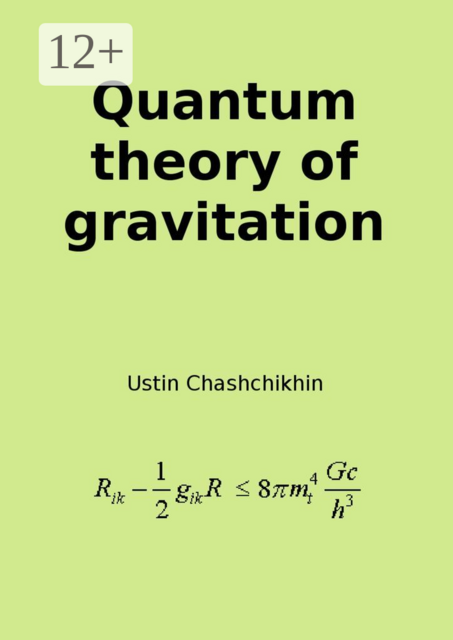
I derive equations of quantum theory of gravitation containing all 3 fundamental constants — G, c and h. I introduce and critically analize a new approach to quantization of energy-momentum tensor Tik which fully correlates with experiments.
I derive quantum solution of singularities’ problem in general relativity, maximal density of quantum matter ~10^27 kg/m3 and maximal curvature of spacetime ~10^2 m^-2. The theory predicts inevitable big bang after big crunch.
ISBN 978-5-0051-6109-3
Created with Ridero smart publishing system
Contents
- Quantum theory of gravitation
- Quantization of gravitational field
- 1. Avoid stereotyping
- 2. The cause of quantization of the electromagnetic field is the presence of the elementary electric charge
- 3. A new approach to quantum gravity
- 4. Is there a minimum elementary mass?
- 5. Is there the elementary mass in the relativity theory?
- 6. Is the velocity discrete?
- 7. Are there elementary energy, momentum, and frequency?
- 8. Is the translational energy of an electron, atom, or molecule quantized?
- 9. Quantization of gravitational field
- 10. Revision of the graviton concept
- 11. Aristotle’s principle of sufficient reason and Occam’s razor
- 12. The criterion of falsifiability
- 13. Conclusions
- References
- Quantum gravitational collapse and quantum solution of singularities problem in general relativity
- 1. Introduction
- 2. Does general relativity predict singularities in black holes?
- 3. First quantum solution of gravitational collapse problem: Pauli principle
- 4. Second quantum solution of gravitational collapse problem: Heisenberg’s uncertainty principle
- 5. Third solution: QED
- 6. Derivation of the maximal density in the quantum theory of gravitation
- 7. Gravitational field of the quantum black hole and maximal curvature of spacetime in quantum gravity
- 8. The inevitability of a big bang as a result of a big crunch
- 9. Conclusions and consequences
- References
Quantization of gravitational field
Abstract:
I derive equations of quantum theory of gravitation containing all 3 fundamental constants — G, c and h.
I introduce and critically analize a new approach to quantization of energy-momentum tensor Tik which fully correlates with experiments.
I derive quantum solution of singularities’ problem in general relativity, maximal density of quantum matter and maximal curvature of spacetime. I show that quantum gravitational collapse is not unlimited compression; for star of any big mass it stops at the stage of maximal density of quantum matter ~1027 kg/m3 with maximal spacetime curvation ~102 m-2 without formation of singularity inside black hole.
The model predicts inevitable big bang after big crunch.
1. Avoid stereotyping
Newton’s theory of gravitation has only one fundamental constant — gravitational constant G. Relativistic theory of gravitation (general relativity) has 2 constants — gravitational constant G and speed of light c. Quantum theory of gravitation by definition must have all 3 fundamental constants — G, c and Planck constant h. Exactly such theory is derived here.
I derive description of gravitational interaction at quantum level, quantum solution of singularities’ problem in general relativity, maximal density of quantum matter and maximal curvature of spacetime. The model predicts inevitable big bang after big crunch.
And, in spite of absence of experimental observations, just using analogy, stereotyping with photon, a graviton hypothesis was put forward. Graviton is postulated as a hypothetical quantum of gravitational field, which is postulated as Bose-condensate of virtual gravitons.
However, during more than a century since derivation of general relativity, all attempts to describe gravitational field as Bose-condensate of virtual gravitons failed and had fundamental difficulties. And all such theories are non-renormalizable and don’t solve the problem [1—21], e.g. a recent review [16]. And it’ particularly noteworthy that the only renormalizable variant [17] uses fake particles. Therefore the contemporary approach is experimentally inapproppriate. And graviton was not yet