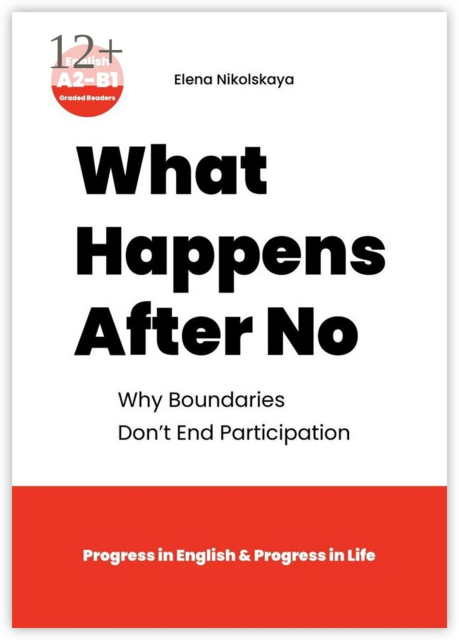
ta muallif kitobidan iqtiboslar  What happens after No. Why boundaries don’t end participation

Ending without explanation is rarely modeled. It is treated as abrupt, immature, or socially risky. Because of this, many people learn that leaving a situation is acceptable only if it is softened, justified, and carefully framed. The words are expected to carry the responsibility that behavior does not tak
Fikr bildirish
yet the system never fully releases the thread.
Fikr bildirish
something does not settle.
Fikr bildirish
decision that wasn’t your call,
Fikr bildirish
Most social environments teach how to sound reasonable, but not how to stop being involved. Silence is treated as risky. Distance is expected to be explained. Leaving without justification often feels wrong, even when nothing is wrong. As a result, many people stay engaged not because they choose to, but because the system never receives a signal that it can stop.
Fikr bildirish
Words Are Not Boundaries
Fikr bildirish
A decision is not the same as an ending.
Fikr bildirish
cutting people off
Fikr bildirish
without a clear reason, participation often stays.
Fikr bildirish
nded “normally.” A role you stepped back from —
Fikr bildirish